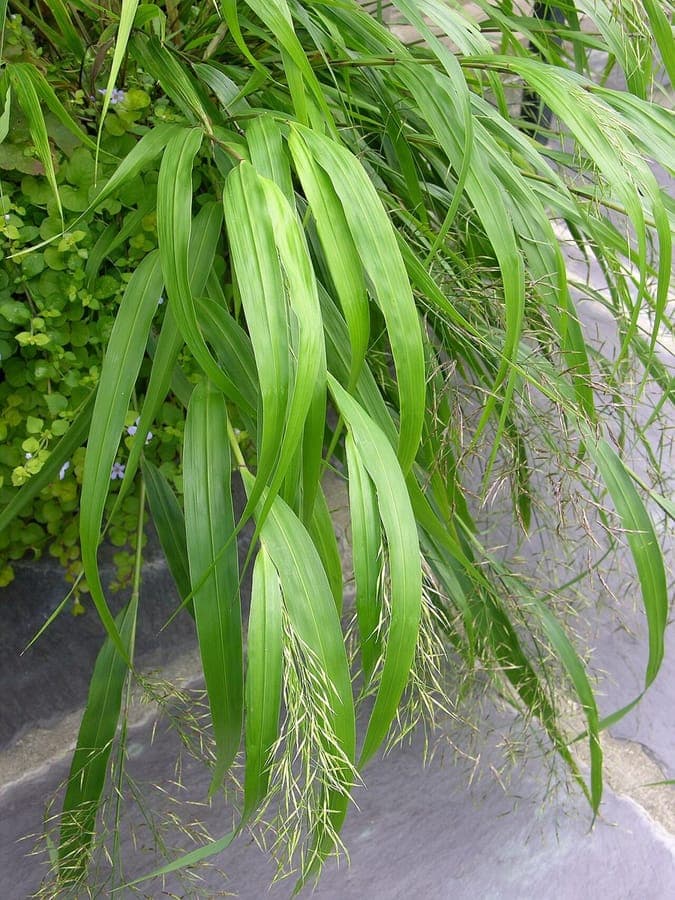
Photo by and (c)2006 Derek Ramsey (Ram-Man). Location credit to the Chanticleer Garden. / CC BY-SA 3.0, via Wikimedia Commons
Japanese Forest Grass: complete guide
Hakonechloa macra
Want to see Japanese Forest Grass: complete guide in your garden?
Full design in HD: €7.99
Look after your Japanese Forest Grass with the GardenWorld app
Identify plants with your camera and get a care calendar with reminders for this plant.


Overview
Japanese forest grass (Hakonechloa macra) is the ornamental grass for shady places. Where most grasses demand full sun, this one is happiest in partial shade. With soft, arching leaves that all fall in the same direction, a clump looks like a small green waterfall. It brings movement and calm to a shady border, the edge of a path or a pot on a north-facing patio.
The grass grows wild only in Japan, in the mountains of Honshu around Mount Hakone, which gave it its name. There it grows on damp rock faces and in open woodland. A clump reaches 30 to 50 cm in height and 40 to 60 cm across and spreads very slowly by short rhizomes. It is no thug, so there is no need for a root barrier.
Besides the plain green species, variegated cultivars are especially popular. 'Aureola' has golden-yellow leaves with narrow green stripes, 'All Gold' is entirely golden, 'Albostriata' has white-striped leaves and 'Nicolas' is green with striking red autumn colour. If you would like to see how Japanese forest grass works in your shade garden, you can have a garden design made on gardenworld.app that takes light and space into account.
Appearance and bloom cycle
The leaves are 15 to 25 cm long and 1 to 2 cm wide, soft, glossy and somewhat bamboo-like. They sit on thin, arching stems. A curious feature is that each leaf twists half a turn at its base, so the underside faces upwards and all the leaves cascade neatly in one direction. This gives the plant its characteristic rippling, combed appearance.
In August and September, fine, airy flower panicles appear among the leaves. Their colour is modest, pale green to beige, but they catch the light beautifully. The real highlight comes in autumn, when the foliage turns orange, copper or reddish depending on the cultivar. In winter the plant dies back to a straw-coloured mound that can stay decorative until spring. Japanese forest grass is late to wake up: new shoots only appear in April or even May, so do not worry if there is nothing to see in March.
Ideal location
The green form is remarkably adaptable, growing in partial shade, light shade and even sun as long as the soil stays moist. The variegated cultivars are fussier. Yellow forms such as 'Aureola' and 'All Gold' scorch in full midday sun, yet lose their golden colour and turn greener in deep shade. Morning sun with afternoon shade suits them best.
Plant Japanese forest grass at the front of a border, along the edge of a path or steps, or let it spill over a low wall so its cascading habit can be appreciated. For a continuous carpet, plant five to seven per square metre. A single clump in a wide, shallow pot makes a fine focal point on a shady patio. Remember that the leaves lean towards the light, so position plants so that they flow towards the viewer.
Soil requirements
Hakonechloa macra likes humus-rich soil that holds moisture yet drains well. Slightly acid to neutral is ideal, though slightly alkaline garden soil is tolerated. Work plenty of compost or leaf mould into the planting hole, especially on sandy soil, so it retains moisture better. On heavy clay, mix in compost and some grit to avoid waterlogging.
Feeding is hardly necessary; a layer of compost in spring is enough. Too much fertiliser makes the foliage floppy and more likely to collapse. In a container, use good multi-purpose compost with some added organic matter, make sure there are drainage holes and put a layer of crocks or clay pebbles at the bottom. Refresh the compost every two or three years.
Free preview
Want to see Japanese Forest Grass: complete guide in your garden? Make a free preview of your design.
Watering
Japanese forest grass does not tolerate prolonged drought. The soil should stay slightly moist throughout the growing season. Water young plants weekly in their first year, and established ones during dry summers too. If it dries out, the leaf tips turn brown and the leaves curl. A mulch of leaf mould or fine bark helps hold moisture.
In a pot the grass needs watering every other day or even daily in summer. Never leave water standing in the saucer, as wet feet in winter do this grass no good either. Once the foliage starts to colour in autumn, water less.
Pruning
Pruning is limited to a single annual cut. Leave the dried clumps standing all winter: they look lovely in a frost and protect the crown from cold. In late February or March, before the new shoots appear, cut all the old stems back to about 5 cm above the ground. Do this in good time, because once new shoots have emerged they are easily cut off by mistake.
Propagate by division in spring, just as the plant begins to grow. Slice a section off the clump with a sharp spade and replant it straight away. As the grass grows slowly, it is best to wait until a clump is a few years old. Japanese forest grass is not known to be toxic to people or pets, and it is not invasive in Europe.
Maintenance calendar
February-March: Cut old foliage back to about 5 cm above the ground before new shoots emerge.
April-May: New shoots appear. Best time for planting and dividing. Apply a layer of compost.
June-July: Keep the soil moist, particularly in dry spells and for plants in pots.
August-September: Delicate flower panicles appear. Keep watering in dry weather.
October-November: Autumn colour in orange, copper or red. Leave the clumps standing.
December-January: Dormant season. The dry foliage stays as winter protection and decoration. Move pots against a sheltered wall.
Winter hardiness
Hakonechloa macra is fully hardy and tolerates temperatures down to about -25 °C. The green species is the toughest; variegated cultivars are slightly more tender but normally come through British and north-west European winters without any trouble. The old foliage left standing over winter protects the crown.
In a pot, the rootball can freeze solid in hard frosts. In winter, stand pots on feet against a sheltered house wall and wrap them in hessian or bubble wrap during prolonged cold. Use frost-proof containers, because a wet rootball that freezes can crack a pot.
Companion plants
Japanese forest grass is a perfect partner for other shade plants, as its fine, arching foliage contrasts beautifully with large, rounded leaves. Hostas such as Hosta sieboldiana are the classic combination: the broad blue-green hosta leaves and the fine grass enhance each other. Heuchera micrantha and its many selections bring dark red or bronze foliage into the mix, which looks especially good beside the yellow cultivars.
A Japanese maple (Acer palmatum) above provides light shade and completes the Japanese picture. Ferns such as the autumn fern (Dryopteris erythrosora) and barrenwort (Epimedium grandiflorum) fill out the planting. The mountain hydrangea (Hydrangea serrata) also looks lovely behind it. The plant calendar on gardenworld.app shows the best time to plant and care for each of these.
Final thoughts
Japanese forest grass is one of the most beautiful and versatile ornamental grasses for shade. It grows slowly but surely, never runs riot, needs little attention and provides movement all season, from the first fresh shoots in May to the coppery tints of November.
Give Hakonechloa macra humus-rich, moist soil and light shade, cut it back once a year and keep the soil moist in summer. That is all it takes to enjoy this green or golden waterfall in your garden for many years.
Frequently asked questions about Japanese Forest Grass
Is Japanese Forest Grass winter hardy?
Hakonechloa macra is fully hardy and tolerates temperatures down to about -25 °C. The green species is the toughest; variegated cultivars are slightly more tender but normally come through British and north-west European winters without any trouble.
When and how do you prune Japanese Forest Grass?
Pruning is limited to a single annual cut. Leave the dried clumps standing all winter: they look lovely in a frost and protect the crown from cold.
How much water does Japanese Forest Grass need?
Japanese forest grass does not tolerate prolonged drought. The soil should stay slightly moist throughout the growing season.
Where does Japanese Forest Grass grow best?
The green form is remarkably adaptable, growing in partial shade, light shade and even sun as long as the soil stays moist. The variegated cultivars are fussier.
What soil does Japanese Forest Grass need?
Hakonechloa macra likes humus-rich soil that holds moisture yet drains well. Slightly acid to neutral is ideal, though slightly alkaline garden soil is tolerated.

See it in your garden
See Japanese Forest Grass in your garden
One photo of your garden and a few questions. You see the result in about a minute.
Try it with a photoIdentify this plant in your own garden. Identify a plant
Similar plants
Hosta sieboldiana: complete guide
Hosta sieboldiana
Hosta sieboldiana growing guide: large blue-green shade plant from Japan. Complete care tips, placement and maintenance for shady gardens and woodland areas.
Japanese Maple: complete guide
Acer palmatum
Everything about Japanese Maple (Acer palmatum): planting, pruning, cultivars and autumn colour. Expert tips for a spectacular ornamental tree in your garden.
Alumroot: complete guide
Heuchera micrantha
Discover how to grow and care for Heuchera micrantha: ideal light, soil, watering, and seasonal maintenance for thriving plants in your garden.
