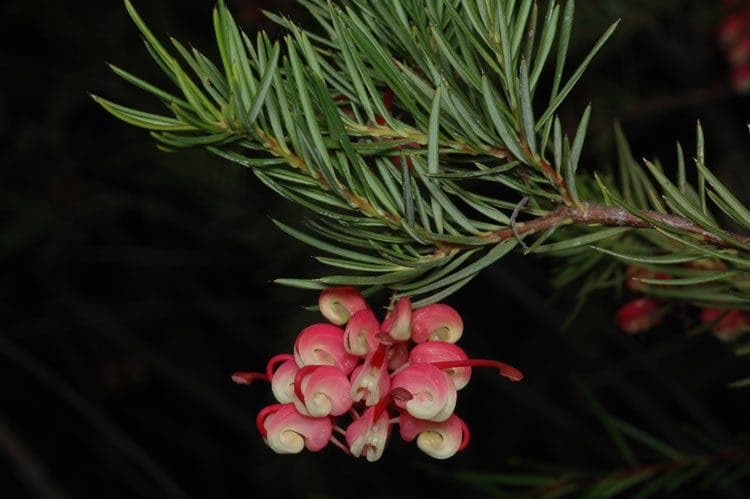
Murray Fagg / CC BY 3.0 au, via Wikimedia Commons
Rosemary grevillea (Grevillea rosmarinifolia): growing guide
Grevillea rosmarinifolia
Want to see Rosemary grevillea (Grevillea rosmarinifolia): growing guide in your garden?
Full design in HD: €7.99
Look after your Rosemary grevillea with the GardenWorld app
Identify plants with your camera and get a care calendar with reminders for this plant.


Overview
Rosemary grevillea (Grevillea rosmarinifolia) is an evergreen shrub in the Proteaceae, the same family as proteas and banksias. It grows wild in New South Wales and Victoria in south-eastern Australia, in open woodland and on acidic, sandy slopes. The species name refers to the foliage, which looks remarkably like rosemary.
Of all the grevilleas on sale, this is the one that copes best with cold. That makes it one of the few Australian shrubs you can genuinely plant in the ground in much of Britain and north-west Europe, provided you choose a favourable spot. A severe winter is still a risk, so if you want certainty, grow it in a container. This guide therefore covers both open ground and overwintering in a pot.
In gardens here it usually reaches 1 to 1.5 m tall and wide, and up to 2 m in mild districts. It grows densely and somewhat prickly, forming a neat, rounded shrub over the years. Commonly sold forms include 'Jenkinsii', more compact with pinkish-red flowers, and the well-known hybrid 'Canberra Gem', a cross between Grevillea rosmarinifolia and Grevillea juniperina that is tougher still. If you want to see where an unusual shrub like this would work best, you can have a garden design created on gardenworld.app that considers your soil, aspect and sheltered corners.
Appearance and bloom cycle
The leaves are needle-like, 1 to 4 cm long and only a few millimetres wide. The upper surface is dark green, the underside silvery white and silky, and the margins are rolled under. Each leaf ends in a sharp point, so wear gloves when pruning.
The flowers sit in small, dense clusters at the shoot tips. Each flower has a curled tube and a long, curving style that sticks out, giving the typical spider-flower shape. The colour is usually red to pink with cream, sometimes entirely pink. In bud the flowers look like tiny rolled-up curls.
The flowering season is long. In Britain it often starts in February or March and continues into June, with odd flowers through summer and autumn. In Australia honeyeaters visit the nectar-rich blooms. Here bumblebees and early bees take advantage, which makes the shrub especially valuable in early spring.
Little is known about toxicity in this particular species. There are no reports of serious poisoning in people or pets, but some other grevilleas can cause skin irritation in sensitive people. Wear gloves when handling the plant and discourage children and animals from chewing it.
Ideal location
Grevillea rosmarinifolia needs sun. Choose an open, sunny position with at least six hours of direct sun a day. In shade it becomes leggy and flowers poorly. Shelter from cold, drying easterly winds matters, because in winter those damage the foliage more than frost itself.
The ideal spot is in front of a south or west-facing wall, on a raised bed or on a slope where water drains away quickly. On light, acidic sandy soils it feels very much at home, provided the site is sheltered. In a container, give it the sunniest place on the patio.
Soil requirements
For this plant, soil matters more than almost anything else. Grevilleas have special cluster roots that let them extract every trace of phosphate from their poor native soils. In fertilised garden soil they therefore take up too much phosphate, which turns the leaves yellow and can kill the plant.
So choose a poor, acidic to neutral, sandy and fast-draining soil. Improve clay with plenty of grit and ericaceous compost, or plant on a raised bed. Do not add garden compost, manure or fertilised potting compost. It also dislikes lime: the leaves turn yellow between the veins.
In a container, use ericaceous compost mixed with a third grit or fine gravel, with a drainage layer at the bottom. Make sure the compost contains no added fertiliser.
Free preview
Want to see Rosemary grevillea (Grevillea rosmarinifolia): growing guide in your garden? Make a free preview of your design.
Watering
An established shrub in the ground is fairly drought tolerant. In the first year after planting, water thoroughly once a week in dry spells so that the roots grow deep. After that, extra water is needed only during prolonged drought.
In a pot you need to water more often: keep the compost slightly moist from spring to autumn and let the surface dry between waterings. Wet roots are a bigger danger than drought, especially in winter. Use rainwater wherever possible.
This species usually needs no feeding. If you do want to feed a potted plant, give a small dose of fertiliser for Australian plants or proteas in spring, with little or no phosphorus.
Pruning
Prune lightly after the main flowering, in June or July. Trim the shoot tips back to just above a few leaves. That keeps the shrub compact and improves flowering the following year. Grevillea rosmarinifolia takes this well, and you can even keep it as a low, informal hedge.
Avoid cutting into bare old wood, as it reshoots poorly from there. Leave any frost damage until April, when you can see where healthy growth begins. Wear sturdy gloves against the prickly leaves.
Maintenance calendar
February-March: Flowering begins. Remove winter protection on mild days.
April: Cut out frost damage. Best time to plant.
May-June: Flowering continues. Water young plants in dry spells.
June-July: Light trim after the main flush.
August-September: Little to do. Keep pots evenly moist.
October-November: Spread a layer of gravel or pine needles around planted shrubs and move pots to a sheltered spot. A plant calendar on gardenworld.app can remind you when it is time to protect your pots.
December-January: Cover with fleece during hard frost.
Winter hardiness
Grevillea rosmarinifolia is the hardiest grevillea widely available. The RHS rates it H4, meaning it withstands an average winter with frosts down to about -10 °C. Well-established plants on dry soil sometimes cope with a little more. Young plants are more vulnerable, and frost combined with wet soil or strong wind is the most dangerous mix. A winter with prolonged hard frost can kill even an older shrub.
Overwintering
In the ground, give the plant extra protection for its first two or three winters. In November spread a mulch of gravel or pine needles around the base, not compost. When frosts below -8 °C are forecast, drape a double layer of fleece over the shrub and remove it as soon as the weather turns milder. A plant that is frosted back can sometimes reshoot from lower branches in spring.
In a pot, the root ball is the weak point. In winter, stand the pot against a sheltered wall on pot feet so it drains, and wrap it in hessian or bubble wrap. In hard frost, move it to a cold, bright place such as an unheated conservatory or a garage with a window, at 0 to 8 °C. A warm room is not suitable. Water sparingly in winter.
Companion plants
Grevillea rosmarinifolia is best paired with plants that like the same poor, acidic soil. Heather (Calluna vulgaris) and Pieris japonica are natural neighbours in a heather garden or acid bed. Blue fescue (Festuca glauca) makes a silvery-blue underplanting that complements its fine green foliage.
For a garden with a southern-hemisphere feel, combine it with New Zealand flax (Phormium tenax) or with Pittosporum tenuifolium as an evergreen backdrop. Watch the feeding, though: feed neighbouring plants individually and never scatter general fertiliser across the whole border.
Final thoughts
Grevillea rosmarinifolia brings a touch of Australia to your garden, with needle-fine foliage and a long flowering season from late winter into summer. Respect its needs, which are sun, poor acidic soil, no phosphate and dry roots in winter, and it proves surprisingly tough. In a sheltered spot it can stay outdoors for years, and a container always gives you a safe fallback.
Frequently asked questions about Rosemary grevillea
Is Rosemary grevillea winter hardy?
Grevillea rosmarinifolia is the hardiest grevillea widely available. The RHS rates it H4, meaning it withstands an average winter with frosts down to about -10 °C.
When and how do you prune Rosemary grevillea?
Prune lightly after the main flowering, in June or July. Trim the shoot tips back to just above a few leaves.
How much water does Rosemary grevillea need?
An established shrub in the ground is fairly drought tolerant. In the first year after planting, water thoroughly once a week in dry spells so that the roots grow deep.
Where does Rosemary grevillea grow best?
Grevillea rosmarinifolia needs sun. Choose an open, sunny position with at least six hours of direct sun a day.
What soil does Rosemary grevillea need?
For this plant, soil matters more than almost anything else. Grevilleas have special cluster roots that let them extract every trace of phosphate from their poor native soils.

See it in your garden
See Rosemary grevillea in your garden
One photo of your garden and a few questions. You see the result in about a minute.
Try it with a photoIdentify this plant in your own garden. Identify a plant
Similar plants
Heather: complete guide
Calluna vulgaris
Discover how to grow and care for Calluna vulgaris: ideal soil, pruning tips, companion plants and winter care. Perfect for UK and US gardens.
Japanese pieris: complete guide
Pieris japonica
Complete care guide for Japanese pieris (Pieris japonica): ideal location, soil, watering, pruning and companion plants. Perfect for shaded, acidic gardens.
Blue fescue: complete guide
Festuca glauca
Festuca glauca, or blue fescue, is a low-maintenance ornamental grass with silvery-blue foliage. Perfect for sunny, dry borders and rock gardens.
