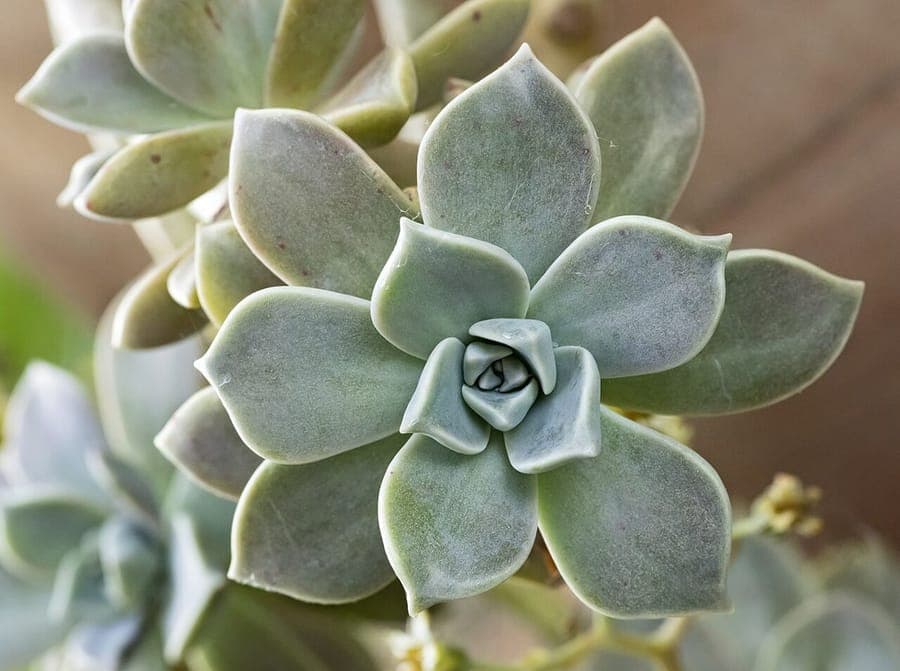
Didier Descouens / CC BY-SA 4.0, via Wikimedia Commons
Ghost plant (Graptopetalum paraguayense): care guide
Graptopetalum paraguayense
Want to see Ghost plant (Graptopetalum paraguayense): care guide in your garden?
Full design in HD: €7.99
Look after your Ghost plant with the GardenWorld app
Identify plants with your camera and get a care calendar with reminders for this plant.


Overview
The ghost plant, Graptopetalum paraguayense, is one of the most forgiving succulents you can grow, and one of the most rewarding. It forms rosettes of plump, powdery leaves that shift from silvery grey to soft pink and lilac depending on how much sun they receive. It is also sold as mother-of-pearl plant, a name that captures the faintly iridescent sheen of a healthy rosette.
The species name is a historical mistake. The plant was first described as coming from Paraguay, but its wild home is in fact north-eastern Mexico, in the state of Tamaulipas, where it clings to rocky slopes. It belongs to the stonecrop family, Crassulaceae, alongside echeverias, sedums and crassulas, and it hybridises readily with its relatives. Crosses with echeveria are sold as ×Graptoveria and crosses with sedum as ×Graptosedum, and many of the pastel rosettes in garden centres have ghost plant somewhere in their ancestry.
What sets this species apart is the way it grows. Young plants are tidy rosettes, but after a couple of years the stems lengthen to 20 or 30 cm and arch over the rim of the pot, each one carrying a rosette at its tip. The result is a small trailing plant that looks lovely spilling from a tall pot, a hanging basket or a shallow bowl on a shelf.
Appearance and flowering
The rosettes measure 5 to 12 cm across. Each leaf is fleshy, 3 to 6 cm long and roughly egg-shaped with a short point, and the leaves overlap neatly around the centre. They are coated with a fine waxy bloom, known as farina, which shields the plant from strong sun and gives it that matt, almost silvery finish. Handle the leaves as little as possible: fingerprints rub off the bloom and stay visible until new growth replaces the marked leaves.
Colour depends heavily on conditions. In full sun with cool nights, the leaves blush pink, peach or lavender. In bright shade they stay blue-grey or greyish green, much like the rosette in the photo above. Both are perfectly healthy. Only pale, stretched growth with long gaps between the leaves signals that the plant is short of light.
In spring, usually from April to June, slender flowering stems emerge from the side of the rosette. They carry loose sprays of star-shaped flowers about 1.5 cm across, white to cream and finely speckled with red. Those markings gave the genus its name: grapto means written or marked and petalum means petal. Unlike some succulents, the rosette does not die after flowering, so you can simply snip off the spent stems.
Position and light
Light is the secret to a compact plant. Indoors, give the ghost plant the brightest spot you have, ideally a south, east or west-facing windowsill with a few hours of direct sun each day. In a dim room it stretches towards the window, the rosettes open out and the stems become long and floppy. Stretched growth will not shrink back, though you can always behead the rosettes and start again.
From mid-May to the end of September the plant is happy outdoors on a patio, balcony or sunny wall, in a pot you bring back inside in autumn. Introduce it to outdoor sun gradually, starting with a week in light shade, or the leaves may scorch and develop brown, sunken patches. A spot sheltered from prolonged rain is best, because this plant dislikes sitting wet.
Compost and repotting
Use a free-draining cactus and succulent compost. If you prefer to mix your own, combine roughly equal parts multipurpose compost and coarse grit, pumice or perlite. Terracotta pots suit it better than plastic because they dry out faster, and a drainage hole is essential. A decorative pot without a hole is an open invitation to root rot.
Repot in spring as growth resumes, and only when the roots fill the pot or the trailing stems make it top-heavy, which is usually every two to three years. Move up just one pot size. After repotting, wait about a week before watering so that any damaged roots can callus over. Feeding is barely necessary: a half-strength succulent fertiliser once a month from April to August is plenty.
Free preview
Want to see Ghost plant (Graptopetalum paraguayense): care guide in your garden? Make a free preview of your design.
Watering and rest
Water only when the compost is completely dry, then water thoroughly until it runs out of the drainage hole, and empty the saucer afterwards. In summer that often means once every seven to ten days, depending on warmth and pot size. Wrinkled, soft leaves mean the plant is thirsty. Glassy, translucent leaves that drop at a touch mean the opposite: too much water.
From November to February the ghost plant rests. Keep it cooler, at 8 to 15 °C, and water very sparingly, perhaps a small drink every three to four weeks, just enough to stop the leaves from shrivelling. A cool, dry winter keeps the rosettes tight and encourages flowering the following spring. If it has to winter in a warm living room, water a little more often and give it as much light as possible.
Propagation
Few succulents are easier to propagate. The leaves detach at the slightest touch, and a leaf that falls onto the compost often roots and produces a new rosette on its own. You can use that habit deliberately.
Gently twist off a healthy leaf, making sure the base comes away intact. Let it dry for a few days, then lay it flat on slightly moist succulent compost in a bright spot out of direct sun. Within a few weeks, tiny roots and a miniature rosette appear at the base. The mother leaf slowly shrivels; remove it only once it is completely dry. Stem tips root just as easily: cut them with 3 to 5 cm of stem, let the cut end dry for a week, then insert them in dry compost and water for the first time a week later. Spring and early summer are the best times.
Maintenance calendar
March–April: Move the plant somewhere a little warmer and increase watering gradually. Repot if needed and take cuttings from leggy stems.
May: Once frosts have passed, move the pot outdoors, starting in light shade for a week. Flowering begins.
June–August: Full sun, water when completely dry, half-strength feed once a month. Remove spent flower stems.
September–October: Stop feeding. Bring the pot indoors before the first night frost and check between the leaves for mealybugs.
November–February: Rest period in a cool, bright place. Water very sparingly.
If you would like reminders for every plant you grow, the planting calendar on gardenworld.app tells you what needs doing each season.
Winter hardiness
The ghost plant can survive a few degrees of frost when its compost is bone dry, but in a typical wet north-west European winter it cannot be trusted outdoors. Cold combined with damp turns the leaves glassy and rots the stems. Bring it in once night temperatures start dropping below 5 °C. An unheated but frost-free conservatory, porch or stairwell makes an excellent winter home, provided there is good light.
As for toxicity, Graptopetalum paraguayense is generally not regarded as poisonous to people or pets. Even so, it is sensible to keep it out of reach of cats and small children, if only because nibbled leaves spoil the look of the rosettes.
Companion plants
In a bowl of mixed succulents, the ghost plant is a dependable filler. Pair it with the blue rosettes of Echeveria elegans and the chunky leaves of Sedum pachyphyllum for a soft, grey-blue scheme. Burro's tail, Sedum morganianum, shares the same trailing habit and looks good in the same hanging pot. A jade plant, Crassula ovata, or the felted leaves of Kalanchoe tomentosa add height and a contrasting texture. Choose companions with the same appetite for light and dryness, so the whole bowl can be watered at once.
Outdoors in summer it looks charming in a terracotta bowl on a step or low wall, alongside lavender or thyme in their own pots. On gardenworld.app you can have a garden design drawn up that includes patios and container spots, giving your summer succulents a permanent sunny corner.
Final thoughts
Graptopetalum paraguayense asks for very little: plenty of light, gritty compost, water only when the pot is dry and a cool winter. Give it those and it will last for years, change colour with the seasons and multiply without any effort on your part. Every fallen leaf is a new plant waiting to happen. Start with a single pot and within a couple of seasons you will have rosettes to pass on to friends.
Frequently asked questions about Ghost plant
Is Ghost plant winter hardy?
The ghost plant can survive a few degrees of frost when its compost is bone dry, but in a typical wet north-west European winter it cannot be trusted outdoors. Cold combined with damp turns the leaves glassy and rots the stems.
How much water does Ghost plant need?
Water only when the compost is completely dry, then water thoroughly until it runs out of the drainage hole, and empty the saucer afterwards. In summer that often means once every seven to ten days, depending on warmth and pot size.

See it in your garden
See Ghost plant in your garden
One photo of your garden and a few questions. You see the result in about a minute.
Try it with a photoIdentify this plant in your own garden. Identify a plant
Similar plants
Echeveria elegans: complete guide
Echeveria elegans
Echeveria elegans, known as Pearl Echeveria, is a beautiful rosette-forming succulent. Learn complete care guide, watering, soil and ideal locations.
Sedum morganianum: complete guide
Sedum morganianum
Burro's-tail succulent from Mexico: elegant trailing plant with watery-green, bead-like foliage. Perfect for hanging baskets and living walls.
Jade plant: complete guide
Crassula ovata
Discover how to care for Crassula ovata: ideal lighting, watering, and seasonal care. A low-maintenance succulent perfect for homes and gardens on gardenworld.app.
