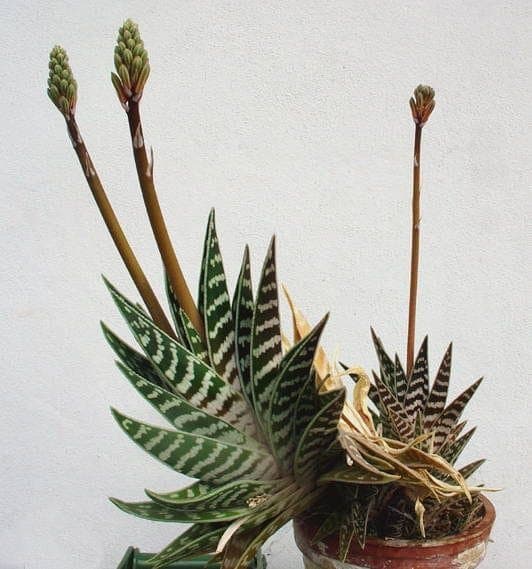
Karelj / Public domain, via Wikimedia Commons
Tiger aloe (Gonialoe variegata): care guide
Gonialoe variegata
Want to see Tiger aloe (Gonialoe variegata): care guide in your garden?
Full design in HD: €7.99
Look after your Tiger aloe with the GardenWorld app
Identify plants with your camera and get a care calendar with reminders for this plant.


Overview
Gonialoe variegata is the plant many people know as the tiger aloe or partridge-breasted aloe, or under its old name Aloe variegata. It has been grown in Europe since the eighteenth century and sat for decades on the windowsills of our grandparents' homes. With triangular, white-banded leaves stacked neatly in three rows, it looks more like a small sculpture than an ordinary houseplant.
In 2014, DNA studies moved it out of the genus Aloe and into the new genus Gonialoe, together with two related species. The name refers to its angled, keeled leaves. It still belongs to the family Asphodelaceae, and garden centre labels often still say Aloe variegata; it is the same plant.
The species comes from dry regions of western South Africa and southern Namibia, including the Karoo and Namaqualand. There it often grows in the shelter of a small shrub on stony ground, used to long droughts, heat and cool nights. That background shapes how you should care for it. If you take it outdoors for the summer, gardenworld.app can draw up a garden design that includes a warm, dry corner of the patio for potted succulents.
Appearance and flowering
A mature plant reaches 15 to 30 cm tall. The leaves are 10 to 15 cm long, firm, V-shaped in cross-section and strongly keeled underneath. They are arranged in three distinct ranks, so the rosette forms a triangle when seen from above. The leaf is deep green with irregular crossbands of white flecks, and the margin is edged with a narrow, white, horny rim. That pattern reminded English speakers of a partridge's breast feathers, hence one of its common names.
The plant sends out underground runners, so after a few years small rosettes pop up beside the mother plant. Old leaves at the base eventually dry to yellow and brown; that is normal.
Indoors it usually flowers between late winter and spring. A stem 20 to 30 cm tall grows from the leaf axils, bearing a cluster of drooping, tubular flowers in salmon-pink to coral-red. The photo shows two plants against a white wall, one in a terracotta pot, with three tall, reddish-brown stems whose flower buds are still closed. At the base of one rosette you can see a few withered, yellowed leaves.
Position and light
The tiger aloe loves light. A south, east or west-facing window is fine. Behind the glass of a south window it copes with plenty of sun, although the leaves may turn reddish brown in high summer. That is a sign of sun stress and fades again once the plant gets a little shade.
With too little light the leaves go soft and pale, the triangular shape loosens and no flowers appear. For a north-facing sill, a haworthia is the better choice.
From late May to mid-September Gonialoe variegata can live outdoors in a warm spot sheltered from rain. Let it get used to outdoor light by placing it in part shade for the first two weeks. Beware of long wet spells: that is exactly where things go wrong with this plant.
Watering and rest
Water is the biggest pitfall. Because the leaves are V-shaped, water easily runs into the heart of the rosette and sits there, which quickly leads to rot, especially in cool weather. Always water the compost around the edge, never over the top of the plant. Bottom-watering also works: stand the pot in a tray of water for ten minutes and let it drain thoroughly.
From March to October, water when the compost is completely dry. In practice that is every ten to fourteen days, a little more often in a hot summer. Always tip away water left in the saucer.
From November to February keep the plant in a bright, cool place at 8 to 12 °C and give hardly any water: a little once a month is enough. A cool rest encourages flowering. On a warm sill above a radiator it becomes soft over winter and flowers less.
Feed once a month from April to August with cactus fertiliser at half strength.
Free preview
Want to see Tiger aloe (Gonialoe variegata): care guide in your garden? Make a free preview of your design.
Compost and repotting
Use a lean, very well-drained mix: cactus compost with at least a third coarse material such as pumice, lava grit or coarse gravel. The roots are fairly shallow and spread sideways, so a wide, shallow terracotta pot is better than a deep plastic one. A layer of grit on the surface keeps the leaf bases dry.
Repot every two to three years in spring, or when the runners fill the pot. Do not set the plant any deeper than before, because the leaf bases should not sit in damp compost. Wait a week after repotting before watering.
Propagation by offsets
The easiest way to propagate it is with the small rosettes that appear beside the mother plant on runners. Take the plant out of its pot in spring and cut away the young rosettes with a piece of runner attached. Let the cuts dry for a few days, then pot them into dry cactus compost. Start watering carefully after a week.
Leaf cuttings rarely succeed with this species. Seed is possible but slow, and if you only have one plant you will usually get no seed, as the flowers generally need pollen from another plant.
Maintenance calendar
January to March: Rest, but also the time when indoor plants often produce flower stems. Keep the plant bright and cool, with very little water.
April and May: More water and a monthly feed. Repot and divide. At the end of May the plant can go outside.
June to August: Growth in the warmth. Water when the compost is dry, never into the heart. Protect from long spells of rain.
September and October: Less water. Bring the plant in before nights drop below 8 °C.
November and December: Cool, bright and dry. Remove withered leaves at the base.
Temperature and hardiness
Gonialoe variegata is not hardy in north-west Europe. It sometimes survives a brief, light night frost if it is completely dry, but it is better not to count on it. Keep it above 5 °C in winter, ideally around 10 °C. A cold greenhouse kept above freezing, a cool stairwell or an unheated bedroom with a good window all make excellent winter quarters.
Summer heat is no problem. It tolerates temperatures up to 35 °C, as long as the compost is not wet and warm at the same time, a combination that rots roots.
Toxicity to pets
As with many aloe relatives, the leaves of Gonialoe variegata contain sap that can cause stomach and gut upsets in cats and dogs, such as vomiting, diarrhoea and lethargy. There is little specific data for this species, but the ASPCA lists Aloe vera as toxic, for example, and the same caution makes sense here. Keep the tiger aloe out of reach of pets, on a high shelf or in a room they do not use.
If your pet has eaten some of the leaf and becomes unwell, call your vet and mention the name of the plant. In people, the sap can mildly irritate the skin, so wash your hands after repotting.
Companion plants
On a windowsill or in a bowl, Gonialoe variegata sits well with other succulents that enjoy sun and dry conditions. Crassula ovata, the familiar jade plant, adds height and a green backdrop. Echeveria elegans forms a blue-grey rosette that contrasts nicely with the dark, banded leaves. Aloe vera and Aloe humilis also suit it and need the same care.
Do not group it with plants that need frequent watering. Giving each plant its own pot makes watering much easier, even when they stand side by side.
Final thoughts
Gonialoe variegata is a classic that deserves rediscovering: compact, boldly marked and cheerfully in flower at a time when there is little happening outdoors. Give it good light, water the compost rather than the heart, and let it rest cool and dry in winter, and it will stay handsome for years. To see when to repot, move it outside or bring it back in, the plant calendar on gardenworld.app gives you a month-by-month overview.
Frequently asked questions about Tiger aloe
Is Tiger aloe winter hardy?
Gonialoe variegata is not hardy in north-west Europe. It sometimes survives a brief, light night frost if it is completely dry, but it is better not to count on it.
How much water does Tiger aloe need?
Water is the biggest pitfall. Because the leaves are V-shaped, water easily runs into the heart of the rosette and sits there, which quickly leads to rot, especially in cool weather.

See it in your garden
See Tiger aloe in your garden
One photo of your garden and a few questions. You see the result in about a minute.
Try it with a photoIdentify this plant in your own garden. Identify a plant
Similar plants
Jade plant: complete guide
Crassula ovata
Discover how to care for Crassula ovata: ideal lighting, watering, and seasonal care. A low-maintenance succulent perfect for homes and gardens on gardenworld.app.
Echeveria elegans: complete guide
Echeveria elegans
Echeveria elegans, known as Pearl Echeveria, is a beautiful rosette-forming succulent. Learn complete care guide, watering, soil and ideal locations.
Aloe vera: complete guide
Aloe vera
Master aloe vera cultivation. Growing guide for placement, watering, and harvesting the precious medicinal gel.
