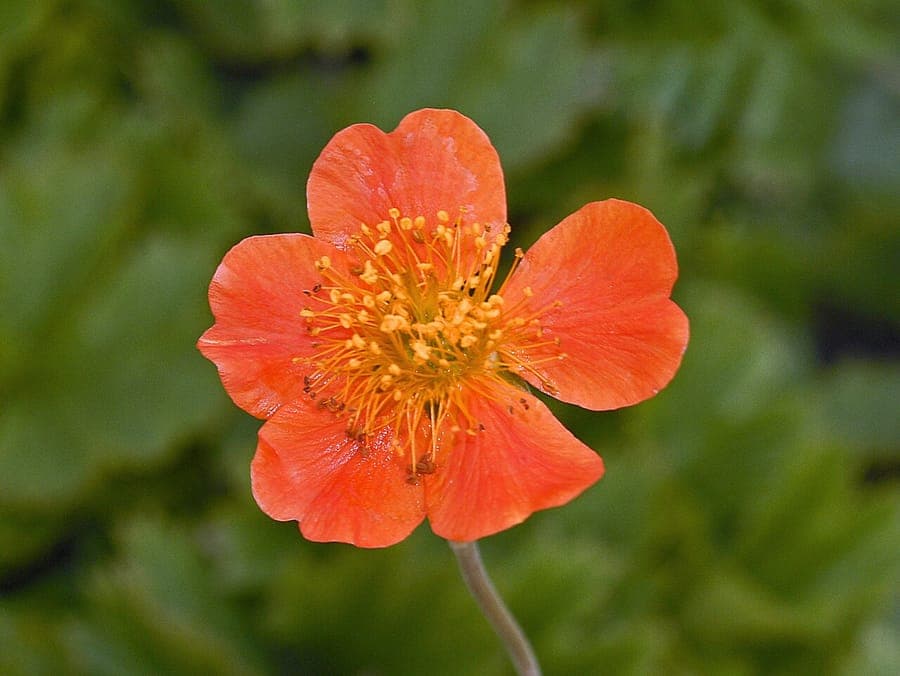
Hectonichus / CC BY-SA 3.0, via Wikimedia Commons
Geum coccineum: complete guide
Geum coccineum
Want to see Geum coccineum: complete guide in your garden?
Full design in HD: €7.99
Look after your Geum coccineum with the GardenWorld app
Identify plants with your camera and get a care calendar with reminders for this plant.


Overview
Geum coccineum, commonly called scarlet avens or red avens, is a compact alpine perennial native to the Balkan Mountains and surrounding regions of southeastern Europe. This charming plant is prized for its brilliant scarlet-red flowers and makes an excellent addition to rock gardens, alpine troughs, and well-drained borders. Growing naturally on steep hillsides and rocky outcrops between 600 and 2000 metres elevation, this species demonstrates excellent drought tolerance and mountainous hardiness.
Botanists and alpine plant enthusiasts worldwide value Geum coccineum in specialized collections. The plant resembles strawberry foliage but features much finer leaves and more elegant flowers. At maturity, it reaches approximately 30 centimetres in height with a spread of 25 centimetres, making it ideal for small borders, container growing, and rock garden design.
Appearance and Bloom
Scarlet avens develops in a compact, mounded rosette form with deeply lobed, softly hairy leaves packed densely together. The foliage is dark green with a slight grey gloss and grows to maximum heights of 20 to 25 centimetres. From late May through July, numerous slender stems carry erect to slightly nodding flowers approximately two to three centimetres across.
The blooms are brilliant scarlet-red, semi-double in many varieties, featuring five or more silky petals with prominent yellow stamens. After flowering, distinctive spherical seed heads develop, actually jointed bristles. These architectural seed heads are initially green, later becoming red-brown, providing interest long after petals fall.
Ideal Location
Scarlet avens thrives in locations with abundant direct sunlight, requiring minimum 6 to 8 hours daily. In warmer climates, afternoon shade during extreme heat provides some benefit. The plant performs well in borders and rock gardens provided placement remains airy and not in deep shade.
Planting in raised beds, rock gardens, or alpine troughs proves ideal, ensuring perfect drainage and preventing water accumulation around the leaf rosette, which causes rot. In flat borders, raise planting beds or incorporate improved drainage materials. The plant is winter-hardy to USDA zone 4, suitable for cold mountainous regions and northern climates.
Soil
Soil must be very well-draining; Geum coccineum cannot tolerate waterlogged conditions. Add fine gravel, coarse sand, or perlite to standard garden soil, creating a mix containing at least 40 to 50 percent inert drainage materials. The plant tolerates slightly acidic to neutral soils, with pH 6.0 to 7.0 ideal. Its alpine origin suggests loose, well-aerated soils perform better than heavy clay.
When container growing, combine a fast-draining alpine mix of approximately 3 parts stone grit (or coarse sand), 2 parts sifted garden soil, and 1 part fine perlite or pumice. This composition mimics alpine conditions and promotes healthy roots.
Watering
Watering requirements vary significantly by season and soil drainage. During the growing season (April through October), water regularly until soil feels lightly moist, never waterlogged. Active leaves and developing stems consume water rapidly. Check regularly, especially during warm periods.
After blooming (July-August), gradually reduce watering. In autumn and winter, severely restrict water application, watering only when soil feels genuinely dry or during extended drought. Container plants dry faster than in-ground specimens. In clay soils with moderate drainage, water more sparingly than in sandy soils. Prevent water remaining on leaves, particularly evening, reducing fungal issues.
Free preview
Want to see Geum coccineum: complete guide in your garden? Make a free preview of your design.
Pruning
Geum coccineum requires minimal to no pruning, though maintenance significantly improves performance. Remove spent flowers (deadheading) in July and August for extended bloom. This stimulates additional flower bud formation and prevents early transition to seed production.
Remove dead or damaged leaves from the rosette base as noticed. In autumn, after flower stems die, cut stems back to approximately 5 centimetres above foliage. This creates neater appearance and prevents dead stems introducing disease.
Group two or three plants approximately 30 centimetres apart for fuller effect. After several years, if a plant becomes crowded and flowers diminish, carefully divide in May-June and replant.
Maintenance Calendar
April: Inspect winter damage. Water moderately as growth begins. Add organic compost layer. May: Bloom period commences. Maintain regular watering. Begin deadheading as first flowers appear. June to July: Peak bloom. Continue deadheading. Adjust watering for heat. August-September: Bloom declines. Gradually reduce water. Remove dead flower stems by late September. October-March: Winter dormancy. Minimal watering. Monitor drainage during rain and snow. Plant between March and September.
Winter Hardiness
Geum coccineum is winter-hardy to USDA zone 4 (minimum temperatures approximately -30 to -28 degrees Celsius). Plants in well-drained, non-waterlogged soil withstand severe winters without damage. In very wet, heavy clay soils, plants may suffer or perish from frost heaving around the leaf rosette.
In continental climates and mountain regions with snow cover, snow provides natural insulation, so plants remain safe. In flat, damp maritime climates without snow, apply a protective mulch layer of 5 centimetres gravel or shredded bark around (not over) the leaf rosette in November-December. This limits moisture accumulation. Remove in March as temperatures rise.
Companion Plants
Geum coccineum grows excellently with other alpine species: Pulsatilla vulgaris (pasque flower), Dianthus deltoides (maiden pink), and Saxifraga aizoon (tufa saxifrage). In larger rock gardens, combine with low growers like Sedum rupestre and Sempervivum (houseleek). For mixed borders, plant with other compact mountain species such as Alchemilla mollis and Geranium sanguineum. In container gardens, it pairs beautifully with alpine relatives like Helleborus niger and Helleborus argutifolius.
These combinations share identical preferences for well-drained soil and full sun. Avoid plant partners requiring abundant water or preferring full shade.
Closing Thoughts
Geum coccineum is an underrated, easy-to-grow alpine plant for those seeking subtle colour and fine architectural form. In a well-prepared rock garden or raised bed, it blooms for many years with minimal maintenance. The glossy red flowers attract butterflies and bees in May and June. Try planting a group of three to amplify the effect. With patience and good drainage, this becomes a cherished garden addition.
Frequently asked questions about Geum coccineum
Is Geum coccineum winter hardy?
Geum coccineum is winter-hardy to USDA zone 4 (minimum temperatures approximately -30 to -28 degrees Celsius). Plants in well-drained, non-waterlogged soil withstand severe winters without damage.
When and how do you prune Geum coccineum?
Geum coccineum requires minimal to no pruning, though maintenance significantly improves performance. Remove spent flowers (deadheading) in July and August for extended bloom.
How much water does Geum coccineum need?
Watering requirements vary significantly by season and soil drainage. During the growing season (April through October), water regularly until soil feels lightly moist, never waterlogged.
Where does Geum coccineum grow best?
Scarlet avens thrives in locations with abundant direct sunlight, requiring minimum 6 to 8 hours daily. In warmer climates, afternoon shade during extreme heat provides some benefit.
What soil does Geum coccineum need?
Soil must be very well-draining; Geum coccineum cannot tolerate waterlogged conditions. Add fine gravel, coarse sand, or perlite to standard garden soil, creating a mix containing at least 40 to 50 percent inert drainage materials.

See it in your garden
See Geum coccineum in your garden
One photo of your garden and a few questions. You see the result in about a minute.
Try it with a photoIdentify this plant in your own garden. Identify a plant
Similar plants
New Zealand bur (Acaena microphylla): care guide
Acaena microphylla
Acaena microphylla forms a low, bronze-green carpet with red spiny burs in summer. Advice on position, soil, trimming, hardiness and keeping its spread in check.
Apple serviceberry: complete guide
Amelanchier × grandiflora
Everything about apple serviceberry (Amelanchier × grandiflora): white April flowers, edible berries, autumn colour, position, pruning and cultivars such as 'Ballerina'.
Dwarf goat's beard (Aruncus aethusifolius): complete guide
Aruncus aethusifolius
Everything about dwarf goat's beard (Aruncus aethusifolius): position, soil, watering, pruning and hardiness. A compact perennial with lacy leaves for shade and rock gardens.
