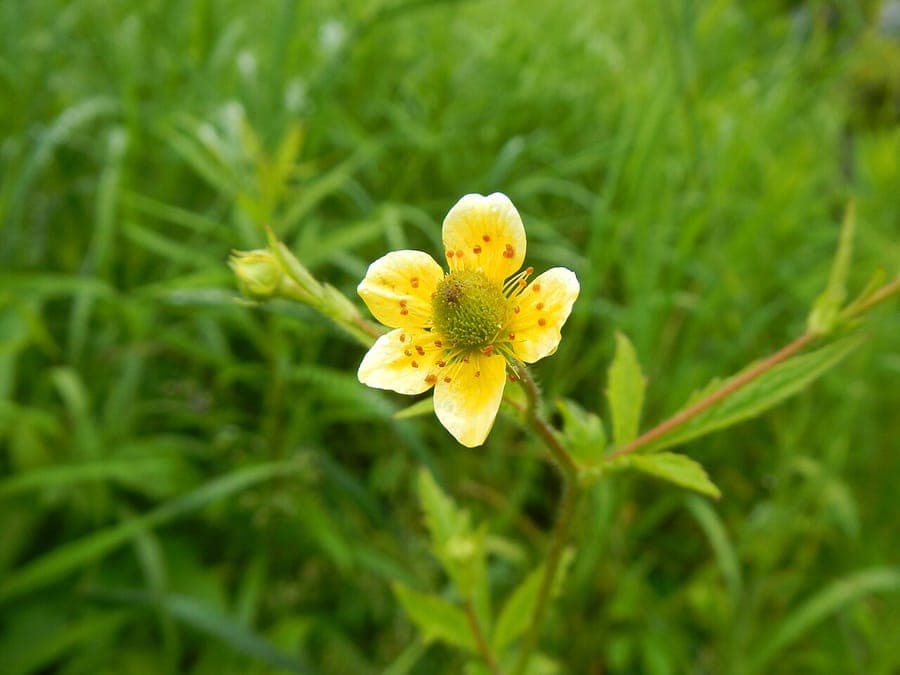
CJChapm / CC BY-SA 4.0, via Wikimedia Commons
Yellow avens: complete guide
Geum aleppicum
Want to see Yellow avens: complete guide in your garden?
Full design in HD: €7.99
Look after your Yellow avens with the GardenWorld app
Identify plants with your camera and get a care calendar with reminders for this plant.


Overview
Yellow avens (Geum aleppicum) belongs to the Rosaceae family and is a beautiful perennial plant characterized by its vibrant yellow flowers and attractive foliage. This plant originates from temperate climates of the Northern Hemisphere and grows easily in European gardens. With its robust growth and long flowering period, yellow avens forms a valuable element in borders, flower beds, and wildflower gardens.
Yellow avens reaches an average height of 30 to 60 centimeters, depending on growing conditions and care. The plant owes its name to the fresh yellow flowers that appear from May to August. These flowers attract bees, butterflies, and other pollinators, making yellow avens an excellent choice for ecologically responsible gardens.
Appearance and bloom
The leaves of yellow avens are deeply lobed and have a dark green color. They form an attractive rosette at the base of the plant. This leaf structure gives the plant an elegant, full appearance that remains interesting throughout the entire season.
The flowers are large, approximately 2 centimeters in diameter, with a bright yellow color. They grow in loose clusters at the ends of straight, hairy stems. After flowering, decorative seed heads form with long, red styles that remain attractive deep into autumn. These seed heads add texture and visual depth to the fall border.
Ideal location
Yellow avens grows best in full sun to partial shade. A location with at least six hours of direct sunlight per day ensures optimal flowering. In partial shade, the plant may flower less abundantly but generally grows well. Ensure the plant receives protection from strong afternoon sun in very warm climates.
Soil
This plant is not fussy about soil type but grows best in well-draining, moderately moist soil. Overly wet soil can cause root rot, so ensure good drainage. Yellow avens tolerates slightly acidic to neutral soil (pH 5.5-7.0). You can add compost or potting soil to heavy clay soils to improve drainage.
Free preview
Want to see Yellow avens: complete guide in your garden? Make a free preview of your design.
Watering
Ensure the soil remains moist during the growing season but not waterlogged. Established plants are fairly drought-tolerant. Water when the top centimeter of soil feels dry. In hot periods, daily watering may be needed, especially for young plants. Reduce watering in autumn and winter as growth slows.
Pruning
Yellow avens requires minimal pruning. Deadhead spent flowers to encourage further blooming. In autumn, you can leave the seed heads for winter interest. In early spring, prune to remove old, damaged growth and keep the plant in shape.
Maintenance calendar
Spring: Plant or transplant in March-April. Begin regular watering. Summer: Deadhead spent flowers and maintain watering. Autumn: Leave decorative seed heads. Reduce watering. Winter: Minimal maintenance needed. Mulch to protect roots.
Winter hardiness
Yellow avens is fully hardy in temperate climates from Northern to Southern Europe. The plant tolerates temperatures down to -15-20C without problems. In very cold regions, some mulching is recommended for extra protection.
Companion plants
Yellow avens combines beautifully with:
- Salvia (sage) - nice color contrasts
- Nepeta (catmint) - blooms simultaneously
- Aquilegia (columbine) - interesting leaf shape
- Knautia - similar growth pattern
- Heuchera - attractive foliage variation
Closing
Yellow avens is a reliable, easy perennial for every gardener. With its long flowering period, decorative seed heads, and beautiful foliage, it offers season-long interest. Plant yellow avens in groups of at least three for maximum border effect. For more garden inspiration and plant combinations, visit gardenworld.app/nl or gardenworld.app/en.
Frequently asked questions about Yellow avens
Is Yellow avens winter hardy?
Yellow avens is fully hardy in temperate climates from Northern to Southern Europe. The plant tolerates temperatures down to -15-20C without problems.
When and how do you prune Yellow avens?
Yellow avens requires minimal pruning. Deadhead spent flowers to encourage further blooming.
How much water does Yellow avens need?
Ensure the soil remains moist during the growing season but not waterlogged. Established plants are fairly drought-tolerant.
Where does Yellow avens grow best?
Yellow avens grows best in full sun to partial shade. A location with at least six hours of direct sunlight per day ensures optimal flowering.
What soil does Yellow avens need?
This plant is not fussy about soil type but grows best in well-draining, moderately moist soil. Overly wet soil can cause root rot, so ensure good drainage.

See it in your garden
See Yellow avens in your garden
One photo of your garden and a few questions. You see the result in about a minute.
Try it with a photoIdentify this plant in your own garden. Identify a plant
Similar plants
New Zealand bur (Acaena microphylla): care guide
Acaena microphylla
Acaena microphylla forms a low, bronze-green carpet with red spiny burs in summer. Advice on position, soil, trimming, hardiness and keeping its spread in check.
Apple serviceberry: complete guide
Amelanchier × grandiflora
Everything about apple serviceberry (Amelanchier × grandiflora): white April flowers, edible berries, autumn colour, position, pruning and cultivars such as 'Ballerina'.
Dwarf goat's beard (Aruncus aethusifolius): complete guide
Aruncus aethusifolius
Everything about dwarf goat's beard (Aruncus aethusifolius): position, soil, watering, pruning and hardiness. A compact perennial with lacy leaves for shade and rock gardens.
