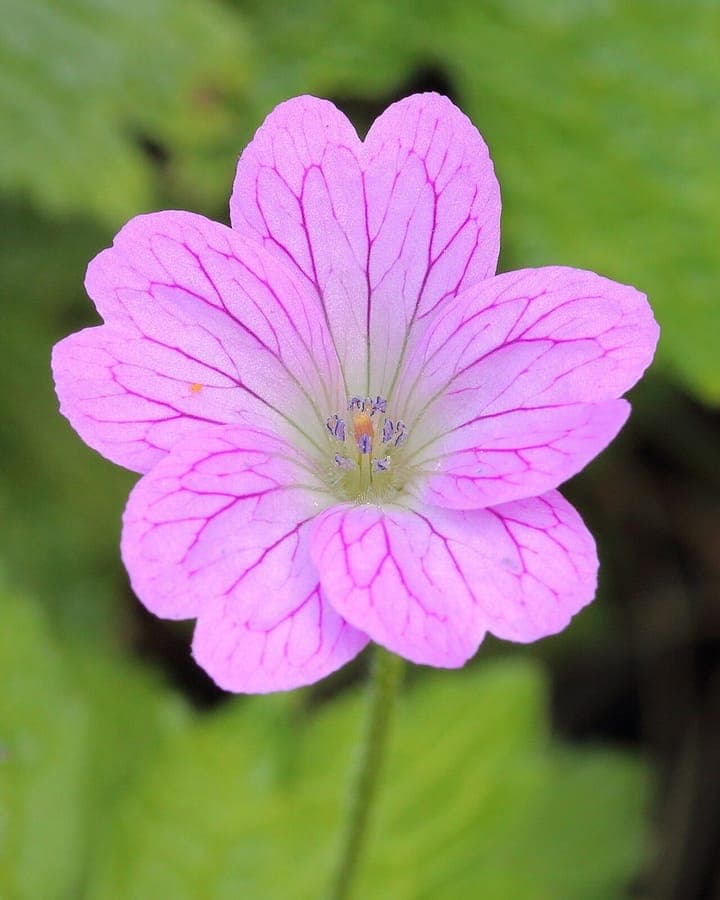
Dominicus Johannes Bergsma / CC BY-SA 3.0, via Wikimedia Commons
Druce's cranesbill (Geranium × oxonianum): complete guide
Geranium × oxonianum
Want to see Druce's cranesbill (Geranium × oxonianum): complete guide in your garden?
Full design in HD: €7.99
Look after your Druce's cranesbill with the GardenWorld app
Identify plants with your camera and get a care calendar with reminders for this plant.


Overview
Geranium × oxonianum is one of the toughest and longest-flowering cranesbills you can grow in a border. It is a cross between Geranium endressii from the Pyrenees and Geranium versicolor from southern Italy and the Balkans. The name refers to Oxford, where the British botanist George Claridge Druce described the hybrid around 1900. Because both parents had long grown side by side in English gardens, the cross arose there spontaneously, and over the years dozens of cultivars have appeared.
What makes this cranesbill special is its combination of vigour and flowering season. From late May into October, pink flowers, often with darker veins, appear above a dense clump of fresh green leaves. The plant is resilient, copes with both sun and partial shade and grows in almost any soil. On gardenworld.app you can create a garden design in which Geranium × oxonianum fills the gaps between roses and shrubs or forms a generous underplanting.
It belongs to the cranesbill family (Geraniaceae). It is fully hardy and has nothing to do with the so-called geraniums for balconies and windowsills, which are actually pelargoniums. In Britain it is sometimes called Druce's cranesbill.
Appearance and bloom cycle
Geranium × oxonianum forms broad, loose clumps 40 to 80 cm high and 60 to 90 cm wide, depending on the cultivar. The leaves are deeply palmately lobed, softly hairy and light green. Some cultivars, such as 'Katherine Adele', have leaves blotched with brownish purple. In mild winters a rosette of leaves remains green at the base.
The flowers are roughly 3 to 4 cm across, with five petals that are often slightly notched at the tip. They range from soft pink to deep pink, usually with fine darker veins running towards the centre. Well-known cultivars include:
- 'Wargrave Pink': bright salmon pink, strong and free-flowering.
- 'A.T. Johnson': silvery pale pink, slightly more compact.
- 'Claridge Druce': lilac pink with dark veins, very vigorous.
- 'Rose Clair': pink with a white sheen and clear veining.
- 'Thurstonianum': narrow, magenta petals, unusual and elegant.
The main flush comes in June and July. After that the plant keeps flowering, with shorter or longer pauses, until the first frosts. Bees, bumblebees and hoverflies visit the flowers all season. Unlike some other cranesbills, this hybrid sets seed readily, and seedlings may differ in colour from the parent plant.
Ideal location
Give Geranium × oxonianum a spot in sun or partial shade. In full sun it flowers most freely, provided the soil does not dry out. In partial shade, for instance on the east side of a house or beneath tall shrubs, the foliage stays fresher and it still flowers well. In deep shade the stems become long and floppy.
Its spreading habit makes it ideal for filling gaps, covering the base of roses or clothing a bank. Plant three to five per square metre, 50 to 60 cm apart. On a windy site the long flower stems may flop apart a little; a few supports or sturdy neighbours solve this.
Soil requirements
This cranesbill is not fussy. Loam, clay, sand and chalky soils all suit it, as long as the ground does not sit waterlogged for long periods in winter. An ordinary, moderately fertile garden soil that does not dry out completely in summer is perfect.
Work some compost into the soil when planting. After that, a layer of compost each spring is enough. Too much nitrogen mainly produces lots of leaves and weak stems, so extra fertiliser is unnecessary.
Free preview
Want to see Druce's cranesbill (Geranium × oxonianum): complete guide in your garden? Make a free preview of your design.
Watering
Water regularly for the first few weeks after planting, and once or twice a week in dry weather during the first season. Established plants cope well with a dry spell, but in prolonged heat and drought they wilt and flowering pauses. A thorough soak at the base soon helps.
Water in the morning and keep the foliage as dry as possible. Plants that often go short of water in summer are also more prone to powdery mildew.
Pruning
The most important cut comes in July, after the first big flush of flowers. By then the plant often looks tired and sprawling. Cut all stems and leaves back to a hand's width above the ground, then water and add a little compost. Within two or three weeks a new, compact mound of fresh foliage appears, followed by a second flush of flowers in August and September.
If you do not want seedlings, remove the spent flower stems promptly. In autumn you can leave the plant standing, as the foliage protects the roots. Clear away old leaves in March before new growth starts. Every four or five years, divide clumps that have become too large or bare in the middle, in spring or September, replanting the young outer sections.
Maintenance calendar
March-April: Remove old leaves. Divide large clumps. Spread a layer of compost. Plant new specimens.
May-June: Flowering begins. Add supports for tall cultivars if needed. Water young plants during dry spells.
July: After the first flush, cut the whole plant back to a hand's width above the ground. Water and add compost.
August-September: New foliage and second flowering. Pull out seedlings you do not want to keep. September is also a good month for dividing.
October: Last flowers. Leave the plant standing.
November-February: Dormant season. No protection needed.
Winter hardiness
Geranium × oxonianum is fully hardy and tolerates temperatures down to about -25 °C. Across the UK and the Low Countries it overwinters without any protection. Some foliage dies back, while the rest stays as a low rosette at the base until spring.
Powdery mildew can appear in dry late summers, especially on plants that are crowded or short of water. The July cut-back helps prevent it. Slugs sometimes nibble young leaves in spring. The plant is not toxic to people, dogs or cats.
Because it sets seed freely, Geranium × oxonianum can self-sow around the garden. In Britain it has naturalised here and there, but it is not listed as an invasive species anywhere in Europe. Deadhead after flowering if you want to limit spread, particularly near natural verges.
Companion plants
The pink flowers fit almost any colour scheme. In a romantic border, pairing it with roses is a classic: the cranesbill hides the bare base and keeps flowering while the roses take a break. Lady's mantle (Alchemilla mollis) offers a fresh lime green contrast, while masterwort (Astrantia major) and foxglove (Digitalis purpurea) add height and a similar cottage-garden mood.
For a cooler scheme, combine it with blue or purple partners such as Balkan clary (Salvia nemorosa) and catmint. Geranium endressii, one of the parents, has a similar character and can share the same border. Beneath shrubs such as hydrangea and lilac, Geranium × oxonianum fills the space without troubling them.
Final thoughts
Geranium × oxonianum is a true workhorse: strong, hardy, undemanding and with a flowering season that lasts for months. The only thing it really needs is a hard cut-back in July, after which it heads into late summer with fresh foliage and a second wave of flowers.
If you would rather not forget the right moments for cutting back and dividing, use the plant calendar on gardenworld.app. That way your cranesbill border stays in flower from June to October.
Frequently asked questions about Druce's cranesbill
Is Druce's cranesbill winter hardy?
Geranium × oxonianum is fully hardy and tolerates temperatures down to about -25 °C. Across the UK and the Low Countries it overwinters without any protection.
When and how do you prune Druce's cranesbill?
The most important cut comes in July, after the first big flush of flowers. By then the plant often looks tired and sprawling.
How much water does Druce's cranesbill need?
Water regularly for the first few weeks after planting, and once or twice a week in dry weather during the first season. Established plants cope well with a dry spell, but in prolonged heat and drought they wilt and flowering pauses.
Where does Druce's cranesbill grow best?
Give Geranium × oxonianum a spot in sun or partial shade. In full sun it flowers most freely, provided the soil does not dry out.
What soil does Druce's cranesbill need?
This cranesbill is not fussy. Loam, clay, sand and chalky soils all suit it, as long as the ground does not sit waterlogged for long periods in winter.

See it in your garden
See Druce's cranesbill in your garden
One photo of your garden and a few questions. You see the result in about a minute.
Try it with a photoIdentify this plant in your own garden. Identify a plant
Similar plants
French crane's-bill: complete guide
Geranium endressii
How to grow Geranium endressii (French crane's-bill) successfully in your garden. Full details on light, soil, pruning, and ideal plant combinations.
Garden lady's-mantle: complete guide
Alchemilla mollis
Alchemilla mollis, or garden lady's-mantle, is a graceful perennial perfect for borders, shade gardens, and low-maintenance landscapes. Grows 15–30 cm tall, blooms June–August.
Astrantia: complete guide
Astrantia major
Complete care guide for Astrantia major: bloom time, ideal location, soil, watering and companion plants. Perfect for shady borders.
