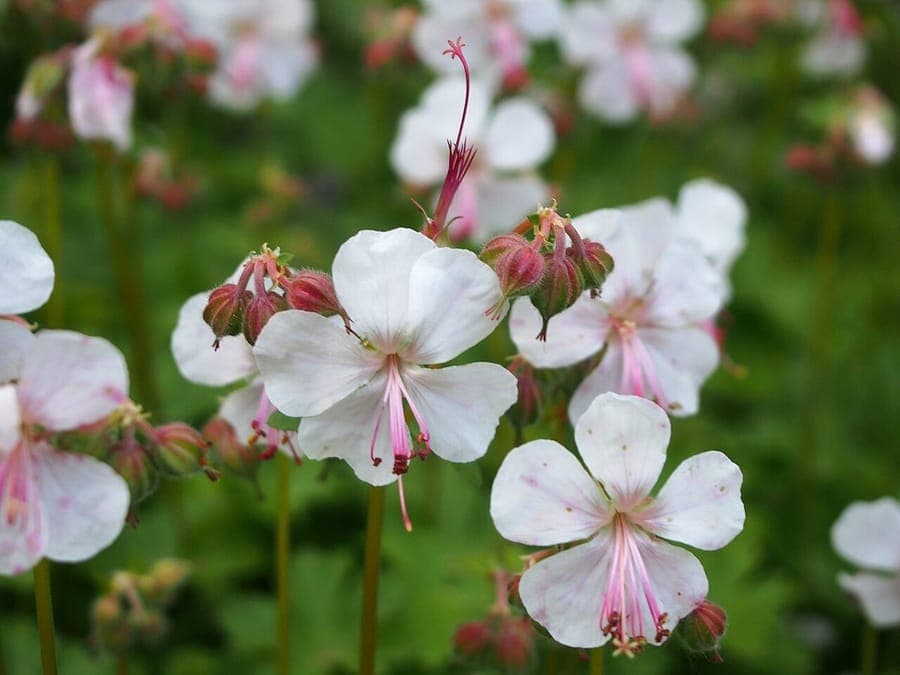
Agnieszka Kwiecień, Nova / CC BY-SA 4.0, via Wikimedia Commons
Cambridge cranesbill (Geranium × cantabrigiense): guide
Geranium × cantabrigiense
Want to see Cambridge cranesbill (Geranium × cantabrigiense): guide in your garden?
Full design in HD: €7.99
Look after your Cambridge cranesbill with the GardenWorld app
Identify plants with your camera and get a care calendar with reminders for this plant.


Overview
Geranium × cantabrigiense, the Cambridge cranesbill, is a low, semi-evergreen hardy geranium that has earned its place as one of the most dependable ground covers for any garden. It is a cross between Geranium dalmaticum and Geranium macrorrhizum, the familiar rock cranesbill. The name refers to Cambridge: in the 1970s Helen Kiefer deliberately recreated the hybrid at the University Botanic Garden there. It later turned out that the same cross also occurs naturally in the Biokovo mountains on the Croatian coast, where the well-known cultivar 'Biokovo' was collected.
This perennial inherited the best of both parents: the compact, soft growth of Geranium dalmaticum and the toughness and aromatic leaves of Geranium macrorrhizum. The result is a dense carpet about 20 to 30 cm tall that smothers weeds, copes with dry shade and needs almost no work. On gardenworld.app you can create a garden design in which this cranesbill fills the awkward spots beneath shrubs and along paths.
It belongs to the cranesbill family (Geraniaceae). Do not confuse it with the bedding and windowsill 'geraniums', which are actually pelargoniums and are not hardy.
Appearance and bloom cycle
Geranium × cantabrigiense forms a low, dense mat 20 to 30 cm high. Through surface runners a single plant slowly spreads to 60 cm or more without ever becoming a thug. The leaves are palmately lobed, slightly glossy, fresh green and softly hairy. Rub one and you will notice a spicy scent inherited from rock cranesbill, though it is milder in the hybrid.
In autumn some of the leaves turn red and orange. The rest stay green through mild winters, so the ground remains covered even in January.
Flowering runs from May into July. The flowers are about 2.5 cm across and held in loose clusters just above the foliage. Each cultivar has its own colour:
- 'Biokovo': white flushed pink, with strikingly long pink stamens. The best known form.
- 'Cambridge': clear lilac pink, slightly lower and denser.
- 'Karmina': deep pink to carmine.
- 'St Ola': pure white.
The flowers are popular with bees and hoverflies. The hybrid sets little or no seed, so you will not find seedlings scattered through the rest of the border.
Ideal location
This cranesbill is exceptionally versatile. It grows in full sun, partial shade and light shade. It flowers most generously in sun, while in shade the foliage stays a little looser but attractively green. Even dry shade under trees and shrubs, one of the hardest spots in any garden, is tolerated once the plant is established.
Ideal places include the front of a border, a bank, the base of a hedge, the gaps between roses or shrubs and the edge of a path. It also does well in large containers and rock gardens. For full ground cover, plant six to eight per square metre, 35 to 40 cm apart. The carpet closes after two seasons. For quicker results, plant a little closer and keep the soil weed-free during the first year with a thin layer of bark chips until the mat takes over.
Soil requirements
Any ordinary garden soil will do, from sand to clay, as long as surplus water can drain away. Geranium × cantabrigiense prefers slightly alkaline to neutral ground but also accepts mildly acidic soils. Heavy clay that stays wet all winter is the only thing it really dislikes.
Work a little compost into the top layer when planting. After that, feeding is hardly necessary. Too much fertiliser makes the foliage floppy and reduces flowering. A thin layer of compost or leaf mould in spring is ample.
Free preview
Want to see Cambridge cranesbill (Geranium × cantabrigiense): guide in your garden? Make a free preview of your design.
Watering
During the first season after planting, water once or twice a week in dry weather so the roots establish well. After that the plant is remarkably drought tolerant. In long, hot summers the leaves may droop a little, but a good soak soon perks them up.
Plants in pots or troughs dry out faster and need regular watering in summer. Water at the base, ideally in the morning.
Pruning
There is very little pruning to do. After the main flush, in late June or July, cut off the spent flower stems. This keeps the mat tidy and sometimes encourages a few extra flowers. If after a few years the carpet becomes open in the middle, shear the foliage back to a hand's width above the ground in July. Within a few weeks fresh, compact leaves appear.
In spring, pull out any damaged or withered leaves. An autumn cut is unnecessary, as the foliage protects the soil over winter.
Geranium × cantabrigiense is also one of the easiest perennials to propagate. In March or April, or in September, lift pieces from the edge of the mat, each with a few rooted runners, and replant them. They almost always take. With just a few parent plants you can quickly cover a large area, and division is also a good way to rejuvenate older, bare clumps.
Maintenance calendar
March-April: Remove damaged leaves. Divide plants that have become too large or bare. Scatter a thin layer of compost.
May-June: Full flower. Water young plants in dry spells.
July: Cut off faded flower stems. Shear back tired mats for fresh foliage if needed.
August: Water during long dry periods, especially plants in containers.
September-October: Good months for planting and dividing. Some leaves turn red.
November-February: Dormant period. Leave the foliage in place as natural protection.
Winter hardiness
Geranium × cantabrigiense is fully hardy and tolerates temperatures down to about -30 °C. Throughout the UK and the Low Countries it needs no winter protection at all. In severe winters some foliage may die back, but the plant reshoots readily from its rhizomes in spring.
Pests and diseases are rare. Slugs usually leave it alone, and rabbits and deer show little interest. In containers, vine weevil larvae can attack the roots. The plant is not toxic to people, dogs or cats, and it is not invasive anywhere in Europe.
Companion plants
As ground cover, this cranesbill provides a calm green underlayer that makes taller plants stand out. Beneath roses it is a classic: it hides the bare base, and the pale flowers of 'Biokovo' suit almost any rose. It also thrives under shrubs such as hydrangeas, viburnums and Japanese maples.
In a shady border, combine it with hostas, Brunnera macrophylla, ferns and Pachysandra terminalis. Lady's mantle (Alchemilla mollis) flowers at the same time and offers a fresh lime green contrast. Rock cranesbill (Geranium macrorrhizum), one of the parents, grows a little taller and can form a second layer behind it. In sun, catmint (Nepeta × faassenii), low salvias and ornamental grasses make good partners.
Final thoughts
Geranium × cantabrigiense answers the question of what to plant where nothing else will grow. It covers the ground all year, flowers freely in May and June, copes with drought and shade and only asks for a tidy-up after flowering. Once you have a few plants, you can easily divide them and spread them further.
Wondering when best to plant or divide? The plant calendar on gardenworld.app shows the border tasks for each month, so your carpet of cranesbill stays dense and full of flowers year after year.
Frequently asked questions about Cambridge cranesbill
Is Cambridge cranesbill winter hardy?
Geranium × cantabrigiense is fully hardy and tolerates temperatures down to about -30 °C. Throughout the UK and the Low Countries it needs no winter protection at all.
When and how do you prune Cambridge cranesbill?
There is very little pruning to do. After the main flush, in late June or July, cut off the spent flower stems.
How much water does Cambridge cranesbill need?
During the first season after planting, water once or twice a week in dry weather so the roots establish well. After that the plant is remarkably drought tolerant.
Where does Cambridge cranesbill grow best?
This cranesbill is exceptionally versatile. It grows in full sun, partial shade and light shade.
What soil does Cambridge cranesbill need?
Any ordinary garden soil will do, from sand to clay, as long as surplus water can drain away. Geranium × cantabrigiense prefers slightly alkaline to neutral ground but also accepts mildly acidic soils.

See it in your garden
See Cambridge cranesbill in your garden
One photo of your garden and a few questions. You see the result in about a minute.
Try it with a photoIdentify this plant in your own garden. Identify a plant
Similar plants
Rock crane's-bill: complete guide
Geranium macrorrhizum
Rock crane's-bill (Geranium macrorrhizum) is a tough groundcover thriving in sun or partial shade. Great for rock gardens and dry spots. Grows 20-30 cm tall.
Garden lady's-mantle: complete guide
Alchemilla mollis
Alchemilla mollis, or garden lady's-mantle, is a graceful perennial perfect for borders, shade gardens, and low-maintenance landscapes. Grows 15–30 cm tall, blooms June–August.
Great forget-me-not: complete guide
Brunnera macrophylla
Brunnera macrophylla, also known as Great forget-me-not, is a shade-loving perennial with heart-shaped leaves and spring blue flowers. Learn care, soil and planting tips.
