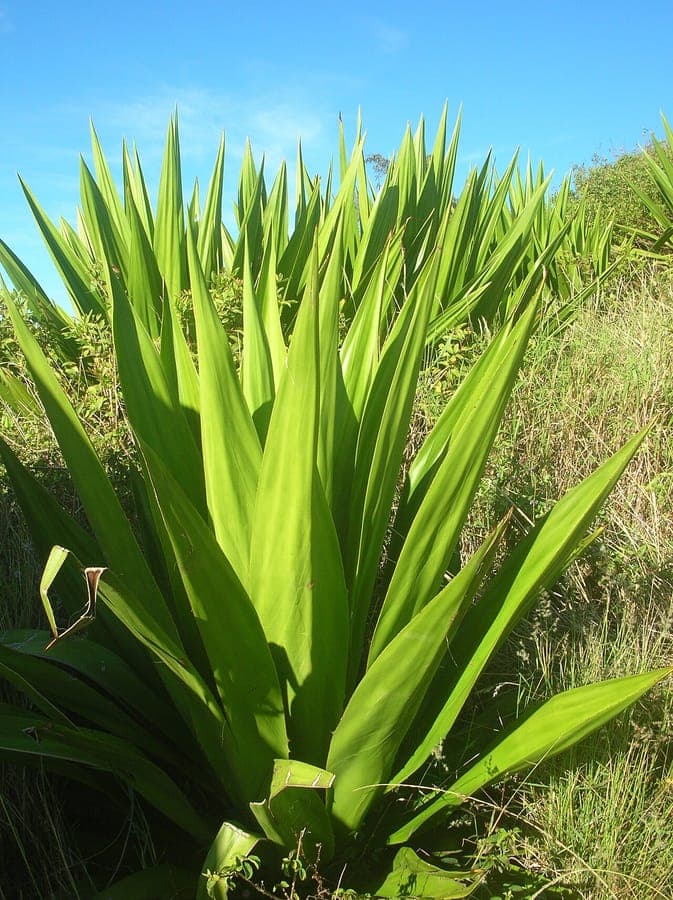
Forest & Kim Starr / CC BY 3.0, via Wikimedia Commons
Mauritius hemp: complete guide
Furcraea foetida
Want to see Mauritius hemp: complete guide in your garden?
Full design in HD: €7.99
Look after your Mauritius hemp with the GardenWorld app
Identify plants with your camera and get a care calendar with reminders for this plant.


Overview
Mauritius hemp (Furcraea foetida), also known as green-aloe, is an impressive subtropical succulent originating from Central and South America. This plant forms spectacular rosettes with long, spreading, fleshy leaves reaching 60-90 centimetres. It offers exotic ornamental value and makes a true statement piece in Mediterranean and tropical garden designs.
Although originally from warm climates, this plant can also grow in temperate regions if well protected from frost. The plant is particularly popular in Southern European gardens and is increasingly sought after by gardeners looking for something distinctly different.
Appearance and bloom
Furcraea foetida forms imposing rosettes of green to bluish-green tinted leaves. The leaves are linear to lance-shaped, 60 to 100 centimetres long and approximately 5 to 8 centimetres wide, with fairly sharp edges. The plant forms no stems, but grows as a dense rosette at ground level.
At maturity (after 8 to 12 years) the plant produces a spectacular flower stalk up to 3 to 4 metres tall. The flowers are cream-white and pleasantly fragrant, collected in dense spikes. After blooming, the mother rosette dies, but not before plantlets form around the old plant.
The characteristic green foliage provides year-round ornamental value, particularly in winter when many other plants offer limited appeal.
Ideal location
Maximum sun is essential. Plant in fully sunny locations receiving at least 6 hours of direct sunlight daily. The plant tolerates partial shade, but grows much less densely and stretches unfavourably in very shaded conditions.
Ensure good air circulation and avoid planting in windless corners where moisture accumulates. This plant thrives on warm stone terraces, against south-facing facades or in well-drained raised beds.
Soil
Absolutely critical: very well-draining soil is essential. Plant in sandy to very sandy-stony soil, possibly with added pumice or aqua-soil. A pH of neutral to slightly acidic (pH 6.5-7.5) is acceptable.
Suggested mix: 50% sharp sand, 30% universal potting soil, 20% pumice or lava grit. Poor-draining soil will cause root rot, so no compromises.
Free preview
Want to see Mauritius hemp: complete guide in your garden? Make a free preview of your design.
Watering
Water uptake must be minimal: this is a succulent with moisture-storing leaves. Water only when soil is completely dry, typically every 3 to 4 weeks during growing season, and sparingly in winter.
Overwatering is the biggest risk with Mauritius hemp. In containers: water more regularly during growing season (but not waterlogged), in ground: minimal. Once weekly in full summer may be sufficient.
Ensure water does not stagnate in the heart of the rosette.
Pruning
Nearly no maintenance pruning required. Only remove dead or damaged leaves. When old rosettes die after flowering, remove them completely to make space for young offshoots.
Any damaged or unsightly leaves can be removed as needed, but avoid excessive pruning.
Maintenance calendar
January to February: Minimal activity. Check for rot problems. No watering.
March to April: Growth begins. Start watering cautiously.
May to September: Active season. Regular watering, but carefully. Monitor for pests.
October to November: Reduce watering as temperatures drop.
December: Prepare frost protection in temperate climates.
Winter hardiness
Tuned for warm climates (USDA 9b-11). In temperate climates possible to USDA zone 8b with protection. Temperatures below 5 degrees Celsius harm the plant. In northern Europe, overwinter as container plant in cool indoor space (10-15 degrees) without water.
In Mediterranean climates (southern France, Spain, Italy) can overwinter outdoors with mulch and protection during frost.
Companion plants
Combine with other desert plants: Cacti, other agaves, Opuntia, Aloe. Mediterranean herbs like rosemary and thyme form complementary plantings. Yellow flowers (Santolina) contrast beautifully with the green foliage.
Final thoughts
Furcraea foetida delivers architectural beauty and tropical feeling. Perfect for large containers or specimen position in sunny gardens. Do not be discouraged by maintenance - this plant actually requires less attention than many others. Begin cautiously with watering and enjoy years of exotic ornamental value!
Find these plants at specialized nurseries and garden centres with Mediterranean offerings.
Frequently asked questions about Mauritius hemp
Is Mauritius hemp winter hardy?
Tuned for warm climates (USDA 9b-11). In temperate climates possible to USDA zone 8b with protection.
When and how do you prune Mauritius hemp?
Nearly no maintenance pruning required. Only remove dead or damaged leaves.
How much water does Mauritius hemp need?
Water uptake must be minimal: this is a succulent with moisture-storing leaves. Water only when soil is completely dry, typically every 3 to 4 weeks during growing season, and sparingly in winter.
Where does Mauritius hemp grow best?
Maximum sun is essential. Plant in fully sunny locations receiving at least 6 hours of direct sunlight daily.
What soil does Mauritius hemp need?
Absolutely critical: very well-draining soil is essential. Plant in sandy to very sandy-stony soil, possibly with added pumice or aqua-soil.

See it in your garden
See Mauritius hemp in your garden
One photo of your garden and a few questions. You see the result in about a minute.
Try it with a photoIdentify this plant in your own garden. Identify a plant
Similar plants
Great camas (Camassia leichtlinii): planting and care
Camassia leichtlinii
Everything about great camas (Camassia leichtlinii): planting the bulbs, heavy wet soil, naturalising in grass, hardiness and the best partners for a flowering meadow.
Pineapple lily (Eucomis bicolor): planting, care and overwintering
Eucomis bicolor
Everything about the pineapple lily (Eucomis bicolor): planting the bulbs, watering and feeding, overwintering in pots or the ground, and the best border partners.
Pineapple lily (Eucomis comosa): growing and overwintering
Eucomis comosa
Eucomis comosa is the tallest and best-known pineapple lily, with creamy spikes topped by a leafy tuft in late summer. Planting, overwintering and leaf cuttings.
