
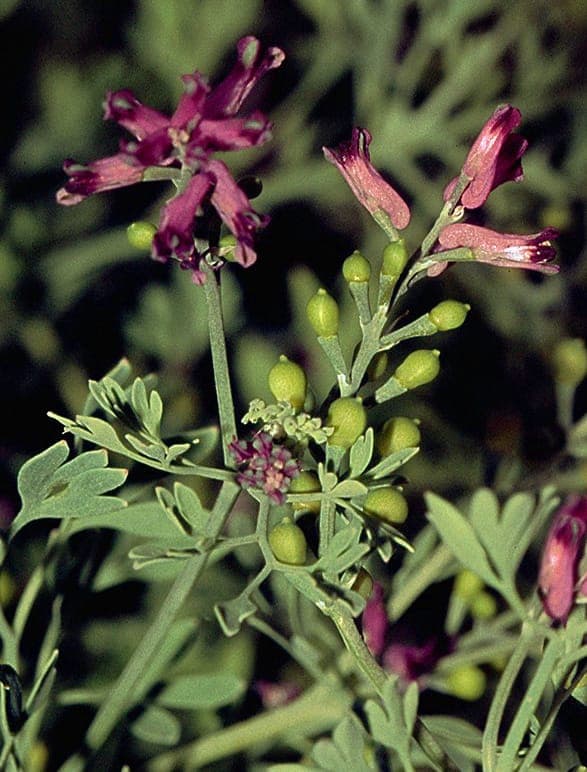
user:Fornax / CC BY-SA 3.0, via Wikimedia Commons
Fumaria schleicheri: complete guide
Fumaria schleicheri
Want to see Fumaria schleicheri: complete guide in your garden?
1 minute, no credit card
Overview
Fumaria schleicheri, commonly known as Schleicher's fumitory or dark fumitory, is a delicate annual plant belonging to the Papaveraceae family. This charming flowering plant grows wild in Central Europe and is named after Swiss botanist Johann Schleicher. The plant is recognized for its distinctive purple flowers that bloom throughout the summer months.
The species is distributed from Austria to Iran and is particularly established in mountainous regions where the climate is temperate and soil drainage is excellent. For gardeners seeking visible bloomers with striking purple coloration, Fumaria schleicheri presents an interesting alternative to conventional bedding plants.
Appearance & Blooming
Fumaria schleicheri grows to approximately 30-40 cm tall with slender, dissected stems. The flowers are small and delicate, displaying a deep purple hue that appears almost violet in sunlight. Each flower consists of four petals, two of which are constricted - characteristic of the Fumaria genus.
The foliage is finely divided, almost fern-like, giving the entire plant an airy appearance in the flower garden. This creates a cloud-like effect in the landscape. Blooming period extends from May through July, with occasional flowers persisting into August under favorable conditions.
Ideal Location
Fumaria schleicheri prefers full sun to partial shade. A location receiving at least 6-8 hours of direct sunlight daily produces the best flowering results. In warmer climates, the plant tolerates afternoon shade, particularly during August.
Select a position where the plant remains visible to passersby, as the flowers have a fleeting quality. A location alongside pathways or adjacent to seating areas enhances the visual impact of these modest purple blooms.
Soil
Fumaria schleicheri thrives in well-draining soil. The plant cannot tolerate waterlogging and performs optimally in alkaline soils. Incorporate compost or aged mulch during planting preparation.
The plant tolerates poor soils well, making Fumaria schleicheri suitable for rock gardens and alpine troughs. A soil pH of 7.5 to 8.0 is ideal. Avoid heavy clay soils without prior amendment and incorporation of organic matter.
Watering
Water requirements are moderate. Ensure soil dries slightly between watering events. Fumaria schleicheri is not drought-sensitive but suffers from waterlogging. During growth and flowering periods, water when the top 2 cm of soil feels dry to the touch.
During the growing season (April through July), provide water weekly depending on weather conditions. During wet autumns, supplemental watering is rarely necessary.
Free design
Want to see Fumaria schleicheri: complete guide in your garden? Make a free design now.
Maintenance
Fumaria schleicheri is an annual plant that completes its lifecycle once seed has matured in autumn. The plant requires no pruning. Removing faded flowers encourages continued bloom production, though this is not strictly necessary.
The plant self-seeds readily in appropriate settings, allowing seed to disperse naturally. For controlled seed density, collect mature seed and sow the following spring under controlled conditions.
Maintenance Calendar
April-May: Sow seed directly in soil or allow self-sown seeds from previous seasons to establish. Water regularly during establishment.
June-July: Plant flowers abundantly. Remove yellowed foliage. Water during dry periods.
August: Flowering begins to diminish. Harvest seed for next season.
September-October: Plant declines. Allow seeds to drop naturally. Clear debris if desired.
Winter Hardiness
Fumaria schleicheri is an annual plant lacking winter hardiness. The plant dies with the first frost. This presents no concern as seed overwinters in the soil, germinating anew the following season. No special winter protection is required.
Companion Plantings
Combine Fumaria schleicheri effectively with other light-textured summer bloomers:
- Delphiniums for vertical blue accents
- Roses as background structure
- Light ornamental grasses for movement
- Related Papaveraceae species for botanical harmony
- Blanket flowers for warm color contrast
The delicate blooms of Fumaria schleicheri disappear easily among heavier plants, so group plants in clusters of at least three to five for visual impact.
Conclusion
Fumaria schleicheri represents a charming addition for gardeners seeking alternatives to conventional summer bedding. Its delicate purple flowers impart sophistication and movement to garden spaces. With minimal maintenance requirements and self-seeding capabilities, this plant rewards gardeners year after year.
Experiment with Fumaria schleicheri in combination with other alpine and wildflower species for naturalistic and ecologically responsible garden designs. The plant also attracts butterflies and beneficial insects, supporting garden biodiversity.
Retail sources: Specialty nurseries and seed suppliers stock seeds occasionally. Availability varies by location. Visit gardenworld.app for more information.
Want to see Fumaria schleicheri: complete guide in your garden? Make a free design now.
Upload a photo, pick a style, and get a photorealistic design with plant list in under a minute.
10,000+ gardens designed already
No credit card required


Similar plants
Papaver gorodkovii: complete guide
Papaver gorodkovii
Papaver gorodkovii, the arctic poppy, thrives from Alaska to Russia's Far East. Discover how to grow this rare, extremely cold-hardy rock garden treasure.
Papaver setiferum: complete guide
Papaver setiferum
Papaver setiferum is a hardy giant Caucasian poppy with fiery red blooms. Discover siting, soil, deadheading and winter hardiness.
Pale Poppy: complete guide
Papaver alboroseum
Discover pale poppy (Papaver alboroseum) - rare alpine poppy with white-pink flowers. Precious beauty from Kamchatka. Cultivation in alpine and rock gardens.