
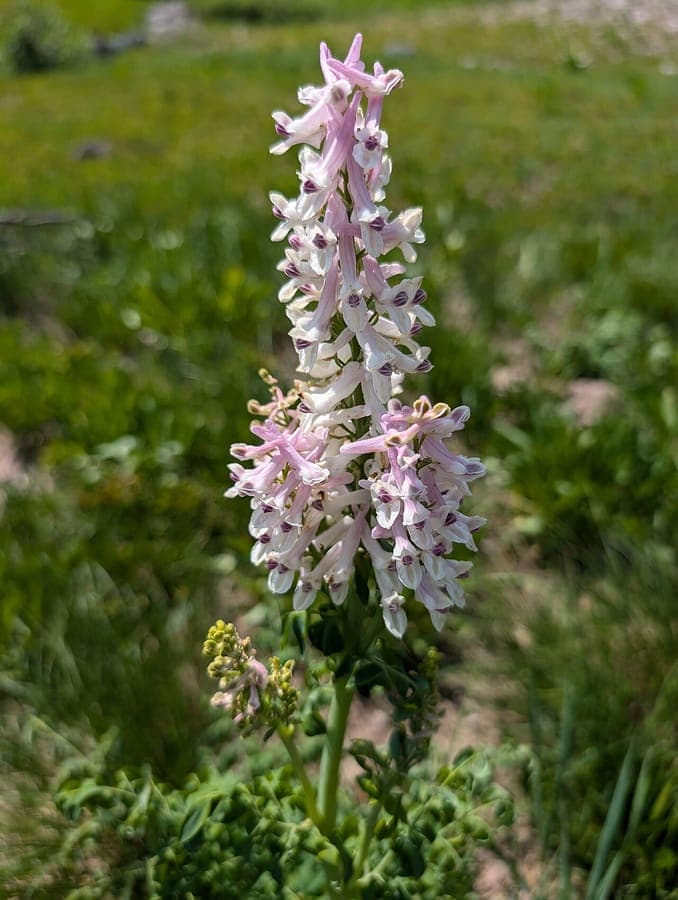
Zac Peterson / CC BY 4.0, via Wikimedia Commons
Sierra fumewort: complete guide
Corydalis caseana
Want to see Sierra fumewort: complete guide in your garden?
1 minute, no credit card
Overview
Sierra fumewort (Corydalis caseana) is a striking herbaceous perennial in the family Papaveraceae, native to the moist mountain forests, canyon bottoms, and streamside habitats of California, Oregon, Washington, Idaho, Utah, Colorado, and New Mexico. It thrives where most garden plants struggle: dense shade, cool soils, and high atmospheric humidity. That very specificity makes it a prized plant for gardeners seeking to create a woodland corner with genuine ecological character.
The species name 'caseana' honours botanist Asa Gray, who described the plant in 1874 from Sierra Nevada material. In English it goes by the names 'Sierra fumewort' and 'fitweed.' It is not commonly stocked by garden centres in the UK, but specialist perennial nurseries and plant fairs are good places to seek it out. Online plant communities and botanical garden plant sales are also reliable sources.
At gardenworld.app you will find design inspiration for shade gardens and woodland plantings where plants like Sierra fumewort anchor a naturalistic aesthetic. Whether you are working with a north-facing fence line or a cool, damp corner under a large canopy tree, this plant deserves consideration.
Appearance and bloom cycle
Corydalis caseana is a clump-forming perennial with graceful, finely divided, light-green foliage. The leaves are pinnately compound with a soft, almost feathery texture reminiscent of Dicentra or Dutchman's breeches. Mature plants typically reach 30 to 90 cm in height, with spread proportionate to the richness of the growing conditions.
The flowers are white, sometimes faintly tinged with pink or lilac at the spur. They are arranged in dense, upright racemes that rise well above the foliage and are produced from June through August, depending on elevation. At higher altitudes the bloom period may be delayed until mid-July or August. The individual flowers have the classic Corydalis form: tubular with a prominent rear spur.
After flowering, the plant produces small, shiny black seeds that are dispersed by ants through a process called myrmecochory. The seeds have oil-rich appendages called elaiosomes that attract ants, which carry the seeds back to their nests and disperse them short distances. This is an elegant natural mechanism that contributes to slow but steady colonisation of suitable habitat.
Ideal location
In nature, Sierra fumewort grows in moist coniferous and mixed forests, along shaded stream banks, and in canyon floors at elevations from around 500 m to over 2,500 m. In the garden, it performs best in partial to full shade. Direct afternoon sun will scorch the delicate foliage and stress the plant severely during dry spells.
The ideal position is beneath a canopy of deciduous or coniferous trees that provides dappled shade in summer and slightly more light in winter. A north- or east-facing border works well, as does a position beside a garden wall or dense hedge. The plant benefits from shelter from strong winds, as the stems are somewhat brittle and can snap in exposed spots.
In cooler, wetter climates - the Pacific Northwest, highland Britain, and maritime western Europe - this plant settles in readily when given the right soil. In warmer or drier regions, careful siting and supplemental irrigation are necessary to keep it thriving.
Soil
Corydalis caseana thrives in humus-rich, well-drained yet consistently moist soil with a slightly acid to neutral pH between 5.0 and 7.4. In its native habitat it grows in deep, loose forest soils rich in decomposing organic matter - leaf litter, rotted wood, and mineral-rich alluvial deposits along streams.
Heavy clay soils that become waterlogged in winter are problematic: the roots will rot in saturated, cold soil. Before planting in clay, improve drainage with generous amounts of coarse grit and well-rotted compost worked in to at least 30 cm depth. Sandy soils are usually too dry and low in nutrients; enrich them with substantial quantities of leaf mould and compost.
A generous surface mulch of leaf mould or wood chips, 5 to 8 cm deep, is strongly recommended. It retains moisture, suppresses weeds, feeds the soil biology, and mimics the natural forest floor that this plant calls home. Refresh the mulch layer each autumn as the leaves fall.
Watering
Sierra fumewort has a clear preference for consistent soil moisture. In its mountain habitats it benefits from snowmelt in spring and regular precipitation throughout the growing season. In the garden, the aim is to replicate this: soil that is reliably moist but never waterlogged.
During the first growing season after planting, water regularly whenever the top few centimetres of soil feel dry. Once the plant is established and its root system is well developed, it becomes somewhat more resilient, but extended dry spells in summer still require supplemental watering to prevent the foliage from wilting and the plant going into premature dormancy.
Deep, infrequent watering is better than frequent shallow applications. Water at the base of the plant rather than overhead, to reduce the risk of fungal problems on the foliage. A drip irrigation system running beneath the mulch layer is particularly effective for maintaining the even moisture this plant needs.
In regions with reliably wet winters and springs, little supplemental watering is needed outside of summer dry spells. Check soil moisture at 10 cm depth before watering.
Free design
Want to see Sierra fumewort: complete guide in your garden? Make a free design now.
Pruning
Corydalis caseana requires very little deliberate pruning. After the flowers fade, spent flower racemes can be removed for a tidier appearance. If you want to encourage self-seeding and natural spread through the garden, leave the seed heads in place until they turn brown and the capsules begin to open, then cut back.
The foliage dies back completely after the first hard frosts of autumn. The dead stems can be left in place through winter as light insulation for the crown, or cut to the ground in late autumn. Use clean, sharp secateurs to cut to just above ground level.
No hard rejuvenation pruning is ever needed. The plant renews itself naturally through seed and, in favourable conditions, through division of the rootstock. Remove any yellowing or diseased leaves during the growing season to keep the plant looking its best and to reduce disease pressure.
Maintenance calendar
February to March: Clear away the previous year's dead stems if not already done. Apply a fresh layer of well-rotted compost or leaf mould around the crown, keeping it away from the central growing point. Mulch over the top to conserve moisture.
April to May: Watch for slug damage on emerging shoots. Young plants are particularly vulnerable. Apply a slow-release organic fertiliser if growth seems sluggish. New growth should appear as temperatures rise.
June to July: Peak flowering period. Monitor soil moisture carefully during warm or dry spells. Deadhead spent racemes if desired, or leave for self-seeding. Keep the area around the plant free of competitive weeds.
August to September: Seeds ripen on any remaining heads. If you want to collect seed, gather the capsules just as they begin to turn from green to tan. Sow fresh seed immediately in pots of humus-rich compost, as viability declines with storage.
October to November: Foliage dies back after frost. Add a fresh mulch layer (5 to 10 cm). Mark the plant's position to avoid accidental damage during winter garden work.
December to January: Full dormancy. No maintenance required beyond monitoring for waterlogging if the season is especially wet.
Winter hardiness
Corydalis caseana originates in mountain environments with cold winters and significant snowfall, which gives it solid cold tolerance. It is rated for USDA hardiness zones 5 to 8, meaning it will survive winter temperatures down to around -28 degrees Celsius in zone 5 conditions. In practice, most of temperate Europe falls into zones 7 or 8, where the plant is reliably hardy.
The key threat in mild, wet winters is not cold per se but waterlogging: saturated soil in combination with frost is more damaging to the roots than dry cold. Ensure good drainage before planting, and consider raising the planting position slightly in gardens with persistently wet conditions.
In colder continental climates at the edge of zone 5 or beyond, a dry mulch of straw or bracken fronds over the crown in late autumn provides worthwhile additional protection. Remove this covering in early to mid-spring once hard frost is no longer expected.
Companion plants
Sierra fumewort partners beautifully with other shade-tolerant woodland perennials that share its preference for cool, moist conditions. Hostas are natural companions - their broad, bold foliage creates a striking textural contrast with the fine, divided leaves of Corydalis. Choose hosta varieties suited to deep shade for the best effect.
Astilbe brings colour in shades of pink, red, white, and salmon and appreciates similar moisture levels. Japanese painted fern (Athyrium niponicum) adds metallic silver tones and elegant texture. Trillium, Polygonatum (Solomon's seal), and Anemone sylvestris are all excellent candidates for a naturalistic woodland planting scheme.
For ground cover beneath the Corydalis, consider Ajuga reptans, which tolerates deep shade, or Lamium maculatum in its many silver-leaved forms. Both are tough, low-maintenance plants that will not compete aggressively with the more delicate Corydalis.
At gardenworld.app you can explore full garden design concepts built around shade plantings and find inspiration for composing plant combinations that work beautifully in real conditions.
Closing thoughts
Sierra fumewort is not a plant for the average sunny border, but for the gardener who wants to do something genuinely interesting with a shady, moist corner of the garden. It rewards patience and careful siting with graceful, long-lasting presence: white flower plumes held above fine, fern-like foliage in the depths of summer shade.
With the right soil preparation, consistent moisture, and a truly shaded position, Corydalis caseana is a reliable and long-lived perennial. Its botanical rarity in cultivation makes it a conversation piece for visitors with a keen eye for plants. Give it the woodland conditions it deserves and it will settle in quietly and grow more beautiful each year.
Want to see Sierra fumewort: complete guide in your garden? Make a free design now.
Upload a photo, pick a style, and get a photorealistic design with plant list in under a minute.
10,000+ gardens designed already
No credit card required

