
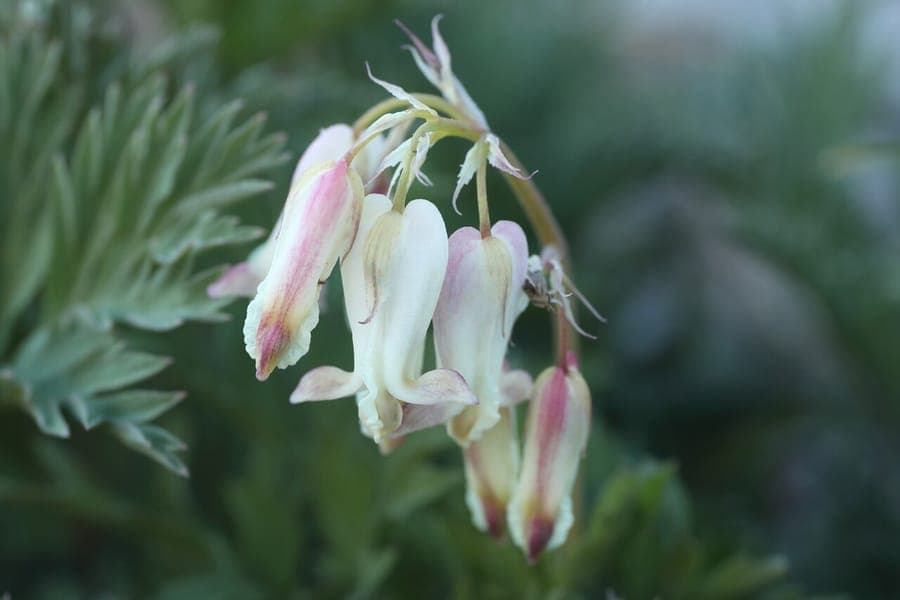
(c) Graham Montgomery, some rights reserved (CC BY-SA) / CC BY-SA 4.0, via Wikimedia Commons
Sierra bleeding heart: complete guide
Dicentra nevadensis
Want to see Sierra bleeding heart: complete guide in your garden?
1 minute, no credit card
Overview
The Sierra bleeding heart (Dicentra nevadensis) is a graceful perennial in the Papaveraceae family, native to the Sierra Nevada mountain range of California. This elegant ground cover is prized for its finely dissected, blue-green foliage and the distinctive heart-shaped flowers that dangle like tiny lanterns along arching stems. Unlike the more widely known Dicentra spectabilis, this is the compact Californian cousin, growing less than half a metre tall, and it is particularly well suited to border and woodland gardens across temperate regions. On gardenworld.app you can find inspiration to give this special plant a beautiful spot in your own garden.
The plant forms underground rhizomes that allow it to spread slowly but steadily. Once established, it increases its coverage each year without becoming invasive, creating a dense mat that suppresses weeds effectively. The combination of ornamental foliage and charming flowers makes it a favourite among gardeners who want something distinctive for shaded corners.
Botanists first described Dicentra nevadensis formally in 1931, and it has sometimes been treated as a subspecies of the western bleeding heart (Dicentra formosa). In cultivation it can be difficult to find in mainstream garden centres, but specialist nurseries often stock it, and its rarity makes it all the more rewarding when you discover it.
Appearance and bloom cycle
The leaves of Dicentra nevadensis are strongly divided and resemble fern fronds, with a shiny blue-green colour forming dense rosettes 20 to 35 cm tall. The flower stems rise slightly above this foliage and carry the characteristic pendant heart-shaped flowers. These blooms are creamy white to pale pink, each measuring only 1 to 2 cm individually, but hanging in dozens along each stem to create a lush, graceful display.
Flowering typically begins in April and continues through June, though in cooler summers the blooms can extend into August. After flowering, foliage in warmer climates may die back, but in the temperate British climate and in northern Europe the leaves often persist through the whole summer. The flower structure is botanically fascinating: two outer petals form the heart shape, while two inner petals create a small protruding tip. Bees and bumblebees visit the flowers to collect nectar from the base of the spurs.
In a well-suited spot, established clumps build up year after year, becoming increasingly floriferous. The growth form is rhizomatous, meaning the plant spreads from underground stems rather than relying on seed. In good conditions it may self-seed modestly, but it rarely becomes a problem.
Ideal location
Dicentra nevadensis grows best in partial to light shade. Direct afternoon sun should be avoided because the delicate leaves scorch easily and the plant wilts quickly in heat. A position under deciduous trees, along a shaded fence or hedge, or in the ground-layer of a woodland garden is ideal. The plant can tolerate more sun if the soil stays consistently moist, but the foliage will then be smaller and less lush.
In nature this species grows on rocky slopes and in mountain forests at elevations of 1,500 to 3,000 metres. In the garden the position need not replicate these conditions precisely, but some protection from fierce winds and strong midday sun is welcome. A north-east or north-west facing border, or a spot at the foot of a hedge, works very well.
Soil
The soil should be loose and free-draining. Dicentra nevadensis prefers a slightly acidic to neutral pH, ideally between 5.5 and 6.0, which matches the conditions in its natural mountain habitat. Loamy, humus-rich soil that retains some moisture while still draining adequately is ideal. Heavy clay soil that allows water to pool around the roots is harmful, as the rhizomes are susceptible to rotting in waterlogged conditions.
When planting, improve the soil by working in a generous quantity of well-rotted compost or leaf mould. This improves both moisture retention and drainage simultaneously. A thin layer of bark mulch or wood chips helps keep the soil cool and moist during summer, which benefits this plant considerably.
Free design
Want to see Sierra bleeding heart: complete guide in your garden? Make a free design now.
Watering
During the growth and flowering period in spring and early summer, Dicentra nevadensis needs regular water. The soil should not dry out completely but should never become waterlogged. Water when the top few centimetres of soil feel dry to the touch. During prolonged dry spells the foliage may die back early, but the rhizome survives underground and shoots afresh the following spring.
In autumn and winter, additional watering is generally unnecessary unless there is an unusually long dry period. Rainwater or tap water that has been allowed to stand briefly to let some chlorine dissipate is preferable. Plants in containers need watering more frequently than those in open ground, especially during warm dry spells.
Pruning
The Sierra bleeding heart requires very little pruning. After flowering the spent flower stems can be removed to keep the plant looking tidy, and this sometimes prompts a secondary, less prolific flush of bloom. The foliage can remain in place as long as it looks green and healthy. Only when the leaves yellow and die back at the end of the season should they be cut down to ground level.
In winter it is best to leave the plant undisturbed. The rhizome survives frost underground. Remove the previous season's dead material only in early spring, so that the new shoots can emerge freely. Excessive digging around the plant or over-pruning can damage the rhizome and weaken the plant in subsequent seasons.
Maintenance calendar
January to February: Plant is dormant. No maintenance required. In severe frost, protect young plants with a light covering of dry straw or leaves.
March: Carefully remove last year's dead foliage. New shoots begin to emerge. Apply a light dose of slow-release fertiliser if desired.
April to June: Flowering period. Enjoy the ornamental blooms. Water regularly during dry weather. Remove spent flower stems.
July to August: Foliage continues growing after flowering. Keep the soil lightly moist. Mulch helps prevent drying out.
September to October: Leaves begin to yellow and die back. Leave them in place until fully dead.
November to December: Cut dead growth back to ground level. Add a protective layer of compost over the root zone if desired.
Winter hardiness
Dicentra nevadensis is winter-hardy to USDA zone 6, meaning it can withstand temperatures down to approximately -23 degrees Celsius. In most parts of Britain, the Netherlands, and Belgium, no special winter protection is therefore required. In particularly severe winters or on wet, boggy ground, a layer of dry straw or leaves over the root zone can still be useful to prevent the rhizome from freezing solid.
In containers the plant is more vulnerable because pots provide far less insulation than open ground. Containers can be overwintered in an unheated shed or in a sheltered position against a wall. In milder regions the plant often flowers noticeably earlier in the season.
Companion plants
Dicentra nevadensis combines beautifully with other shade-loving perennials. Excellent partners include Astilbe varieties, which fill the flowering gap after the bleeding heart finishes with their feathery plumes. Hostas provide structural contrast with their broad leaves alongside the finely cut dicentra foliage. Ferns such as Dryopteris and Polystichum create a harmonious woodland corner planting.
For companion plants like hostas and ferns, visit specialist garden centres, nurseries, or well-stocked garden sections at larger retailers. On gardenworld.app you can see how such shade combinations work in practice and how to put together a woodland or shade border that remains interesting throughout the entire season.
Closing
The Sierra bleeding heart Dicentra nevadensis is an exceptionally graceful, low-maintenance perennial that enriches any shade border or woodland garden. With its finely cut foliage, charming heart-shaped flowers and robust rhizome, it is a reliable choice for gardeners who want to bring a touch of Californian mountain nature into their own outdoor space. Plant it in free-draining, humus-rich soil in a partially shaded position and it will reward you for many years with a lavish display each spring.
Want to see Sierra bleeding heart: complete guide in your garden? Make a free design now.
Upload a photo, pick a style, and get a photorealistic design with plant list in under a minute.
10,000+ gardens designed already
No credit card required


Similar plants
Papaver gorodkovii: complete guide
Papaver gorodkovii
Papaver gorodkovii, the arctic poppy, thrives from Alaska to Russia's Far East. Discover how to grow this rare, extremely cold-hardy rock garden treasure.
Papaver setiferum: complete guide
Papaver setiferum
Papaver setiferum is a hardy giant Caucasian poppy with fiery red blooms. Discover siting, soil, deadheading and winter hardiness.
Pale Poppy: complete guide
Papaver alboroseum
Discover pale poppy (Papaver alboroseum) - rare alpine poppy with white-pink flowers. Precious beauty from Kamchatka. Cultivation in alpine and rock gardens.