
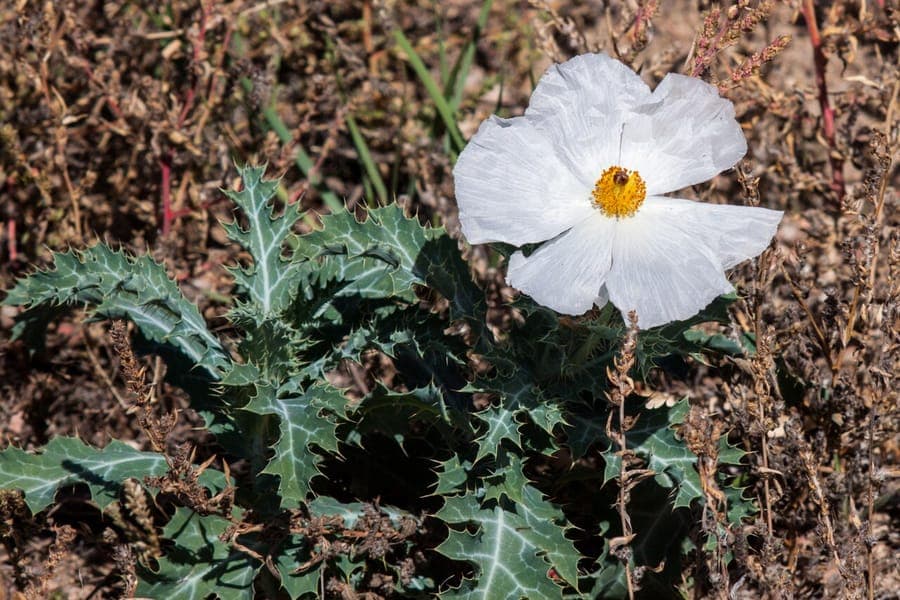
WideClyde / CC BY-SA 3.0, via Wikimedia Commons
Crested pricklypoppy: complete guide
Argemone polyanthemos
Want to see Crested pricklypoppy: complete guide in your garden?
1 minute, no credit card
Overview
Argemone polyanthemos, commonly known as crested pricklypoppy, plains prickly-poppy, or thistle poppy, is a striking annual herb in the poppy family (Papaveraceae). Native to the dry, open plains of central North America - spanning from Texas and Oklahoma north to Wyoming and Montana - this plant has evolved to thrive in harsh conditions where most garden plants would struggle. The species name 'polyanthemos' derives from Greek and simply means 'many-flowered', a quality that becomes obvious when a mature plant is in full bloom with dozens of blossoms opening in succession throughout summer.
For gardeners who appreciate bold, architectural plants with a wild spirit, crested pricklypoppy is a genuine discovery. It suits prairie-style gardens, gravel borders, dry slopes, Mediterranean-inspired beds, or large containers on a sunny patio. On gardenworld.app you can explore how plants like this transform neglected, hot corners of a front garden into striking, water-wise plantings that need almost no upkeep. The plant attracts bees and other pollinators throughout its long bloom season, making it valuable beyond its visual appeal.
Appearance and bloom cycle
Argemone polyanthemos grows between 40 and 90 cm tall, forming an upright, well-branched stem that is conspicuously armed with sharp, yellowish spines. The entire plant - stems, leaves, and seed capsules - carries these spines, making the plant unmistakable at a glance. The leaves are deeply lobed, blue-green in colour, and covered with a whitish bloom that gives them an almost silvery look. Smaller spines run along the leaf margins and mid-veins, providing effective deer and rabbit deterrence.
The flowers are spectacular: 5 to 9 cm across, with 4 to 6 paper-thin white petals surrounding a dense, bright golden cluster of stamens. Each flower lasts only one or two days, but the plant continuously forms new buds from June through to September, keeping the display going all summer long. The flowers open in the early morning and close or drop their petals by late afternoon. After blooming, the plant produces large, spinous seed capsules that are as ornamental as the flowers and remain on the plant through winter, providing structure in the border. The plant's sap is yellow and mildly toxic; always wear gloves when cutting or transplanting, and keep children and pets from eating any part of the plant.
Ideal location
Full sun is essential. A position that receives at least six to eight hours of direct sunlight per day is ideal; light afternoon shade is tolerated, but insufficient light leads to lax, floppy stems, reduced flowering, and increased susceptibility to fungal disease. In its natural range, crested pricklypoppy grows on open prairies, roadsides, and rocky hillsides where the sun shines unobstructed all day.
Wind is not a problem. The sturdy, spiny stems handle exposed positions well, making this plant suitable for open front gardens and windy sites. In terms of hardiness, the species is rated for USDA zones 4 to 9, but in north-west Europe it is treated almost universally as an annual because it does not survive a wet, cold winter. Self-seeding plants, however, reappear reliably from seed that has overwintered in the soil.
Soil
Argemone polyanthemos asks very little of the soil but does have clear preferences. It thrives in dry to moderately moist, fast-draining ground. Sandy, gravelly, or stony soil is ideal; heavy clay must be avoided because waterlogged roots cause rapid rotting. The optimal soil pH is between 7.0 and 8.5, so it is naturally at home in lime-rich, slightly alkaline soils - the kind often found along paths, on building rubble, or in southern-facing borders.
Fertilising is counterproductive: rich soil encourages lush, floppy foliage at the expense of flowers. If you need to improve drainage in a heavier soil, incorporate coarse grit or fine gravel to a depth of 20 to 30 cm before planting. A mulch of gravel or crushed stone around the base of the plant both enhances drainage and creates the dry, textured look that suits this prairie native perfectly.
Free design
Want to see Crested pricklypoppy: complete guide in your garden? Make a free design now.
Watering
Once established, crested pricklypoppy is exceptionally drought-tolerant and rarely needs watering in a typical northern European climate. During an extended dry spell in summer, a deep watering every ten to fourteen days - directed at the base of the plant, keeping the foliage dry - is sufficient to keep plants productive. The golden rule is to water deeply but infrequently, and always allow the soil to dry out completely between waterings.
Overwatering is by far the greatest threat to this plant. Soggy soil causes root rot quickly and the plant declines rapidly. In the first weeks after sowing or transplanting, more regular watering is needed to promote germination and establishment. Once the plants are 10 to 15 cm tall and clearly growing strongly, you can step back and let the weather do the work in most seasons.
Pruning
Virtually no pruning is needed. Argemone polyanthemos has a naturally upright, well-structured habit and maintains its form without any cutting. Spent flowers do not need to be removed; the plant produces new blooms continuously until cut back by the first frost. If you want to limit self-seeding - this plant can spread generously if allowed - remove the seed capsules before they split open. The seed capsules are highly decorative and make excellent material for dried arrangements.
Whenever you do handle the plant, wear thick gardening gloves. The spines are genuinely sharp and the yellow sap that bleeds from cut stems can cause skin irritation in sensitive individuals. Use clean, sharp secateurs and work quickly to minimise damage to the plant.
Maintenance calendar
March-April: Sow seeds directly in the ground at their final position, or start them early indoors in root trainers. Seeds germinate at a soil temperature of at least 15 degrees Celsius. Covering the sowing area with black plastic for two weeks before sowing helps warm the soil.
May: Thin seedlings to 30-50 cm apart. Begin modest watering if conditions are very dry.
June-September: Full bloom. Minimal care required. Remove seed capsules if you want to restrict spreading.
October: After the first frost, the plant dies back. Remove dead stems or leave them standing for winter structure and bird interest.
November-February: Decide whether you want to allow self-seeding. Capsules that fell to the ground will yield new plants the following year with no effort on your part.
Winter hardiness
Argemone polyanthemos is an annual (or sometimes biennial in its native range), and it does not survive northern European winters. In USDA zones 4 to 9 it may sometimes persist as a biennial, but in Britain and the near Continent it is best treated as a reliable hardy annual. The seeds, however, are robust and can overwinter in the soil, germinating the following spring after the ground has warmed. Plants that are allowed to set and drop seed become self-perpetuating, returning year after year without any replanting needed. This makes the crested pricklypoppy one of the easiest annuals to maintain in the garden once you have established a colony.
Companion plants
Crested pricklypoppy pairs beautifully with other drought-tolerant plants that share its wild, open character. Excellent companions include Echinacea purpurea (purple coneflower), Salvia nemorosa (woodland sage), Agastache (hyssop), Rudbeckia (black-eyed Susan), and ornamental Alliums. Ornamental grasses with a feathery, upright habit - such as Stipa tenuissima and Festuca glauca - complement the bold texture of the pricklypoppy leaves well.
Avoid combining it with moisture-loving plants such as Hostas, Astilbes, or roses, whose watering needs conflict with the dry conditions this plant prefers. On gardenworld.app you will find design ideas for sun-baked front gardens where crested pricklypoppy plays a starring role alongside other prairie and steppe classics. Seeds and occasionally young plants are available from specialist garden centres in the UK during the spring season.
Closing thoughts
Argemone polyanthemos is one of those plants that rewards gardeners who are willing to do less rather than more. No fussing with regular watering, no feeding, barely any pruning, and it repays the lack of attention with weeks of spectacular white blooms and year-round structural interest from its spiny capsules. For anyone designing a drought-tolerant, low-maintenance front garden, the crested pricklypoppy deserves a prominent place in the plan.
Want to see Crested pricklypoppy: complete guide in your garden? Make a free design now.
Upload a photo, pick a style, and get a photorealistic design with plant list in under a minute.
10,000+ gardens designed already
No credit card required


Similar plants
Silverweed: complete guide
Argentina anserina
Everything about Argentina anserina (silverweed): a tough groundcover with silver foliage and yellow flowers, ideal for moist corners and waterside planting.
Freckled milkvetch: complete guide
Astragalus lentiginosus
Everything about Astragalus lentiginosus, the freckled milkvetch from western North America. Location, soil, care, and garden combinations covered.