
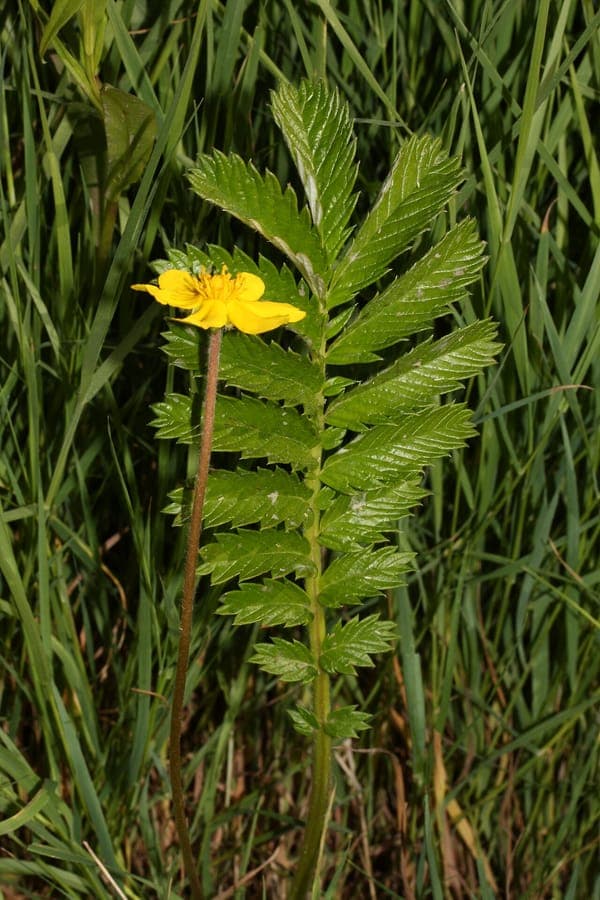
Walter Siegmund (talk) / CC BY-SA 3.0, via Wikimedia Commons
Silverweed: complete guide
Argentina anserina
Want to see Silverweed: complete guide in your garden?
1 minute, no credit card
Overview
Silverweed, botanically known as Argentina anserina and formerly classified as Potentilla anserina, is one of the most adaptable and widely distributed groundcover plants of the temperate zone. A member of the rose family (Rosaceae), it is native across almost the entire Northern Hemisphere: from Iceland and Greenland to Japan, from Alaska to the Himalayas, and throughout Europe including the coastal and riverside areas of Britain, the Netherlands, and Belgium. In the wild it colonises wet meadows, riverbanks, sandy and clay soils near water, roadsides, and lightly disturbed ground.
The English common name 'silverweed' describes the silky, silver-white underside of the pinnate leaves, which flash in the wind like small mirrors. The genus name Argentina comes from the Latin for silver, and the species name anserina means 'of the goose', because geese are known to graze on the sweet roots and young shoots. The plant has a long history of human use: the starchy roots were roasted and eaten in times of scarcity, the leaves were used in folk medicine, and farmers once used its presence as an indicator of soil type and groundwater level.
For today's gardener, silverweed is valued primarily as a groundcover for difficult spots where little else will grow: waterlogged corners, north-facing beds, stream edges, and compacted soil areas. On gardenworld.app you can see how native groundcovers like this transform neglected front garden areas into sustainable, ecologically valuable plantings that attract bees, beetles, and other beneficial insects.
Appearance and bloom cycle
Silverweed produces low rosettes of pinnate leaves that lie nearly flat on the ground and send out long lateral runners (stolons) that creep in all directions. The individual leaflets are oval to oblong, toothed along the margin, dark green on the upper surface, and coated on the underside with a dense layer of silky, silver-white hairs that give the plant its characteristic gleam. The leaves are arranged alternately with smaller leaflets interspersed between the larger ones, creating the attractive feather-like structure that makes silverweed instantly recognisable.
From May through August, and sometimes into September, the flowers appear: single, five-petalled, and bright lemon-yellow, 1.5 to 2.5 cm across. They closely resemble wild strawberry flowers but are a richer, cleaner yellow. Each flower is carried on a slender, hairy stalk 5 to 15 cm tall, rising from the leaf rosette. The flowers are an excellent nectar source for bees and bumblebees. After flowering the plant sets small, dry fruits that birds and small mammals disperse, but the most efficient means of spread is via the stolons, which can reach a metre in length and root wherever they touch the ground, forming new rosettes.
Ideal location
Silverweed is remarkably tolerant of different light conditions. It thrives in full sun but also performs well in partial shade and even in fairly deep shade beneath trees, though flowering is reduced in low light. In nature it grows on open, moist ground in full sun, but it adapts readily to shadier garden situations once established.
In terms of hardiness, silverweed is exceptionally tough - rated to USDA zone 3 and lower, it survives the winters of northern Scandinavia, Canada, and Siberia without trouble. It tolerates periodic waterlogging and brief flooding, making it particularly well suited to low-lying areas, pond edges, and spots where rainwater pools. This combination of extreme cold hardiness, tolerance for both flooding and drought once established, and adaptability to various light levels makes it a uniquely versatile plant.
Soil
Argentina anserina is not fussy about soil structure. It grows in sand, clay, loam, and everything in between. The optimal pH range is 7.0 to 8.0, indicating a preference for neutral to slightly alkaline soils, though it is also found on mildly acidic ground. Moisture is more important than soil type: the plant prefers moist to wet conditions but, once deeply rooted, tolerates extended dry periods as well.
No soil enrichment is needed before planting silverweed. It grows modestly on poor soil and vigorously on fertile ground. If you want to manage the rate of spread, choose a moderately fertile site. Humus-rich, moist soil produces the best leaf colour and richest flowering, but the plant establishes successfully even in quite poor conditions.
Free design
Want to see Silverweed: complete guide in your garden? Make a free design now.
Watering
In most West European garden situations, silverweed needs almost no supplementary watering. It is naturally adapted to fluctuating moisture conditions and handles both wet and dry periods well. During dry summers, particularly on light, sandy soils, a weekly watering is beneficial. On heavier or moister soils, additional watering is rarely if ever required.
For newly planted rosettes in spring, more regular watering during the first four to six weeks is important to help the stolons root and spread. Once the plant is well established and actively producing runners, it becomes largely self-sufficient. Take care that the soil does not dry out severely in the first weeks after planting young specimens; this can cause the rosette to die back before the stolons have had a chance to root properly.
On gardenworld.app you can find further guidance on designing front gardens with water-wise groundcovers that need minimal irrigation - silverweed is one of the best examples of a native plant that thrives without an irrigation system in typical garden conditions.
Pruning
Silverweed requires almost no pruning in most garden situations. The low, creeping rosettes stay naturally tidy. If you want to control the spread - the stolons can cover a substantial area in a few seasons - simply clip back unwanted runners with shears or secateurs in spring or autumn. This is the only real maintenance the plant needs.
At the end of winter you can remove any brown or withered leaves from the previous season to encourage fresh spring growth. Deadheading after flowering is not necessary; the plant sets little seed and the spent flower stalks are not unsightly. If a patch becomes too dense or overgrown, rake out surplus rosettes with a garden fork - they lift out easily and can be composted or transplanted elsewhere.
Maintenance calendar
March-April: Remove any dead or yellowed foliage from the previous year. Plant new rosettes or stolon divisions in the desired position.
May-June: Flowering begins. Check the spread of stolons and trim back any that are advancing too far.
July-August: Peak flowering. Water weekly during dry spells on sandy soil.
September: Flowering winds down. No further action needed.
October-November: Leaves may yellow slightly in autumn but often persist through winter. Optionally top-dress with a thin layer of compost around the rosettes.
December-February: The plant rests but remains visible. The rosettes may be lightly frosted but recover quickly. No action needed.
Winter hardiness
Silverweed is exceptionally winter-hardy. It survives the severe winters of northern Scandinavia, Canada, and Siberia and is among the most cold-tolerant groundcovers available to European gardeners. In north-west Europe, winter loss is essentially unheard of: the leaf rosettes tolerate frost down to around -20 degrees Celsius without significant damage.
The plant is a long-established component of grasslands, stream banks, and roadsides throughout lowland Britain, the Netherlands, and Belgium, and it remains common along ditch margins and canal banks in many areas. In the garden it is fully hardy and needs zero winter protection or care. Even after severe frost it comes back quickly in early spring with fresh, silver-gleaming leaves.
Companion plants
Silverweed pairs well with other moisture-tolerant and waterside plants: Lythrum salicaria (purple loosestrife), Iris pseudacorus (yellow flag iris), Caltha palustris (marsh marigold), and Mentha aquatica (water mint). In drier positions it combines attractively with low-growing thyme (Thymus), Ajuga reptans (bugle), and Fragaria vesca (wild strawberry), which share a similar creeping habit.
In larger gardens, silverweed makes a good skirt for isolated shrubs at the edge of a lawn or border, filling the bare ground beneath with a carpet of silver. Seeds and plants are occasionally stocked by specialist native-plant garden centres and wildflower nurseries. Alternatively, stolon divisions can be taken from established plants with permission from landowners.
Closing thoughts
Silverweed is an understated plant with real garden merit. It asks very little, rewards with attractive silver foliage and cheerful yellow flowers, and succeeds in spots where few other plants are willing to go. For any gardener seeking a low-growing, native groundcover for a wet corner, a stream edge, or a shaded border, Argentina anserina is one of the most reliable and ecologically valuable choices available.
Want to see Silverweed: complete guide in your garden? Make a free design now.
Upload a photo, pick a style, and get a photorealistic design with plant list in under a minute.
10,000+ gardens designed already
No credit card required


Similar plants
Crested pricklypoppy: complete guide
Argemone polyanthemos
Everything about Argemone polyanthemos, the crested pricklypoppy from the North American prairie: growing, location, bloom and garden tips.
Freckled milkvetch: complete guide
Astragalus lentiginosus
Everything about Astragalus lentiginosus, the freckled milkvetch from western North America. Location, soil, care, and garden combinations covered.