Elie plus / CC BY 3.0, via Wikimedia Commons
Pointed-petal fritillary (Fritillaria acmopetala): growing guide
Fritillaria acmopetala
Want to see Pointed-petal fritillary (Fritillaria acmopetala): growing guide in your garden?
Full design in HD: €7.99
Look after your Pointed-petal fritillary with the GardenWorld app
Identify plants with your camera and get a care calendar with reminders for this plant.


Overview
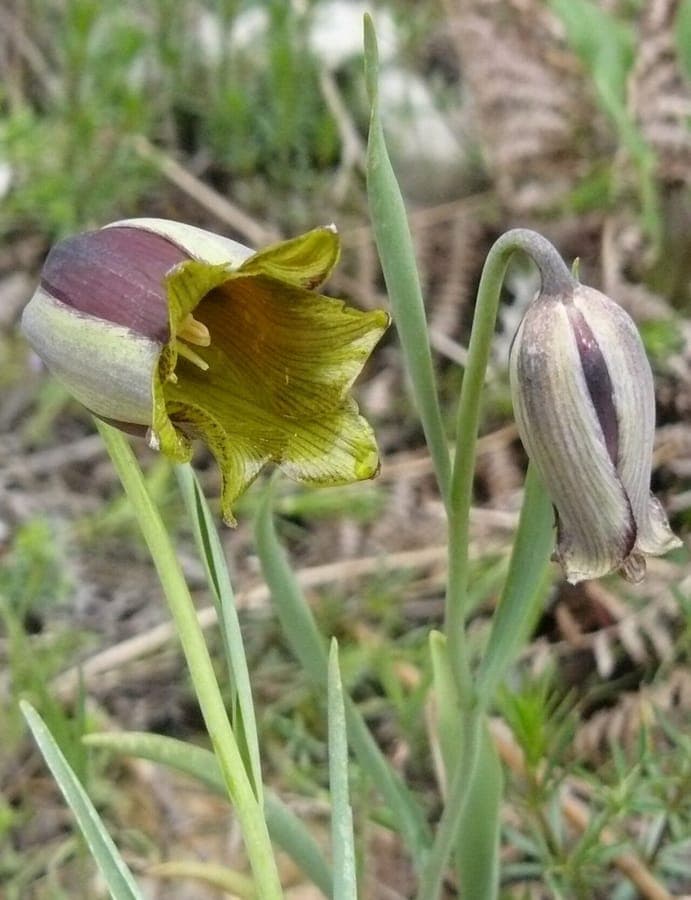
Fritillaria acmopetala, sold in English-speaking catalogues as the pointed-petal fritillary, is one of the most graceful spring bulbs you can grow in an ordinary garden. The snake's head fritillary has chequered purple bells and the crown imperial shouts in orange, but this species prefers understatement: nodding bells of jade green, washed inside with chocolate brown.
It belongs to the lily family (Liliaceae) and grows wild in the eastern Mediterranean, in southern Turkey, Cyprus, Syria and Lebanon, on stony limestone slopes, among scrub and in open pine woodland. That origin tells you exactly what it wants in a garden: sun or light shade, soil that dries out in summer and, above all, no waterlogging while the bulb is dormant.
This is a bulb for naturalistic borders, rock gardens and gravel beds, and for gardeners who want something quieter than tulips and daffodils in April. On gardenworld.app you can have a garden design drawn up in which small spring bulbs like this one sit among perennials that take over later in the season.
Appearance and flowering season
Each bulb sends up a slender, upright stem about 30 to 40 cm tall, carrying five to eight narrow, linear leaves in a soft blue-green. At the top the stem arches over and holds one to three bell-shaped flowers, each roughly 3 to 4 cm long.
From outside the bells are pale apple green. The inner tepals carry a broad band of purplish to reddish brown that often shows through the outer ones. The tips of the tepals flare outwards in a neat curve, giving the bell a slightly flared, almost tulip-like outline.
Flowering comes in April and early May, roughly alongside late daffodils and the first species tulips. Each plant stays in flower for two to three weeks. Afterwards an upright, winged seed capsule forms. The foliage stays green for a few more weeks and dies back during June, after which the bulb rests until autumn. Mark the spot with a label, because nothing shows above ground through summer and it is easy to dig into the clump by accident.
Ideal position
Give Fritillaria acmopetala full sun or light, dappled shade. In deep shade the stems flop and flowering suffers.
What matters even more than light is the summer rest. From July to September the bulb does not want to sit in permanently moist soil. A spot among perennials that are not watered much in summer, a rock garden, a gravel garden or a raised bed suits it perfectly.
The plant is small and delicate, so put it where you can see it up close: beside a path, at the front of a border, or in a drift among low ground cover. A group of ten to fifteen bulbs already makes a statement, and the clumps slowly widen over the years as the bulbs produce offsets.
Soil requirements
Free drainage is the single most important condition. The species does well on light sandy soil, loam and chalky soil, as long as water drains away quickly. A neutral to slightly alkaline pH is ideal; acid, peaty soil is less suitable.
On heavy clay, dig plenty of grit or coarse sand into the top 25 cm before planting. A handful of sharp sand beneath each bulb stops water collecting around its base. Moderately fertile soil is enough. A thin layer of compost in autumn will do; heavy feeding only gives you floppy stems.
Planting the bulbs
The bulbs are made of loose, fleshy scales with no protective tunic, so they dry out quickly. Plant them as soon as possible after buying, ideally in September or October while the soil is still warm and the bulbs can root before winter. Never leave them for weeks in a plastic bag or a warm shed.
Plant about 10 to 12 cm deep, measured from the base of the bulb, and space them 8 to 10 cm apart with the pointed end upwards. On wet or heavy ground you can lay the bulb slightly on its side so water does not collect in the hollow at the top.
For a natural look, scatter a handful of bulbs gently over the ground and plant them where they land.
Bear in mind that every part of Fritillaria acmopetala, and the bulb in particular, contains steroidal alkaloids. The plant is toxic to people and pets if eaten. Wear gloves if your skin is sensitive, keep bulbs well away from children, dogs and cats, and never store them where they could be mistaken for onions.
Free preview
Want to see Pointed-petal fritillary (Fritillaria acmopetala): growing guide in your garden? Make a free preview of your design.
Watering
During growth in March and April the plant needs moderate moisture, which a normal spring in north-west Europe usually supplies. If there is no rain for a fortnight while it is in flower, give each group a good can of water, preferably in the morning.
As soon as the leaves start to yellow, stop watering. The bulb needs a dry summer rest. In the open ground that simply means keeping the sprinkler away from this spot. Move pots to a dry, sheltered place such as under a porch roof once the foliage has died down, and start watering them again carefully from late September to trigger new root growth.
Pruning
There is no real pruning to do. Snip off faded flowers only if you do not want seed. If you leave the capsules, the plant may slowly seed itself around in a spot it likes.
Always leave the foliage after flowering until it has turned yellow and dry by itself. During those weeks the bulb builds up its reserves for next year. Cut the green leaves too early and the following spring brings weak flowering or none at all. Only remove the foliage once it has completely withered.
Maintenance calendar
September–October: Plant new bulbs immediately after purchase. Work grit into heavy soil. Divide congested clumps once the foliage has gone.
November–February: Dormant period with root growth below ground. No care needed. In hard frost, move pots against a wall or into a cold, light shed.
March: The first blue-green shoots appear. Check for slugs and remove them.
April–early May: Flowering time. Watch out for lily beetles, the bright red beetles that also attack fritillaries, and pick off adults and larvae by hand. Water only in prolonged dry spells.
June: The foliage yellows. Leave it until it has died back completely and mark the position.
July–August: Dry summer rest. No water, no feed.
Winter hardiness
Fritillaria acmopetala is hardy in western Europe. The Royal Horticultural Society rates it as tolerating frost of around -10 to -15 °C, and in practice it survives colder nights as long as the bulb sits in dry soil. An ordinary winter in Britain, Belgium or the Netherlands is no problem.
The real danger is not cold but wet, airless soil combined with frost, which makes the scaly bulb rot. On free-draining ground no winter protection is needed. Bulbs in pots are more vulnerable because frost reaches them from every side: below about -5 °C, move containers against the house wall, wrap them in hessian or bubble wrap, or put them in an unheated garage for a while.
Companion plants
With its muted colours, this fritillary needs partners that do not drown it out. The pheasant's eye daffodil (Narcissus poeticus), white with a small red-rimmed eye, and the wild tulip (Tulipa sylvestris) in soft yellow make lovely companions. Dog's tooth violet (Erythronium dens-canis) and grape hyacinths (Muscari armeniacum) flower at the same time and are of a similar scale.
For the months after flowering, choose perennials that fill the gap without needing much water in summer. Cushion spurge (Euphorbia epithymoides), with its sulphur-yellow bracts, echoes the green and yellow tones of the fritillary in spring.
Final thoughts
Fritillaria acmopetala is not a plant that shouts from across the garden, but stoop down in April and you will find one of the finest bell shapes spring has to offer. It asks for very little: sun or light shade, soil that drains freely, a dry summer and a little time to settle in. Respect its toxicity and avoid planting it where dogs like to dig.
If you want to know when to plant the bulbs, when to divide them and when to look out for lily beetles, the planting calendar on gardenworld.app lists those moments for your own garden, so you can enjoy these green bells every spring.
Frequently asked questions about Pointed-petal fritillary
Is Pointed-petal fritillary winter hardy?
Fritillaria acmopetala is hardy in western Europe. The Royal Horticultural Society rates it as tolerating frost of around -10 to -15 °C, and in practice it survives colder nights as long as the bulb sits in dry soil.
When and how do you prune Pointed-petal fritillary?
There is no real pruning to do. Snip off faded flowers only if you do not want seed.
How much water does Pointed-petal fritillary need?
During growth in March and April the plant needs moderate moisture, which a normal spring in north-west Europe usually supplies. If there is no rain for a fortnight while it is in flower, give each group a good can of water, preferably in the morning.
What soil does Pointed-petal fritillary need?
Free drainage is the single most important condition. The species does well on light sandy soil, loam and chalky soil, as long as water drains away quickly.

See it in your garden
See Pointed-petal fritillary in your garden
One photo of your garden and a few questions. You see the result in about a minute.
Try it with a photoIdentify this plant in your own garden. Identify a plant
Similar plants
Poet's narcissus: complete guide
Narcissus poeticus
All about Narcissus poeticus: full sun, pH 5.5-6.5, blooms in May, 30-40 cm tall. Ideal for cottage gardens, naturalised lawns, and borders. Hardy, fragrant, and low maintenance.
Wild tulip: complete guide
Tulipa sylvestris
Everything you need to know about Tulipa sylvestris: growing conditions, care tips, and ideal garden partners for natural landscapes.
Dogtooth-violet: complete guide
Erythronium dens-canis
How to grow Erythronium dens-canis: ideal light, soil pH, watering needs and companion plants. Perfect for woodland gardens and shady borders.
