
xulescu_g / CC BY-SA 2.0, via Wikimedia Commons
Dogtooth-violet: complete guide
Erythronium dens-canis
Want to see Dogtooth-violet: complete guide in your garden?
1 minute, no credit card
Overview
Erythronium dens-canis, commonly known as Dogtooth-violet, isn't actually a violet and doesn't resemble a dog's tooth unless you're really squinting at the bulb. Still, the name sticks, and so does the plant - once you've grown it right. Native to deciduous woodlands across southern and central Europe, this delicate spring bloomer thrives in cool, shaded spots where few other bulbs dare to perform. It reaches a modest 10–15 cm in height and blooms from March through May, depending on your zone and winter warmth. It's a slow starter but a long-term tenant in the garden if conditions are just right.
Dogtooth-violet is a true woodland geophyte, meaning it wakes up early, blooms fast, and then disappears underground by early summer. This rhythm makes it ideal for planting under trees or alongside shrubs that leaf out late, giving it the light it needs during its active phase. On gardenworld.app, you can design a shade garden layout that prioritizes early spring interest - pairing Erythronium with other ephemerals for a layered, natural look.
Appearance & bloom cycle
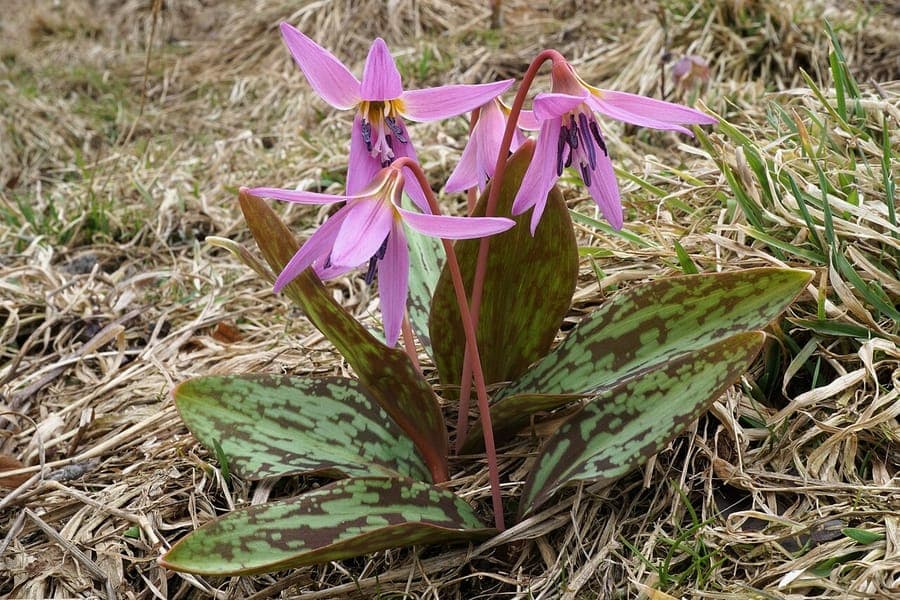
The plant sends up two lance-shaped, mottled leaves in late winter - deep green with bronze or purple marbling that adds texture even before flowering. The nodding, six-petaled blooms emerge shortly after, hanging like tiny chandeliers at the top of slender stems. The flowers are a rich, deep purple, almost wine-colored, with prominent yellow stamens that add contrast. Each flower lasts 2–3 weeks, and the entire blooming window stretches from March to May in most temperate climates (USDA zones 4–8).
After blooming, the foliage yellows and dies back completely by June. This dieback is natural and necessary - don't cut it down prematurely. The bulb uses this period to store energy for next year's show.
Ideal location
Dogtooth-violet prefers dappled shade or partial shade, scoring an 8 on the light scale (10 being full sun). Think forest edges, under open-canopy trees like birch or hornbeam, or on the north or east side of a structure. Avoid hot afternoon sun, which dries out the soil too quickly and scorches the leaves. Full shade delays growth and reduces flowering.
If you're designing a woodland garden, use gardenworld.app to map light patterns across your yard. This helps you place Erythronium where it'll get morning light but be shaded by midday.
Free design
Want to see Dogtooth-violet: complete guide in your garden? Make a free design now.
Soil requirements
This plant demands moist, humus-rich, well-drained soil with a pH between 4.5 and 5.0 - that's on the acidic side. Heavy clay soils need amending with leaf mold, composted bark, or pine needles to improve drainage and acidity. Sandy soils benefit from generous additions of compost or well-rotted leaf litter to retain moisture.
Plant bulbs in autumn, from September to November, at a depth of 8–10 cm and spaced 10 cm apart. Handle them gently - they're firm but not indestructible.
Watering
Keep the soil consistently moist during the active growing season (February to June). Dry spells in early spring can stunt growth and shorten bloom time. Water deeply once a week if rainfall is low, preferably with rainwater to avoid lime buildup. After foliage dies back in June, stop watering entirely. The bulbs go dormant and won't need moisture until the following winter.
Pruning
No pruning required. Just let the leaves die back naturally. Cutting them early weakens the bulb and may prevent flowering the next year. Mark the spot if needed - it's easy to forget where they are once the foliage vanishes.
Maintenance calendar
- September–November: Plant bulbs
- December–January: Dormant; no action needed
- February: Foliage emerges; watch for slugs
- March–May: In bloom; water during dry spells
- June: Foliage yellows; stop watering
- July–August: Fully dormant; no care needed
Winter hardiness
Dogtooth-violet is reliably hardy in USDA zones 4–8. It tolerates winter lows down to -25°C. No mulch is needed in most regions, but in areas with heavy, wet clay, a light layer of leaf litter or pine needles can prevent rot and maintain soil structure.
Companion plants
Pair Erythronium with other spring ephemerals and shade-tolerant perennials:
- Helleborus orientalis – for early color and structure
- Epimedium grandiflorum – for ground cover after Erythronium fades
- Anemone blanda – for extended bloom time
- Pulmonaria officinalis – for contrasting foliage and pollinators
Avoid aggressive spreaders or dense ground covers that could smother the bulbs. Give Erythronium room to breathe and re-emerge each spring.
Closing
Erythronium dens-canis is not a show-off, but it's a quietly elegant addition to any shade garden. It asks for specific conditions - acidic, moist, humus-rich soil and dappled light - but rewards patience with a fleeting yet unforgettable display. Buy quality bulbs from trusted garden centres in autumn, and consider planting them in drifts for a naturalized effect. Over time, they'll multiply slowly, forming small colonies that brighten the woodland floor. Use gardenworld.app to visualize bulb placement and companion planting, ensuring your spring garden tells a story of rhythm and renewal.
Want to see Dogtooth-violet: complete guide in your garden? Make a free design now.
Upload a photo, pick a style, and get a photorealistic design with plant list in under a minute.
No credit card required


Similar plants
Reverchon's gagea: complete guide
Gagea reverchonii
Full guide to Gagea reverchonii, Reverchon's gagea: rare Pyrenean bulb with bright yellow spring flowers, soil needs and companion planting.
Leafy gagea: complete guide
Gagea foliosa
Gagea foliosa is a rare Mediterranean bulb with bright yellow star-shaped flowers blooming February to March in well-drained rocky settings.
Tubular gagea: complete guide
Gagea fragifera
Gagea fragifera is a mountain bulb with golden-yellow star flowers blooming May to July on subalpine slopes from Europe to the Himalaya.