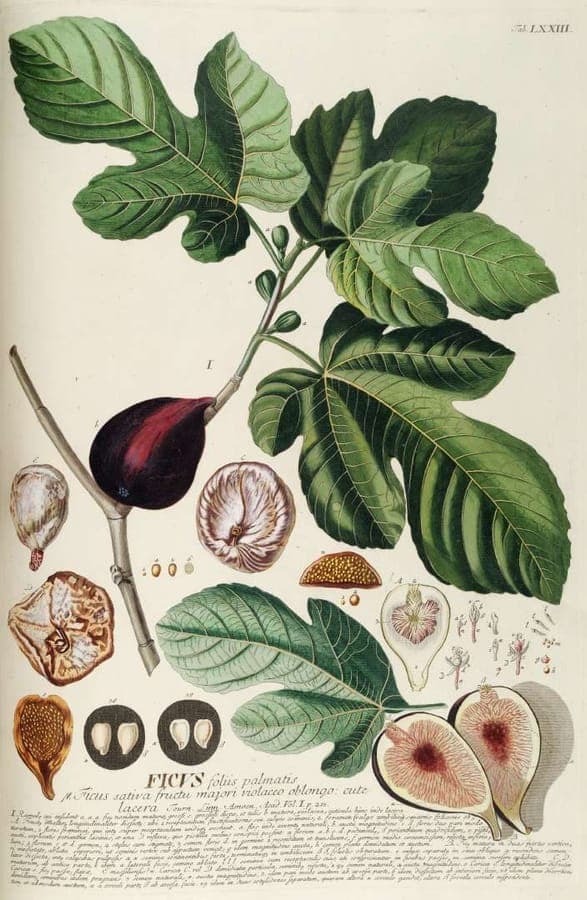
Trew, C.J / Public domain, via Wikimedia Commons
Common Fig: complete guide
Ficus carica
Want to see Common Fig: complete guide in your garden?
Full design in HD: €7.99
Look after your Common Fig with the GardenWorld app
Identify plants with your camera and get a care calendar with reminders for this plant.


Overview
The common fig (Ficus carica) is one of those plants that instantly conjures up holidays in the south, yet it grows remarkably well in gardens across Britain and north-west Europe. Trained against a warm wall, tucked into a sheltered courtyard or grown in a large container, a well-chosen variety will reward you with soft, sweet fruit year after year. The fig is native to south-west Asia and the eastern Mediterranean and has been cultivated for thousands of years.
In a temperate climate a fig usually forms a broad shrub or a small multi-stemmed tree, 3 to 5 metres tall and roughly as wide. In a pot it is easy to keep at 1.5 to 2 metres. The varieties grown in northern Europe have one great advantage: they set fruit without pollination, so they do not need the fig wasp, which does not live here anyway. If you are unsure where a fig would sit best in your plot, you can have a garden design made on gardenworld.app that takes sun, walls and available space into account.
Dependable varieties for cooler gardens include 'Brown Turkey' (reliable, brownish-purple fruit), 'Brunswick' (large green-brown figs) and 'Bornholm', a very hardy selection from Denmark.
Appearance and bloom cycle
Fig leaves are unmistakable: large, 15 to 25 cm long, rough to the touch on the upper surface and deeply cut into three to five lobes. Figs are deciduous and come into leaf in April.
You will never see a fig in bloom in the usual sense. The tiny flowers are hidden inside a fleshy, hollow structure which later becomes the fruit we eat. In our climate there are effectively two generations of fruit. Small embryo figs that form in late summer and survive the winter at the shoot tips go on to ripen the following July and August. Figs that only appear during summer usually ripen too late and drop off unripe in autumn. A ripe fig hangs down slightly on its stalk, feels soft, has coloured fully and sometimes shows fine cracks in the skin.
Ideal location
Warmth is everything for a fig. Choose the sunniest spot you have, ideally against a south- or south-west-facing wall. The brickwork soaks up heat during the day and releases it at night, which helps the fruit ripen and the new wood mature before winter. Aim for at least six to eight hours of direct sun a day for a decent crop.
Shelter from cold easterly and northerly winds matters, because they cause more damage in winter than frost alone. Keep the size of the root system in mind as well: fig roots are vigorous and travel a long way, so plant at least 2 to 3 metres from foundations, drains and pond liners. If fruit is your goal, restrict the roots deliberately. Dig a planting pit about 60 by 60 cm and line the sides with paving slabs. A fig with limited root room produces less foliage and more figs.
Soil requirements
Figs are not fussy about soil as long as it drains freely. Ordinary garden soil, from light sandy to loamy, is fine, and chalky soil is no problem at all: anything between pH 6 and 8 suits. Heavy, wet clay is the main risk, because waterlogged roots in winter are far more likely to suffer frost damage. On clay, work in coarse grit and some rubble, and consider planting slightly proud of the surrounding ground.
Rich soil is more of a hindrance than a help. Plenty of nitrogen produces long, soft shoots with few figs, and that sappy growth copes badly with winter. Add a little well-rotted compost at planting, then give only a light spring feed with a potash-rich fruit fertiliser. In a container, use a loam-based compost with about a third grit or fine lava rock mixed in, and a layer of crocks or clay pebbles at the bottom for drainage.
Watering
An established fig in open ground can cope with a dry spell, but it does need regular water in summer while the fruit swells. Drought in June and July makes young figs drop, while erratic watering causes ripe fruit to split. During dry weather, one generous soak of 10 to 20 litres a week is far better than a daily splash.
Water young wall-trained plants weekly in their first year. Figs in pots dry out quickly, and daily watering in high summer is perfectly normal. Reduce watering in autumn so the wood can ripen. Over winter a potted fig should be kept almost dry, with just enough water to stop the rootball drying out completely.
Free preview
Want to see Common Fig: complete guide in your garden? Make a free preview of your design.
Pruning
Prune figs with restraint. Wait until late March or April, when the hardest frosts are over and you can see which branches have come through the winter. Cut dead and frosted wood back to healthy growth, remove crossing branches and thin out the centre to let in light and air. An open goblet shape works well for free-standing plants, while a wall-trained fig can be fanned out and tied to horizontal wires.
In early July, pinch out the tips of young shoots after five or six leaves. This encourages new embryo figs to form at the tips, ready to overwinter and ripen the following summer. In late October or November, remove every fig larger than a pea: these will not ripen now and will only be killed by frost. Leave the tiny figlets at the tips alone, because they are next year's crop.
Wear gloves and long sleeves when pruning. The milky sap contains furocoumarins which, combined with sunlight, can cause painful red patches and blisters on the skin that may linger for weeks. Sap and leaves are also irritating to dogs and cats if they chew them, causing drooling, vomiting or skin irritation.
Maintenance calendar
March-April: Remove winter protection once hard frosts are no longer forecast. Prune out dead wood and shape the plant. Give a light feed with fruit fertiliser.
May: Tie in new growth on wall-trained plants. Move potted figs back outside to a sunny spot.
June: Keep the soil moist in dry weather so young fruit does not drop. Check for scale insects, particularly against walls and in containers.
July-August: Pinch out young shoots after five or six leaves in early July. Pick ripe figs every day or two. Net the fruit if birds and wasps get there first.
September-October: Final harvest. Cut back on watering and stop feeding.
November: Remove all figs larger than a pea. Protect young plants. Move potted figs into a cool, frost-free shed or garage.
December-February: Dormant season. Check protection after storms or snow.
Winter hardiness
Ficus carica is hardier than many people assume. A mature plant with well-ripened wood usually survives -12 to -15 °C. In prolonged cold the young twigs may be killed, but the plant almost always reshoots from older wood or from the base.
Young plants are more vulnerable during their first three years. In November, pile a thick layer of straw or dry leaves around the base and, in severe frost, wrap the canopy in a few layers of horticultural fleece. Avoid plastic sheeting, as condensation builds up underneath and the branches rot. A fig in a container is best overwintered in an unheated garage or shed at 0 to 8 °C. As it has no leaves at that point, the space can be dark.
A word on spreading: in some European cities, birds disperse fig seed and seedlings appear in old walls and along railway embankments. In north-west Europe the fig is not regarded as a problematic invasive species, but pull seedlings out of mortar joints before their roots do any damage.
Companion plants
A fig naturally brings a Mediterranean feel, and the best companions build on that. Rosemary (Rosmarinus officinalis), thyme (Thymus vulgaris) and English lavender (Lavandula angustifolia) all enjoy the same warm, sunny spot and free-draining soil, and they fill the base of the fig with scent and colour. An olive (Olea europaea) in a pot alongside strengthens the southern look.
Along a long south-facing wall, a fig pairs beautifully with a grapevine (Vitis vinifera), so you can pick two kinds of fruit from the same wall in late summer. Avoid moisture-loving border plants right against the trunk: they compete for water and keep the base too wet in winter. The plant calendar on gardenworld.app shows when to plant and prune each of these partners.
Final thoughts
With a sunny wall, free-draining soil, restricted roots and a little winter protection in the early years, a fig will give you fruit in late July and August that easily rivals anything grown further south.
Prune in spring, pinch out in July and clear the larger figs in November. Follow that simple rhythm and your Ficus carica will crop happily for many years.
Frequently asked questions about Common Fig
Is Common Fig winter hardy?
Ficus carica is hardier than many people assume. A mature plant with well-ripened wood usually survives -12 to -15 °C.
When and how do you prune Common Fig?
Prune figs with restraint. Wait until late March or April, when the hardest frosts are over and you can see which branches have come through the winter.
How much water does Common Fig need?
An established fig in open ground can cope with a dry spell, but it does need regular water in summer while the fruit swells. Drought in June and July makes young figs drop, while erratic watering causes ripe fruit to split.
Where does Common Fig grow best?
Warmth is everything for a fig. Choose the sunniest spot you have, ideally against a south- or south-west-facing wall.
What soil does Common Fig need?
Figs are not fussy about soil as long as it drains freely. Ordinary garden soil, from light sandy to loamy, is fine, and chalky soil is no problem at all: anything between pH 6 and 8 suits.

See it in your garden
See Common Fig in your garden
One photo of your garden and a few questions. You see the result in about a minute.
Try it with a photoIdentify this plant in your own garden. Identify a plant
Similar plants
English Lavender: complete guide
Lavandula angustifolia
Everything about English Lavender (Lavandula angustifolia): planting, pruning, care and overwintering. Practical tips for lush purple blooms.
Rosemary: complete guide
Rosmarinus officinalis
Everything about Rosemary (Rosmarinus officinalis): planting, care, overwintering and culinary use. Practical tips for a healthy, aromatic shrub.
European grape: complete guide
Vitis vinifera
Everything you need to know about growing Vitis vinifera: ideal conditions, pruning, harvest tips and best companion plants for your garden.
