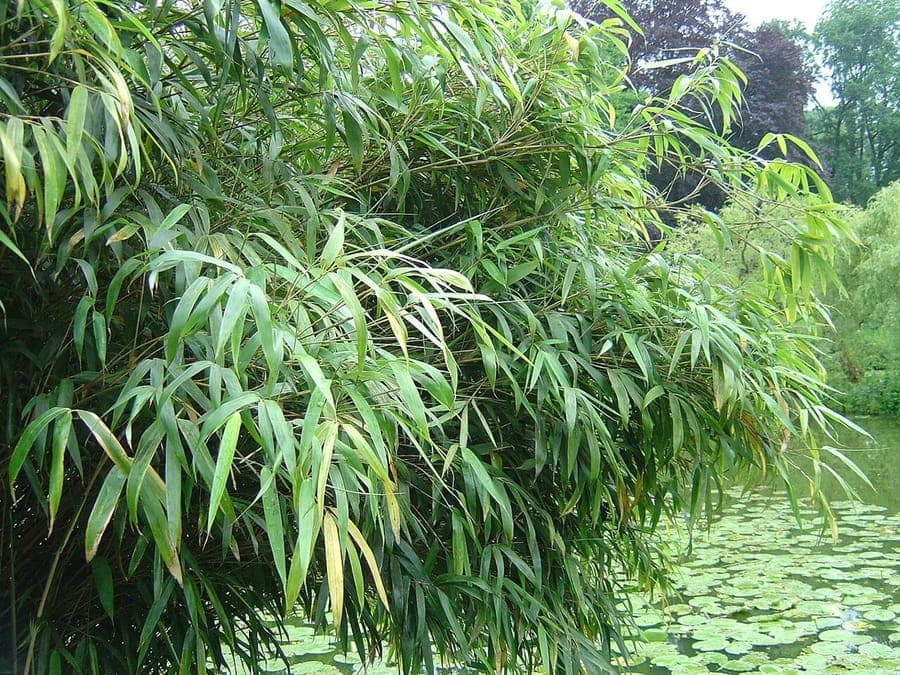
Djlayton4, Daniel J. Layton / CC BY-SA 3.0, via Wikimedia Commons
Fountain bamboo (Fargesia nitida): complete guide
Fargesia nitida
Want to see Fountain bamboo (Fargesia nitida): complete guide in your garden?
Full design in HD: €7.99
Look after your Fountain bamboo with the GardenWorld app
Identify plants with your camera and get a care calendar with reminders for this plant.


Overview
Fargesia nitida is the bamboo for the cool, shady corner of the garden. Where many plants grow thin in partial shade, this one forms a dense, upright clump of slender dark canes clothed in narrow, glossy leaves. It comes from the high mountains of Gansu and Sichuan in China, where it grows in cool forest at 2,400 to 3,200 metres. That origin explains its liking for shelter and moisture, and its excellent hardiness.
The species name nitida means shining and refers to the foliage. In English it is known as fountain bamboo or Chinese fountain bamboo, after its fountain-like outline. It reached Europe at the end of the nineteenth century via the botanic garden in St Petersburg and has been grown in gardens for well over a hundred years. In the wild it is one of the bamboos the giant panda depends on.
Fountain bamboo grows 3 to 4 metres tall but stays remarkably narrow, with a clump 1 to 1.5 metres across. That makes it ideal as an evergreen screen, a slim hedge along a wall or a focal point beside a pond, as in the photograph. If you are unsure where it would sit best, gardenworld.app can create a garden design for you that takes shade, moisture and the eventual spread of the clump into account.
Does Fargesia nitida spread?
No. Like all Fargesia species it has short, thickened rhizomes from which new canes rise tight against the old ones. The clump widens by only a few centimetres a year and does not send runners metres across the garden as invasive genera such as Phyllostachys or Sasa do. A rhizome barrier is unnecessary. In fact it is one of the narrowest clumping bamboos, so it fits into a border less than a metre deep, a narrow strip along a drive or a large container on a balcony. The RHS notes that it spreads only slowly in the British climate.
Appearance, canes and foliage
The canes are what immediately set Fargesia nitida apart from umbrella bamboo (Fargesia murielae). They are about 1 cm thick, blue-grey with bloom at first, then darken to purple-brown or almost black, especially at the nodes and in sun. The cane sheaths are purplish too. One unusual trait: a new cane makes no side branches in its first year. It stands as a bare, straight wand with a small tuft of leaves at the top, and only the following spring do side shoots break along its whole length.
The leaves are narrow and fine, 5 to 8 cm long and 0.5 to 1 cm wide, dark green and glossy above. They are densely packed, so the clump looks heavier and darker than the pale green umbrella bamboo. Young canes stand ramrod straight; older ones arch slightly at the top, giving the fountain shape. In the photograph above, a mature clump leans out over a pond.
Bamboo is not toxic to dogs and cats. Raw shoots do contain compounds that release cyanide, so never eat them without boiling them thoroughly.
Flowering and dying back
Like other bamboos, Fargesia nitida flowers only rarely, and plants of the same origin then tend to flower together. From the mid-1990s and well into the 2000s, the old European garden stock of this species flowered en masse. Many clumps died afterwards; in some, part of the plant survived and slowly reshot after a few years.
Most plants on sale today come from newly collected wild seed or from seedlings of that flowering. Well-known selections include 'Nymphenburg' with fine, arching foliage, 'Great Wall' with strong, upright growth for hedging, 'Jiuzhaigou 1' with reddish canes and 'Black Pearl' with very dark canes. For these younger generations the next mass flowering is not expected for decades. If flower spikes do appear, the plant cannot be saved: cut out the flowering canes and wait, or replace it.
Free preview
Want to see Fountain bamboo (Fargesia nitida): complete guide in your garden? Make a free preview of your design.
Ideal location
This is the biggest difference from umbrella bamboo: Fargesia nitida prefers partial to full shade. A spot with morning sun or dappled light beneath taller trees is ideal, as is a north- or east-facing side of the house. In full midday sun the narrow leaves quickly roll up and bleach, particularly on dry soil. Cold winter winds and winter sun also do harm, so a sheltered position protects the evergreen foliage.
For a hedge, plant 50 to 70 cm apart. As a specimen it needs roughly a square metre of ground. It also does well in a container of at least 40 to 60 litres, provided you water faithfully.
Soil requirements
Fargesia nitida wants humus-rich, moist but free-draining soil. Woodland soil is the ideal: full of leaf mould, slightly acidic to neutral. On sandy soil, work plenty of compost or leaf mould into the planting hole; on clay, add grit. A 5 cm mulch of leaf compost keeps the roots cool and matters even more in shade.
Feed in April and June with a nitrogen-rich organic fertiliser. Stop after July so the young canes can harden before winter.
Watering
This bamboo needs more moisture than most garden plants. In its first year, give 10 to 15 litres two or three times a week during dry spells. Even established clumps should be watered when it has been dry for more than two weeks. Rolled leaves are the first sign of thirst; water straight away and they unfurl within a day. In pots you will often need to water daily in summer.
In winter the leaves lose water on sunny frosty days while the ground is frozen. In dry winters, water occasionally on frost-free days.
Pruning
Fountain bamboo needs little pruning. In March or April, cut the oldest, dead and spindly canes out at ground level to keep the clump open and fresh. Do not expect a new cane to look full straight away; give it a year to branch. As a hedge it can be trimmed to height in spring; shortened canes stop growing upwards but branch more densely. Remove the lowest side shoots if you want to show off the dark canes.
Maintenance calendar
March-April: Remove old and dead canes, give the first feed and renew the mulch. A good time for planting.
May-June: New, still unbranched canes shoot up. Second feed and regular watering.
July-August: Water generously in drought, especially in pots. Watch for rolled leaves.
September-October: Plant until mid-October. This year's canes harden off.
November-February: Water on frost-free days during dry frosty spells. Wrap containers.
To keep track of these moments, the planting calendar on gardenworld.app shows month by month what to do for fountain bamboo and the other plants in your garden.
Winter hardiness
Fargesia nitida is very hardy and tolerates frost to about -25 °C. It is fully hardy throughout Britain and the Low Countries. Severe frost with sun and wind can brown the leaves, but the canes leaf up again in spring. Wrap plants in pots during hard frost and move them out of the wind.
Companion plants
In shade, fountain bamboo looks lovely with ferns such as the male fern (Dryopteris filix-mas) and the soft shield fern (Polystichum setiferum). The large, glossy leaves of Japanese aralia (Fatsia japonica) contrast beautifully with its fine foliage. Skimmia (Skimmia japonica) and mophead hydrangeas (Hydrangea macrophylla) add colour. By a pond, combine it with hostas and Japanese irises.
Final thoughts
Fountain bamboo is an elegant, slender bamboo that thrives where others struggle: in cool shade. It does not run, is very hardy and above all asks for moist, humus-rich soil. Choose a young selection such as 'Great Wall' or 'Nymphenburg', give it a sheltered spot, and it will provide greenery, movement and rustling leaves year after year.
Frequently asked questions about Fountain bamboo
Is Fountain bamboo winter hardy?
Fargesia nitida is very hardy and tolerates frost to about -25 °C. It is fully hardy throughout Britain and the Low Countries.
When and how do you prune Fountain bamboo?
Fountain bamboo needs little pruning. In March or April, cut the oldest, dead and spindly canes out at ground level to keep the clump open and fresh.
How much water does Fountain bamboo need?
This bamboo needs more moisture than most garden plants. In its first year, give 10 to 15 litres two or three times a week during dry spells.
Where does Fountain bamboo grow best?
This is the biggest difference from umbrella bamboo: Fargesia nitida prefers partial to full shade. A spot with morning sun or dappled light beneath taller trees is ideal, as is a north- or east-facing side of the house.
What soil does Fountain bamboo need?
Fargesia nitida wants humus-rich, moist but free-draining soil. Woodland soil is the ideal: full of leaf mould, slightly acidic to neutral.

See it in your garden
See Fountain bamboo in your garden
One photo of your garden and a few questions. You see the result in about a minute.
Try it with a photoIdentify this plant in your own garden. Identify a plant
Similar plants
Male fern: complete guide
Dryopteris filix-mas
Learn how to grow Male fern (Dryopteris filix-mas) successfully: care, soil, watering, and ideal companion plants for lush green woodland gardens.
Japanese fatsia: complete guide
Fatsia japonica
Discover the Japanese fatsia, a tropical houseplant with large, hand-shaped leaves. This guide covers cultivation, care, and creating a tropical atmosphere.
Skimmia japonica: complete guide
Skimmia japonica
Evergreen shrub with red berries and fragrant leaves that remain visible long. Winter hardy to -10C, perfect for shade.
