Wouter Hagens / Public domain, via Wikimedia Commons
Eucalyptus gunnii: complete guide
Eucalyptus gunnii
Want to see Eucalyptus gunnii: complete guide in your garden?
Full design in HD: €7.99
Look after your Eucalyptus gunnii with the GardenWorld app
Identify plants with your camera and get a care calendar with reminders for this plant.


Overview
Eucalyptus gunnii, commonly known as cider gum or Gunn's eucalyptus, is a remarkable Tasmanian tree that adapts well to temperate climates. This tree from the Myrtaceae family (myrtle, guava) is prized for its stunning blue-silver rounded juvenile foliage, especially on young growth. The tree can reach 25-30 meters in ideal conditions, though regular pruning easily maintains it as a larger shrub.
This tree appeals to gardeners seeking architectural interest beyond typical foliage. The leaf scent is fresh and pleasantly eucalyptus-aromatic.
Appearance and bloom
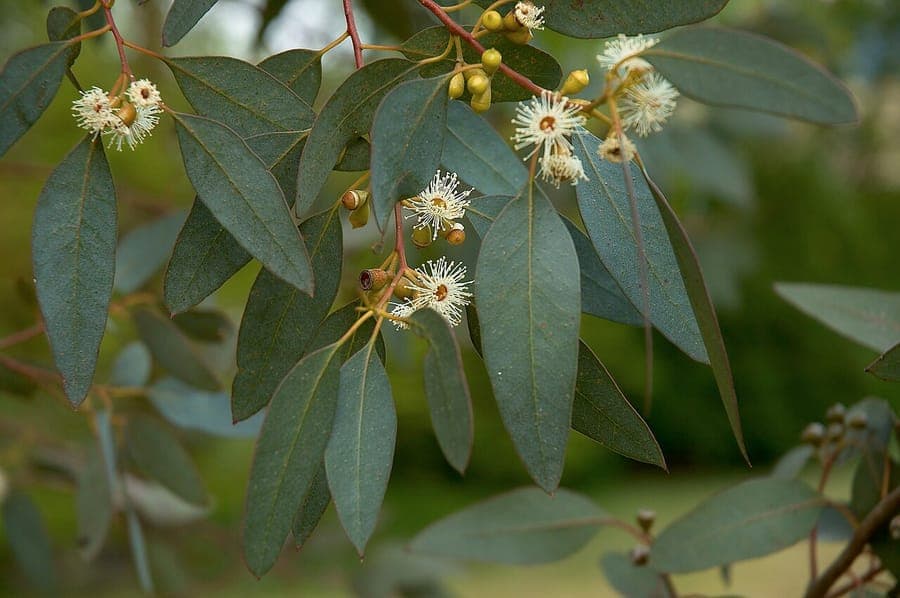
Eucalyptus gunnii displays three distinct foliage phases. Juvenile leaves are round, rigid, densely clustered, and possess a striking blue-silver waxy coating. Adult leaves are thinner, lance-shaped, and bright green. The bark is typically grey with pink or cream-colored flaking patches as it sheds.
Flowers are small white to cream-colored clusters appearing mainly in May-June. While not showy ornamentally, these flowers attract bees and support pollinator populations.
Fruit are characteristic woody seed capsules that provide architectural interest throughout the year.
Ideal location
Cider gum demands full sun with minimum 6-8 hours of direct sunlight daily. The tree tolerates wind well and can handle strong winds, though sheltered positions are preferred in youth.
The tree suits open gardens, large containers in youth, and windy locations. It excels in contemporary gardens where architectural forms are appreciated.
Soil
Eucalyptus gunnii is remarkably flexible with soil types. It tolerates acidic to neutral pH (5.5-7.5) and can grow in poor, sandy soil. However, excellent drainage prevents root rot.
In containers, use quality tree or seed compost mixed with sand or perlite for optimal drainage. Heavy clay must be amended with compost and sand.
Once established, the tree tolerates drought stress readily.
Watering
Cider gum is drought-tolerant once established, but requires regular watering during the first two years for strong root development. Water deeply but infrequently; allow soil to dry slightly between waterings.
In containers, water until moisture appears at drainage holes, then allow soil to dry partially. Overwatering is more damaging than underwatering.
Mature, established trees tolerate extended dry periods.
Free preview
Want to see Eucalyptus gunnii: complete guide in your garden? Make a free preview of your design.
Pruning
Pruning is crucial for maintaining shape and compactness. Young trees can be cut back hard (to 30-50 cm height) in early years to promote bushier forms. This pruning is best done in early spring.
Annual maintenance pruning keeps the tree compact and promotes vigorous blue-silver juvenile growth, which has greater ornamental value than adult green foliage.
Maintenance calendar
Spring (March-May): Primary growing season. Apply balanced tree fertilizer. Begin pruning work to define shape. Watering increases with rising temperatures.
Summer (June-August): Growth slows. Maintain regular watering during dry periods. No fertilizer needed. Flowering occurs.
Autumn (September-October): Growth slows further. Reduce watering. No feeding.
Winter (November-February): Tree is largely dormant. Minimal watering. Pruning cuts can be made for spring regeneration.
Winter hardiness
Eucalyptus gunnii is one of the most cold-resistant eucalyptus species, hardy to approximately -15degC (USDA zone 8). This makes it excellent for the Netherlands, Belgium, and northern France.
Young trees may suffer frost damage; protect in early winters with wrapping material. Established trees are very winter-hardy.
Companion plants
Cider gum's blue-silver foliage combines beautifully with dark-leaved plants and contrasting structures. Partner with dark bamboo, purple heuchera, or deep-blue conifers.
In contemporary gardens, use as a solo accent or group 2-3 trees for mass effects.
The tree combines well with Mediterranean shrubs and lavender.
Conclusion
Eucalyptus gunnii brings architectural interest and year-round color to any garden. This is a tree for lovers of unusual forms and textures. With regular pruning and proper siting, you'll cultivate a specimen tree offering visual reward in winter and summer.
Visit gardenworld.app for more structural plants and guidance on integrating trees into your garden design.
Pruning
Frequently asked questions about Eucalyptus gunnii
Is Eucalyptus gunnii winter hardy?
Eucalyptus gunnii is one of the most cold-resistant eucalyptus species, hardy to approximately -15degC (USDA zone 8). This makes it excellent for the Netherlands, Belgium, and northern France.
When and how do you prune Eucalyptus gunnii?
Pruning is crucial for maintaining shape and compactness. Young trees can be cut back hard (to 30-50 cm height) in early years to promote bushier forms.
How much water does Eucalyptus gunnii need?
Cider gum is drought-tolerant once established, but requires regular watering during the first two years for strong root development. Water deeply but infrequently; allow soil to dry slightly between waterings.
Where does Eucalyptus gunnii grow best?
Cider gum demands full sun with minimum 6-8 hours of direct sunlight daily. The tree tolerates wind well and can handle strong winds, though sheltered positions are preferred in youth.
What soil does Eucalyptus gunnii need?
Eucalyptus gunnii is remarkably flexible with soil types. It tolerates acidic to neutral pH (5.5-7.5) and can grow in poor, sandy soil.

See it in your garden
See Eucalyptus gunnii in your garden
One photo of your garden and a few questions. You see the result in about a minute.
Try it with a photoIdentify this plant in your own garden. Identify a plant
Similar plants
Feijoa (Acca sellowiana): growing pineapple guava
Acca sellowiana
The feijoa or pineapple guava (Acca sellowiana) is an evergreen shrub with red-tufted flowers and aromatic fruit. Site, hardiness, pollination and harvest explained.
Crimson bottlebrush (Callistemon citrinus): care and overwintering
Callistemon citrinus
Growing crimson bottlebrush (Callistemon citrinus, now Melaleuca citrina): position, compost, watering, pruning and overwintering this tough Australian shrub.
Weeping bottlebrush (Callistemon viminalis): care and 'Little John'
Callistemon viminalis
Weeping bottlebrush (Callistemon viminalis, now Melaleuca viminalis): growing it in containers, the dwarf 'Little John', pruning and frost-free overwintering.
