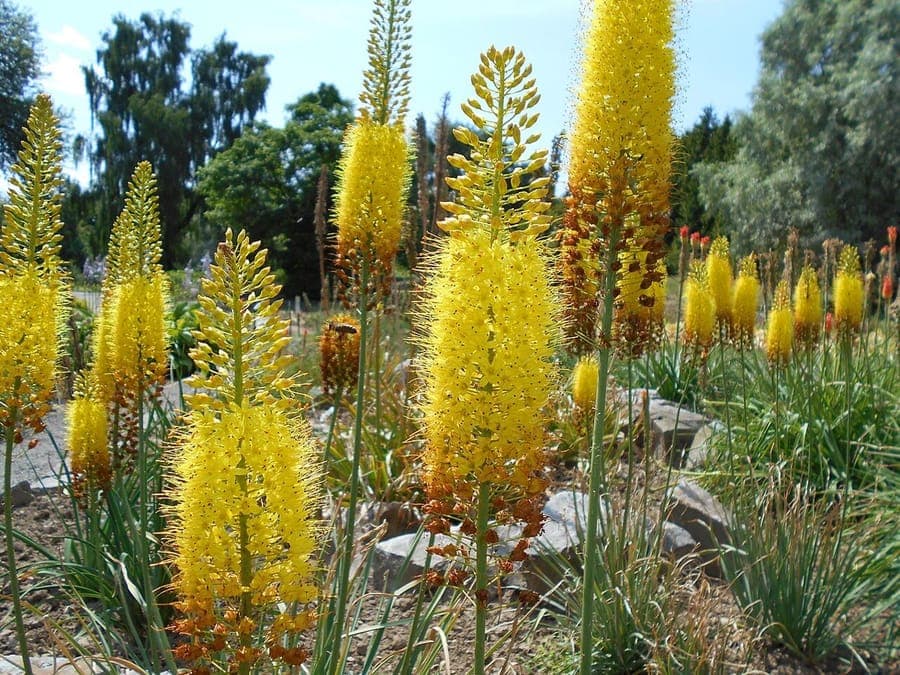
Salicyna / CC BY-SA 4.0, via Wikimedia Commons
Narrow-leaved foxtail lily (Eremurus stenophyllus): growing guide
Eremurus stenophyllus
Want to see Narrow-leaved foxtail lily (Eremurus stenophyllus): growing guide in your garden?
Full design in HD: €7.99
Look after your Narrow-leaved foxtail lily with the GardenWorld app
Identify plants with your camera and get a care calendar with reminders for this plant.


Overview
Eremurus stenophyllus is the yellow foxtail lily that sends up glowing spikes like candles above the border in early summer. In English it is often called the narrow-leaved foxtail lily, while foxtail lily and desert candle are used for the whole genus. You can recognise it by its slim leaves and its bright yellow flower spikes, which turn orange-brown from the bottom as they fade. The species name says it plainly: stenophyllus means "with narrow leaves". Older books and bulb catalogues sometimes still list it as Eremurus bungei.
The plant belongs to the Asphodelaceae family and grows wild on dry steppes and stony slopes in Iran, Afghanistan, Pakistan and the southern part of Central Asia. There, the rain falls mainly in winter and spring, while summers are hot and bone dry. That rhythm shapes everything you do with it in the garden: growth and flowering in spring and early summer, then a long rest in warm, dry soil.
A mature plant reaches 80 to 100 cm in height and about 40 cm across, which makes it one of the more compact species and perfectly usable in an ordinary town garden. It is one of the parents of the popular Shelford and Ruiter hybrids (Eremurus × isabellinus), sold in shades of orange, pink and apricot. If you want to see where such a strong vertical accent works best, you can have a garden design made on gardenworld.app that looks at the whole border at once.
Appearance and flowering season
In March the crown pushes up a tuft of narrow, grey-green leaves, 20 to 30 cm long, which partly lie on the soil and form a loose rosette. By early summer they begin to yellow, often while the plant is still in flower. That is entirely normal and not a sign of disease.
In June a bare, sturdy stem rises from the centre. The upper third to half is densely packed with hundreds of small starry flowers about 1 cm across, each with long protruding stamens. That gives the spike its fluffy, bottlebrush look. The flowers open from the bottom upwards. After a few days the lowest ones turn rusty orange and then brown, while the tip is still in bud or in clear yellow bloom. This two-toned spike, visible in the photo, is typical of the species. Flowering lasts three to four weeks, roughly from mid-June to mid-July.
Bees, bumblebees and hoverflies visit the flowers constantly. After flowering, round seed capsules form along the stem. As a cut flower it is spectacular: cut the stem when the bottom third has opened and the rest will carry on flowering in the vase.
Ideal position
Full sun is not a preference but a requirement. Choose the warmest spot in the garden, ideally facing south and away from tree shade. In a cool, partly shaded spot the plant stays small and stops flowering after a couple of years. The foot of a south-facing wall or the edge of a gravel garden is ideal.
Plant it where the soil is not watered every day in summer. Because the foliage disappears in July, it leaves a gap in the border, so place lower, late-flowering perennials in front of it to fill the space by August. In an exposed site the stems can snap in a summer gale, so a sheltered corner in full sun is better than an open field.
Soil requirements
Drainage matters above everything else. The fleshy roots spread like a starfish around a central bud and rot quickly in wet, heavy clay. Sandy soil, sandy loam and stony ground are perfect. On clay, dig coarse sand and fine gravel into the top 30 cm over at least half a square metre, or plant on a slightly raised bed.
A neutral to slightly alkaline soil (pH 6.5 to 7.5) suits it best. Moderate fertility is plenty: a handful of well-rotted compost at planting time is enough. Too much nitrogen produces long, soft stems that flop over.
Planting the crowns
Foxtail lilies are sold as dry crowns: a bud in the middle with ten to twenty fleshy roots fanning out like spokes, together around 15 to 25 cm wide. Those roots are brittle, so handle them gently.
Plant between mid-September and the end of October, while the soil is still warm. Dig a wide, shallow hole about 15 cm deep. Build a small mound of coarse sand or grit in the centre, set the crown on top and spread the roots out in every direction. Cover so that the bud sits 5 to 8 cm below the surface. On heavy ground, err on the shallow side. Space the plants 40 cm apart and group three or five together for a proper display.
Mark the spot with a cane. The plant is invisible from July to March, and anyone forking over the border or adding new perennials can easily damage the roots.
Free preview
Want to see Narrow-leaved foxtail lily (Eremurus stenophyllus): growing guide in your garden? Make a free preview of your design.
Watering
After planting, water once thoroughly so the soil settles around the roots. After that there is nothing to do in autumn and winter, as rain is more than enough. In a dry spring you can water occasionally in April and May, because that is when the leaves grow and the flower stem forms.
From July onwards, stop completely. Watering during the summer rest is the quickest way to rot the crown, so a rotating sprinkler over the border makes a poor neighbour.
Dealing with spent stems and foliage
If you want seed to ripen, leave the stem standing until the capsules turn brown. Seedlings need four to six years to flower, and on a dry, open site the species can sow itself around a little. If you would rather avoid that, cut the stem down to ground level after flowering.
Never cut the foliage while it is still green. It yellows naturally, and during those weeks the plant builds up its reserves for the following year. Only remove it once it is completely withered.
Dormancy
From July to March Eremurus stenophyllus rests entirely below ground. In its native range the soil bakes dry over summer, and it is precisely that warm, dry spell that allows the plant to form next year's flower buds. A wet summer is not a disaster in itself, provided the water drains away quickly.
During this period, do not spread a thick layer of bark or compost over the crown, as such a mulch holds moisture. A layer of gravel keeps the bud drier. Clumps that have become crowded can be lifted carefully and divided in late August or September, keeping at least one bud and a good set of roots on each piece.
Maintenance calendar
January to February: dormant. Keep wet leaves and soggy mulch off the planting spot.
March: shoots appear. Protect them from late frost with an upturned pot or fleece and watch out for slugs, which love the young tips.
April to May: leaves grow. Water only during prolonged drought. A small dose of potash-rich feed is enough.
June to July: flowering. Cut a few stems for the vase if you like.
July to August: the foliage dies back. Stop watering and tidy away the dead leaves.
September to October: plant new crowns and divide congested clumps. For a reminder at the right moment each year, add the foxtail lily to your plant calendar on gardenworld.app.
November to December: dormant. On cold, wet sites, lay some dry straw or conifer branches over the spot.
Winter hardiness
Eremurus stenophyllus is fully hardy. The RHS gives it its top rating of H6, meaning it tolerates frost down to roughly -20 °C. Cold is therefore no problem in Britain or the Low Countries. The real threats are waterlogged soil in winter and late frost on the young shoots in March. Frosted shoots can cost you that year's flowers, although the plant itself usually recovers.
Companion plants
The yellow spikes look superb with blue and violet. Grow them among lavender, Salvia nemorosa and Russian sage (Perovskia atriplicifolia), which fill the gap left by the vanished foliage later in summer. Flat sea holly (Eryngium planum) suits the steppe mood perfectly.
An ornamental grass such as Stipa gigantea adds lightness and echoes the same golden tones. Red hot pokers (Kniphofia uvaria) repeat the upright shape, as you can see in the background of the photo. Avoid dense ground cover that spreads over the crown and keeps the soil cool and damp.
Final thoughts
Eremurus stenophyllus asks for little work but for the right spot: full sun, soil that dries out quickly and a summer rest without a sprinkler. Respect those three things and you will get a row of golden candles every June that draws in bees and visitors alike. Plant in September, spread the roots over a mound of grit and mark the spot with a cane. After that, most of the year is simply a matter of waiting.
Frequently asked questions about Narrow-leaved foxtail lily
Is Narrow-leaved foxtail lily winter hardy?
Eremurus stenophyllus is fully hardy. The RHS gives it its top rating of H6, meaning it tolerates frost down to roughly -20 °C.
How much water does Narrow-leaved foxtail lily need?
After planting, water once thoroughly so the soil settles around the roots. After that there is nothing to do in autumn and winter, as rain is more than enough.
What soil does Narrow-leaved foxtail lily need?
Drainage matters above everything else. The fleshy roots spread like a starfish around a central bud and rot quickly in wet, heavy clay.

See it in your garden
See Narrow-leaved foxtail lily in your garden
One photo of your garden and a few questions. You see the result in about a minute.
Try it with a photoIdentify this plant in your own garden. Identify a plant
Similar plants
Stipa gigantea: complete guide
Stipa gigantea
Giant feather-grass is a striking ornamental grass with feathery seed heads and golden shimmer. Learn how to grow this monumental grass successfully in your garden design.
Perovskia atriplicifolia: complete guide
Perovskia atriplicifolia
Russian sage is a semi-shrub with purple-blue flowers and grey-green foliage that blooms from July to October. Perfect for dry gardens and landscape design.
Woodland sage: complete guide
Salvia nemorosa
Everything about Woodland Sage (Salvia nemorosa): planting, care, pruning and combinations. Expert tips for months of blue-violet flower spikes.
