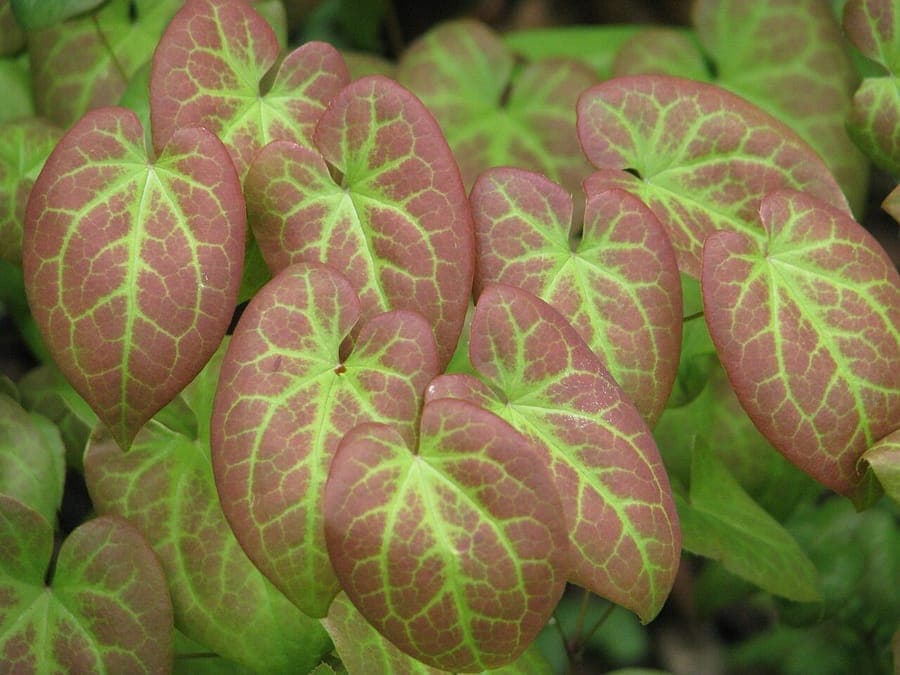
peganum from Small Dole, England / CC BY-SA 2.0, via Wikimedia Commons
Barrenwort (Epimedium × versicolor): guide
Epimedium × versicolor
Want to see Barrenwort (Epimedium × versicolor): guide in your garden?
Full design in HD: €7.99
Look after your Barrenwort with the GardenWorld app
Identify plants with your camera and get a care calendar with reminders for this plant.


Overview
Barrenwort, Epimedium × versicolor, is one of the most widely planted ground covers for shade in European gardens, and for good reason. It tolerates dry soil beneath trees, smothers weeds with a dense canopy of leaves, flowers gracefully in spring and stays green through mild winters. Few plants combine so much toughness with so much refinement.
Epimedium × versicolor is a hybrid between the Japanese Epimedium grandiflorum and Epimedium pinnatum subsp. colchicum from the Caucasus. It arose around 1850 in Belgium, among the horticulturists of Ghent. Several forms exist, but by far the best known is 'Sulphureum', with soft yellow flowers. You may also come across 'Versicolor', with pink and yellow flowers, and 'Cupreum', with coppery tones.
The plant belongs to the barberry family (Berberidaceae), which you might not expect of such a delicate-looking perennial. It forms creeping rhizomes from which new leaves and flower stems rise each year. On gardenworld.app you can have a garden design made in which barrenwort turns the awkward, dry strip beneath your trees or hedge into a neat green carpet.
Appearance and bloom cycle
Barrenwort grows 25 to 35 cm tall and slowly spreads into clumps 40 to 60 cm wide, eventually knitting into a continuous mat. Each leaf is made up of several heart-shaped leaflets 5 to 8 cm long on wiry but sturdy stalks. In spring the young foliage is beautifully coloured: reddish brown with bright green veins, as in the photo. In summer it turns a uniform glossy green, and in autumn and winter it takes on bronze to russet tones again.
Flowering comes in April and May. Above or just among the young leaves, airy sprays of ten to twenty flowers about 2 cm across appear. In 'Sulphureum' they are soft yellow with short yellow spurs, a shape reminiscent of a bishop's mitre, which explains another common name, bishop's hat. The flowers are elegant but modest and deserve a spot where you can see them close up, such as beside a path.
Little is known about toxicity. There are no reports of poisoning in people or pets, but the plant contains active compounds and is not edible, so discourage pets from chewing it. Barrenwort is not invasive in Europe: it spreads slowly and hardly self-seeds.
Ideal location
Epimedium × versicolor grows best in partial to full shade. It is completely at home beneath deciduous trees and shrubs: in spring it gets the light it needs to flower, in summer protection from the sun. The north side of a house or wall suits it well too. Full sun is tolerated in moist soil, but the leaves become paler and the edges may scorch.
Its great asset is that 'Sulphureum', once established, tolerates dry shade, a situation where most plants give up. Think of the base of a beech or a hedge, or the strip beneath a large conifer. Plant 30 to 40 cm apart, or allow six to nine plants per m² for complete cover within two to three years.
Barrenwort also does well in a pot or trough, for instance on a shady patio or a north-facing balcony. Choose a container at least 30 cm wide and deep so the rhizomes have room, and fill it with potting compost mixed with some leaf mould. Repot or divide every three years, otherwise the container fills with roots.
Soil requirements
Barrenwort is not fussy. A humus-rich, free-draining soil is ideal, but it also grows on sand, loam and even light clay, as long as the ground does not become waterlogged in winter. The pH can range from slightly acidic to slightly alkaline, roughly 5.5 to 7.5.
When planting, work some compost or leaf mould into the soil, especially under trees, where the ground is often poor and exhausted. A leaf mould mulch helps young plants root. Feeding is hardly necessary: a thin layer of compost in March, just after cutting back the old foliage, is enough.
Free preview
Want to see Barrenwort (Epimedium × versicolor): guide in your garden? Make a free preview of your design.
Watering
In its first year barrenwort needs regular watering to develop its rhizomes. In dry weather give around 3 to 5 litres per plant each week, especially in the spring and summer after planting. Under trees, be a little more generous, because the tree roots compete for moisture.
After that the plant becomes remarkably drought tolerant. Established clumps can get through a dry summer; at most you will see brown leaf edges during long heatwaves. An occasional deep watering at those times keeps the foliage looking good. Plants in pots and troughs do need regular watering.
Pruning
The main pruning job is simple and rewarding. In February or early March cut all the old foliage down to the ground before the new flower stems emerge. That way the flowers and the colourful young leaves are on full display rather than hidden beneath tatty winter foliage. Leave it too late and you risk cutting off the emerging flower buds as well. On large areas, hedge shears make quick work of it.
Nothing else is needed. To propagate, lift pieces of rhizome with a few buds each in early spring or September and replant them at once. Pests and diseases are rare; vine weevil adults may occasionally notch the leaves.
Maintenance calendar
February-March: Cut old foliage to the ground before the flower stems appear. Scatter a thin layer of compost.
April-May: Flowering time and emergence of the bronze-red young leaves. A good time to plant.
June-August: Leaves turn green and close over the soil. Water young plants in dry spells.
September: An ideal time to divide or plant; new plants root before winter.
October-November: Leave fallen tree leaves between the plants. The foliage turns bronze.
December-January: Dormant period. Leaves persist through mild winters.
For an overview of what you can do in your garden each month, the planting calendar on gardenworld.app is a handy guide.
Winter hardiness
Epimedium × versicolor is reliably hardy to about -25 °C (USDA zone 5). In Britain and the Low Countries it needs no protection. In mild winters the leaves remain green to bronze; in severe frost they wither, but that does not matter since you cut them back in February anyway.
Late frost in April can damage young leaves and flowers. A sheltered spot under trees usually softens the blow. In containers, give the plant a protected position against a wall.
Companion plants
Barrenwort forms a calm base layer through which other shade plants can rise. Lenten roses (Helleborus orientalis) flower in February and March, just before the barrenwort; their large blooms above the fine yellow carpet make a lovely pairing. Lungwort (Pulmonaria saccharata), with silver-spotted leaves and blue and pink flowers, blooms at the same time and fits perfectly.
Bulbs make ideal partners: snowdrops (Galanthus nivalis) and daffodils (Narcissus pseudonarcissus) push up through the carpet, while the barrenwort foliage later hides the dying bulb leaves. For height and structure, add ferns such as the male fern (Dryopteris filix-mas). Hostas, Solomon's seal and Siberian bugloss are also at home in the same company.
Final thoughts
Epimedium × versicolor is the answer to the most difficult spots in the garden: dry, shady ground beneath trees and hedges. It is hardy, tough, nearly evergreen and flowers gracefully in spring with soft yellow blooms. Cut away the old leaves every February, give it some water in its first year, and it will form a tidy carpet that lasts for many years.
Frequently asked questions about Barrenwort
Is Barrenwort winter hardy?
Epimedium × versicolor is reliably hardy to about -25 °C (USDA zone 5). In Britain and the Low Countries it needs no protection.
When and how do you prune Barrenwort?
The main pruning job is simple and rewarding. In February or early March cut all the old foliage down to the ground before the new flower stems emerge.
How much water does Barrenwort need?
In its first year barrenwort needs regular watering to develop its rhizomes. In dry weather give around 3 to 5 litres per plant each week, especially in the spring and summer after planting.
Where does Barrenwort grow best?
Epimedium × versicolor grows best in partial to full shade. It is completely at home beneath deciduous trees and shrubs: in spring it gets the light it needs to flower, in summer protection from the sun.
What soil does Barrenwort need?
Barrenwort is not fussy. A humus-rich, free-draining soil is ideal, but it also grows on sand, loam and even light clay, as long as the ground does not become waterlogged in winter.

See it in your garden
See Barrenwort in your garden
One photo of your garden and a few questions. You see the result in about a minute.
Try it with a photoIdentify this plant in your own garden. Identify a plant
Similar plants
Lenten-rose: complete guide
Helleborus orientalis
Learn how to grow and care for Helleborus orientalis. This early-blooming perennial thrives in shady spots and flowers from February to April, adding colour when little else is blooming.
Bethlehem lungwort: complete guide
Pulmonaria saccharata
Learn how to grow and care for Pulmonaria saccharata: ideal conditions, watering, pruning, and companion planting for a thriving shade garden.
Male fern: complete guide
Dryopteris filix-mas
Learn how to grow Male fern (Dryopteris filix-mas) successfully: care, soil, watering, and ideal companion plants for lush green woodland gardens.
