Peter coxhead / CC BY-SA 3.0, via Wikimedia Commons
Red barrenwort (Epimedium × rubrum): guide
Epimedium × rubrum
Want to see Red barrenwort (Epimedium × rubrum): guide in your garden?
Full design in HD: €7.99
Look after your Red barrenwort with the GardenWorld app
Identify plants with your camera and get a care calendar with reminders for this plant.


Overview
Red barrenwort, Epimedium × rubrum, is a stalwart of the shade border. In April and May it is covered in crimson flowers with pale yellow centres that seem to float on hair-thin stems. Afterwards it forms a dense, fresh carpet of heart-shaped leaves that covers the soil and keeps weeds down. In autumn that foliage turns a beautiful red and bronze.
Epimedium × rubrum is a hybrid between the alpine barrenwort (Epimedium alpinum) from southern Europe and the Japanese Epimedium grandiflorum. It arose in Europe in the nineteenth century and quickly became popular in English and German gardens. From the alpine barrenwort it inherited its toughness and reddish flower colour; from Epimedium grandiflorum, its larger, more elegant flowers.
Barrenworts belong to the barberry family (Berberidaceae). They grow from underground rhizomes and spread slowly without becoming invasive. On gardenworld.app you can have a garden design made in which red barrenwort joins ferns, hostas and spring flowers to fill a shade border that stays interesting all year.
Appearance and bloom cycle
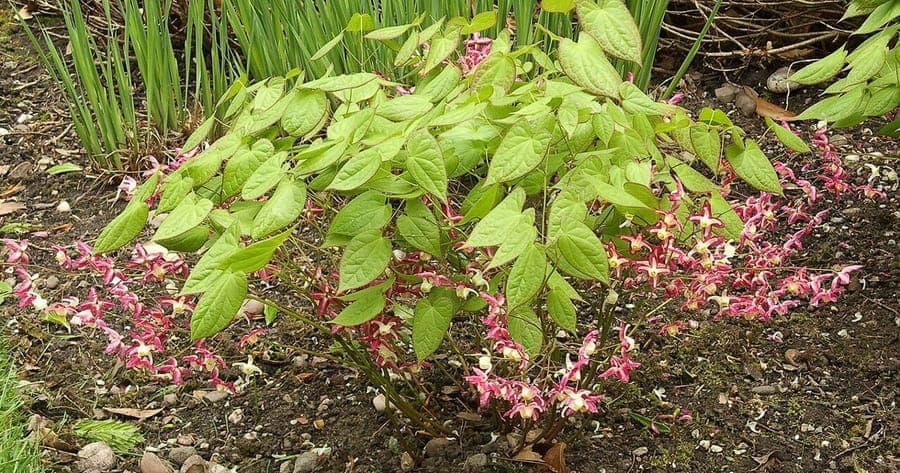
Red barrenwort grows 25 to 30 cm tall and 30 to 45 cm wide. After a few years the clumps knit together into a continuous mat. Each leaf is made up of heart-shaped, finely toothed leaflets 5 to 8 cm long on sturdy, wiry stalks. Young leaves are pale green with a red flush or red edges, as you can see in the photo. In summer they turn plain green, and in autumn they colour a striking red to bronze-red. In mild winters some foliage persists; in hard winters it dies back.
Flowering takes place in April and May, often just before or as the leaves unfold. Loose sprays carry ten to twenty flowers about 2 cm across. The outer sepals are crimson to wine red, the petals and short spurs pale yellow to cream. The result is a delicate two-tone effect that is best enjoyed close up. The photo shows the flower sprays fanning out over the soil beneath and beside the leaves.
There are no reports of barrenwort poisoning in people or pets, but the plant contains active compounds and is not edible, so it is best to keep chewing pets away. Red barrenwort is not invasive anywhere in Europe: it spreads slowly and sets little seed.
Ideal location
Epimedium × rubrum grows best in partial or light shade, for example under deciduous trees or on the east or north side of a building. In spring, before the trees leaf up, it receives enough light to flower freely; in summer the canopy blocks strong sun. Morning sun is fine, but full afternoon sun bleaches and dries the leaves.
Compared with the yellow barrenwort (Epimedium × versicolor 'Sulphureum'), red barrenwort is a little less suited to bone-dry shade. A spot with some more moisture, such as a border with humus-rich soil under a light tree canopy, suits it better. Plant 30 cm apart, or allow eight to ten plants per m² if you want a carpet quickly.
It is also a fine addition to a pot or trough at least 30 cm wide, especially on a shady patio where you can admire the little flowers up close.
Soil requirements
Red barrenwort likes a loose, humus-rich, free-draining soil that does not dry out. Loam and humus-rich sand are ideal; improve heavy clay with leaf mould and compost. It dislikes waterlogged roots in winter. The pH can be slightly acidic to neutral, roughly 5.5 to 7.5.
When planting, work some leaf mould or compost into the soil, then cover it with a 3 to 5 cm mulch of leaf mould or fine bark. This imitates the leaf litter of a woodland floor. Feeding is hardly needed. A thin layer of compost in March, after cutting back the old leaves, is enough.
Free preview
Want to see Red barrenwort (Epimedium × rubrum): guide in your garden? Make a free preview of your design.
Watering
In its first year after planting, red barrenwort needs regular watering. In dry weather give 3 to 5 litres per plant each week until the rhizomes are well established. Under trees, give a little more, as tree roots take a lot of water.
Established plants cope with a short dry spell, but in prolonged drought the leaf edges develop brown patches and the foliage may wither early. In such summers, water deeply now and then, preferably in the morning at the base of the plant. Check pots every two or three days in warm weather.
Pruning
The main job is cutting away the old foliage at the end of winter. Do it in February, or early March at the latest, before the flower stems emerge. That way the red flowers stand clear instead of being hidden by tatty winter leaves. Leave it too late and you will inevitably snip off flower buds too.
Beyond that there is little to do. For more plants, lift a piece of rhizome with a few buds in early spring or September and replant it at once. Pests and diseases are uncommon. Adult vine weevils sometimes notch the leaf edges, but this is usually only cosmetic.
Maintenance calendar
February-March: Cut old leaves to the ground before the flower stems appear. Scatter a thin layer of compost.
April-May: Flowering time. Young leaves unfold with a red flush. A good time to plant.
June-August: Leaves turn green and close over the soil. Water during long dry spells.
September: Ideal for dividing or planting.
October-November: Leaves colour red and bronze. Leave fallen tree leaves between the plants as a natural mulch.
December-January: Dormant period. Some foliage persists in mild winters.
For an overview of what you can do in your garden each month, the planting calendar on gardenworld.app is a handy guide.
Winter hardiness
Epimedium × rubrum is reliably hardy, tolerating temperatures down to about -25 °C or lower (USDA zone 5, and zone 4 according to many sources). In Britain and the Low Countries it needs no winter protection. In hard frost the leaves die back, but the rhizomes simply reshoot in spring.
Late frost in April can damage young flowers and leaves. A spot under trees or shrubs usually provides enough shelter. Move potted plants against a wall in winter so the root ball does not freeze solid.
Companion plants
The fine carpet of red flowers looks best beside plants with larger leaves or a different flower colour. Siberian bugloss (Brunnera macrophylla) blooms at the same time with sky-blue flowers and makes a lively spring pairing with red barrenwort. Bleeding heart (Lamprocapnos spectabilis) adds pink, heart-shaped flowers above the barrenwort in May.
For structure and evergreen foliage, the soft shield fern (Polystichum setiferum) is an excellent choice. Bigroot cranesbill (Geranium macrorrhizum) fills the edges as a second ground cover and flowers later in the season. Beneath a Japanese maple (Acer palmatum), red barrenwort makes superb underplanting: its reddish autumn foliage echoes the maple's own autumn colour. Hostas, snowdrops and small daffodils also suit this shade border.
Final thoughts
Epimedium × rubrum is a graceful, tough perennial that brightens the shade garden in spring with hundreds of small red and yellow flowers. It then keeps the soil covered with fresh foliage that turns red in autumn. Give it partial shade and a humus-rich soil that does not dry out, and cut away the old leaves every February. That is all it needs to stay beautiful for many years.
Frequently asked questions about Red barrenwort
Is Red barrenwort winter hardy?
Epimedium × rubrum is reliably hardy, tolerating temperatures down to about -25 °C or lower (USDA zone 5, and zone 4 according to many sources). In Britain and the Low Countries it needs no winter protection.
When and how do you prune Red barrenwort?
The main job is cutting away the old foliage at the end of winter. Do it in February, or early March at the latest, before the flower stems emerge.
How much water does Red barrenwort need?
In its first year after planting, red barrenwort needs regular watering. In dry weather give 3 to 5 litres per plant each week until the rhizomes are well established.
Where does Red barrenwort grow best?
Epimedium × rubrum grows best in partial or light shade, for example under deciduous trees or on the east or north side of a building. In spring, before the trees leaf up, it receives enough light to flower freely; in summer the canopy blocks strong sun.
What soil does Red barrenwort need?
Red barrenwort likes a loose, humus-rich, free-draining soil that does not dry out. Loam and humus-rich sand are ideal; improve heavy clay with leaf mould and compost.

See it in your garden
See Red barrenwort in your garden
One photo of your garden and a few questions. You see the result in about a minute.
Try it with a photoIdentify this plant in your own garden. Identify a plant
Similar plants
Great forget-me-not: complete guide
Brunnera macrophylla
Brunnera macrophylla, also known as Great forget-me-not, is a shade-loving perennial with heart-shaped leaves and spring blue flowers. Learn care, soil and planting tips.
Soft shield-fern: complete guide
Polystichum setiferum
How to grow and care for Polystichum setiferum in your garden. Ideal for shady borders, with soft, arching fronds and year-round interest.
Rock crane's-bill: complete guide
Geranium macrorrhizum
Rock crane's-bill (Geranium macrorrhizum) is a tough groundcover thriving in sun or partial shade. Great for rock gardens and dry spots. Grows 20-30 cm tall.
