
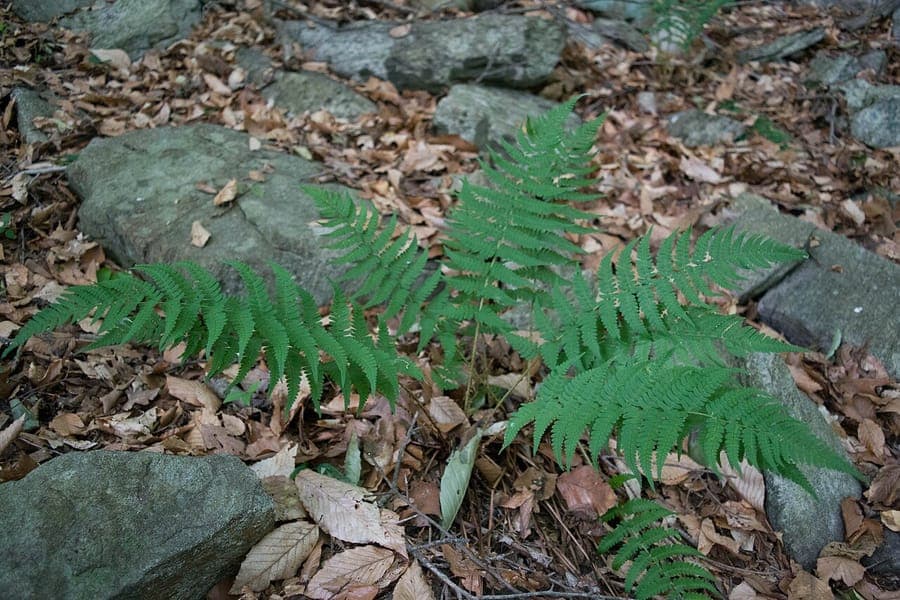
Wasp32 / CC BY 4.0, via Wikimedia Commons
Marginal fern: complete guide
Dryopteris marginalis
Want to see Marginal fern: complete guide in your garden?
1 minute, no credit card
Overview
The Marginal fern (Dryopteris marginalis), also known as leather wood fern, is a North American forest fern ideally suited to shaded borders. This elegant, evergreen fern reaches 40-70 cm in height and forms a very refined, symmetrical frond arrangement that persists throughout the year. The plant derives its name from the position of the sori (spore clusters) positioned along the frond margins.
On gardenworld.app you can create a garden design where marginal fern forms the foundation of shade borders. This is a plant for gardeners who wish to create genuine woodland flora. The fern grows slowly, asks very little maintenance, and provides structural interest in shade where most other plants fail.
Appearance and form
The Marginal fern distinguishes itself through very fine, doubly-divided fronds (bi-pinnate) that feel substantial and are evergreen. The fronds are dark green in colour, very elegant in form, and grow in a symmetrical pattern that is exceptionally refined. The plant forms dense, rounded clumps.
Ferns do not flower, but instead produce spores. In Marginal fern, the sori are visible on the undersides of the frond lobes - they lie precisely along the margin, forming elegant geometric patterns. These sori are an important identifying feature.
Ideal location
Marginal fern thrives best in deep shade to partial shade with adequate moisture. This is a plant for woodlands, deciduous shade beneath larger trees, and moist, shady corners. In full sun the plant struggles, as does in completely dry shade.
The plant naturally grows in Eastern North American mountain forests, so seek similar conditions - deciduous shade with sufficient moisture availability. Space plants 30-40 cm apart.
Soil requirements
Marginal fern demands humus-rich, well-draining soil with good moisture retention. The ideal soil is acidic to neutral (pH 5.5-7.0), nourishing but not overfed. Work abundant leaf mould into the planting hole and mulch heavily with leaf compost.
This is crucial: marginal fern will not thrive on poor, dry clay. It feels at home where autumn leaves naturally remain and decompose into nourishing humus.
Free design
Want to see Marginal fern: complete guide in your garden? Make a free design now.
Watering
Marginal fern is, despite its evergreen appearance, moisture-loving. Once established, the plant needs regular water during dry periods. Give at least weekly water if it does not rain.
In European climates with regular rainfall the plant feels at home. During dry summers you must water regularly. The plant accepts moister soil better than drier.
Pruning
Marginal fern requires virtually no pruning. In spring (March) you can remove faded fronds. However, this is optional as many gardeners prefer to let the natural loss of old fronds happen organically.
Damaged fronds can be removed throughout the year.
Maintenance calendar
March: Remove damaged or faded fronds from the previous season.
April-May: New growth appears. Check moisture availability.
June-August: Plant grows slowly. Continue watering.
September-October: Spore ripening. Plant may self-sow.
November-February: Winter dormancy. Plant remains mostly green.
Winter hardiness
Marginal fern is very hardy (USDA zones 3-8) and tolerates temperatures down to -35 degrees Celsius. This is a fully hardy species. The plant is evergreen, so foliage persists throughout the year.
Companion plants
Marginal fern combines beautifully with other shade-loving plants. Partner with Hosta for foliage contrast, Pulmonaria for colour, and Hepatica for spring interest. In groundcover combinations work well with ivy (Hedera) and small shade-lovers like Vinca.
Closing
Marginal fern is a classic woodland fern that deserves far wider use. Plant in groups of three to five for stronger effect. On gardenworld.app you can design shade borders where marginal fern serves as the structural backbone. This is a plant that persists reliably for years with minimal maintenance.
Want to see Marginal fern: complete guide in your garden? Make a free design now.
Upload a photo, pick a style, and get a photorealistic design with plant list in under a minute.
No credit card required


Similar plants
Male fern: complete guide
Dryopteris filix-mas
Learn how to grow Male fern (Dryopteris filix-mas) successfully: care, soil, watering, and ideal companion plants for lush green woodland gardens.
Hard shield-fern: complete guide
Polystichum aculeatum
Discover how to grow Polystichum aculeatum successfully in your garden. Learn about shade tolerance, soil needs, watering, and seasonal care tips.
Hart's-tongue fern: complete guide
Asplenium scolopendrium
Learn how to grow Asplenium scolopendrium successfully in your garden. Ideal location, soil, watering needs, and care tips for this elegant evergreen fern.