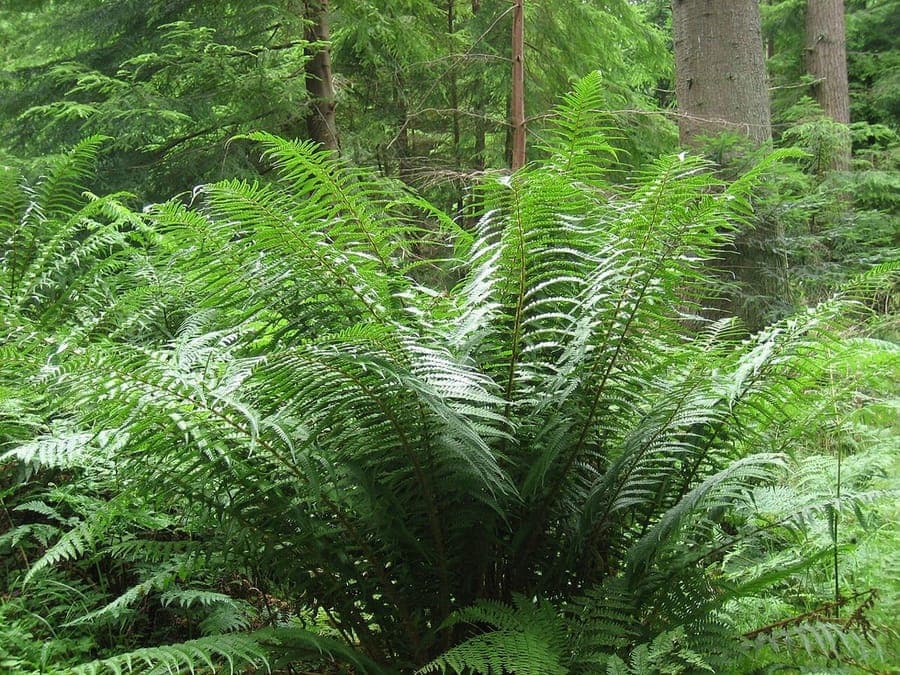
MPF / CC BY 2.5, via Wikimedia Commons
Golden-scaled male fern: complete guide
Dryopteris affinis
Want to see Golden-scaled male fern: complete guide in your garden?
Full design in HD: €7.99
Look after your Golden-scaled male fern with the GardenWorld app
Identify plants with your camera and get a care calendar with reminders for this plant.


Overview
The golden-scaled male fern (Dryopteris affinis) is one of the most handsome and dependable ferns you can grow in a shady garden. It is a native of western and central Europe, at home in the damp oak woods of Ireland, Wales and Scotland as much as in the valleys of the Ardennes and the Black Forest. In Britain it is common in woodland, along shaded stream banks and on north-facing hedgebanks, so it settles into gardens with remarkably little fuss.
At first glance Dryopteris affinis looks much like the common male fern (Dryopteris filix-mas). The differences are in the detail: the stalks and midribs are densely clothed in golden-brown to russet scales, the fronds are slightly firmer and glossier, and the plant keeps its green fronds far longer into winter. As a result it looks fresh and tidy from April until well past Christmas.
A mature plant reaches 60 to 120 cm in height and 60 to 90 cm across, occasionally more in a sheltered, moist spot. The fronds rise from a single central crown in a graceful shuttlecock, and the plant does not spread by runners. That makes it ideal as a focal point in a shady border or as a repeating element along a woodland path. If you would like to see where a fern like this fits best, you can have a garden design made on gardenworld.app that takes your shade, soil and existing plants into account.
Several garden forms are widely available. 'Cristata', often sold as 'Cristata The King', has fronds with forked, crested tips and a beautifully arching habit. 'Crispa Gracilis' is a dwarf of around 30 cm with crinkled foliage, perfect for small gardens or a shady rockery, while 'Pinderi' has strikingly narrow, upright fronds.
Appearance and foliage
Ferns do not flower; they reproduce by spores, so all the ornamental value lies in the foliage, and here this species excels. In April and May the young fronds unfurl as tight croziers. They are a vivid yellow-green and thickly covered in golden scales, which can look almost metallic in low spring sunshine.
A mature frond is lance-shaped and pinnate to nearly bipinnate, with numerous segments that look squarely cut off at the tip, as if trimmed with scissors. A useful identification feature sits on the underside: where each side leaflet joins the midrib there is a small dark, almost black spot. The colour is a deep, slightly glossy green.
From July, rounded clusters of spore cases appear on the undersides, each protected by a kidney-shaped flap. In August and September they turn brown and release their spores. In autumn the foliage does not colour like that of deciduous trees; it simply stays green. Only in harder frosts do the fronds bend over and gradually brown, and in mild winters they often stand upright until February.
Ideal location
Dryopteris affinis is happiest in partial to full shade. A spot under tall trees, on the north or east side of a house or between shrubs is perfect. It tolerates gentle morning sun well and, on moist soil, can cope with more light than many ferns. Fierce afternoon sun on a dry site, however, leads to scorched, pale fronds.
Space plants 60 to 80 cm from other large perennials so the shuttlecock has room to develop. A group of three or five creates a calm, natural effect in a woodland garden. It also does well in a large, deep container on a shaded patio, provided the compost never dries out.
Soil requirements
Like most woodland ferns, this species loves loose, humus-rich soil that holds moisture without becoming waterlogged. A slightly acidic to neutral soil (pH roughly 5 to 7) suits it best. On sandy ground, work a generous amount of leaf mould or well-rotted garden compost into the top 20 to 30 cm when planting. On heavy clay the same organic matter opens up the structure and prevents standing water.
Plant the crown so that its centre sits at soil level, never deeper. A few centimetres of leaf mould or fine bark mulch around the plant keeps the roots cool and moist and imitates the leaf litter of a woodland floor. Leave fallen leaves under the fern in autumn; they break down into exactly the kind of humus it enjoys.
Free preview
Want to see Golden-scaled male fern: complete guide in your garden? Make a free preview of your design.
Watering
Regular watering matters in the first year after planting. In dry spells, give a full can of water once or twice a week so the soil is moist down to root level.
Once established, Dryopteris affinis is surprisingly tolerant. It copes with short dry periods in shade better than many ferns, which makes it a good choice for the awkward dry shade beneath trees, as long as you enrich the soil with organic matter. During long heatwaves, though, give extra water or the frond edges will crisp. Container plants often need watering every two or three days in summer. Water in the morning where possible and aim at the soil rather than into the crown.
Pruning
You do not prune a fern like a shrub, but an annual tidy keeps it looking its best. Because the fronds stay green for so long, leave them in place over winter. They protect the crown against frost and look elegant in the winter garden.
In late February or early March, before the new fronds unfurl, cut the old fronds off just above the ground. Do not leave it too late: once the young croziers are poised in the centre, it is easy to damage them with the secateurs. Work from the outside in and keep your hand between the blades and the crown.
Maintenance calendar
January-February: Leave the evergreen fronds standing. After heavy snow, gently shake it off to prevent the fronds snapping.
March: Cut back old fronds before the new ones emerge. Spread a thin layer of leaf mould around the crown.
April-May: The golden-scaled croziers unfurl. An ideal time to plant or to divide large, multi-crowned clumps.
June-August: Water during dry spells, especially young plants and those in containers. Spore clusters appear on the undersides of the fronds.
September-October: A good planting window while the soil is still warm. Leave fallen leaves around the fern as a natural mulch.
November-December: Dormant season. The fronds usually stay green and give structure to the winter garden.
If you like to see at a glance when each plant needs attention, the planting calendar on gardenworld.app gives a month-by-month overview of pruning, planting and routine care.
Winter hardiness
The golden-scaled male fern is fully hardy across Britain and the rest of north-west Europe. It withstands temperatures down to about -25 °C, roughly USDA zones 4 to 5, so it needs no protection even in cold upland gardens.
In prolonged frost the fronds brown and collapse, but the crown survives without trouble and sprouts again in spring. Containers are a different story, as the root ball can freeze solid. Move pots against a wall in winter and wrap them in hessian or bubble wrap if necessary.
A word on safety: like the common male fern, Dryopteris affinis contains compounds in its rhizome and fronds (phloroglucinol derivatives) that are toxic if eaten. Male fern was once used to expel tapeworms, sometimes with serious poisoning as a result. Never eat any part of the plant, including the young croziers, and keep children and pet rabbits or guinea pigs from nibbling it. Dogs and cats generally ignore ferns, but poisoning from related ferns has been recorded in grazing animals such as horses and sheep.
Companion plants
This fern makes a superb backbone for a shady border. Its finely cut, upright fronds contrast beautifully with plants that have large, flat leaves. Hostas such as Hosta sieboldiana, with its blue-grey foliage, are a classic partner. The Lenten rose (Helleborus orientalis) flowers in February and March, just when you cut away the old fern fronds, adding colour at the moment the fern is briefly bare.
For spring and summer flowers, choose Siberian bugloss (Brunnera macrophylla), Solomon's seal (Polygonatum multiflorum) or foxglove (Digitalis purpurea), whose tall spires rise above the ferns in a woodland setting. Bear in mind that foxglove is itself highly poisonous, so plant it with care where small children play. Japanese forest grass (Hakonechloa macra) and low ground cover such as barrenwort (Epimedium) complete the picture.
Final thoughts
Dryopteris affinis is a fern for gardeners who want plenty of structure for very little work. It is native, fully hardy, stays green for most of the year and, with its golden scales in spring, is a genuine eye-catcher. Humus-rich soil, a spot in partial shade and one tidy-up a year are all it asks. Plant it in a group under trees or as a single specimen beside a shaded bench, and you will enjoy a calm green presence that looks a little different in every season.
Frequently asked questions about Golden-scaled male fern
Is Golden-scaled male fern winter hardy?
The golden-scaled male fern is fully hardy across Britain and the rest of north-west Europe. It withstands temperatures down to about -25 °C, roughly USDA zones 4 to 5, so it needs no protection even in cold upland gardens.
When and how do you prune Golden-scaled male fern?
You do not prune a fern like a shrub, but an annual tidy keeps it looking its best. Because the fronds stay green for so long, leave them in place over winter.
How much water does Golden-scaled male fern need?
Regular watering matters in the first year after planting. In dry spells, give a full can of water once or twice a week so the soil is moist down to root level.
Where does Golden-scaled male fern grow best?
Dryopteris affinis is happiest in partial to full shade. A spot under tall trees, on the north or east side of a house or between shrubs is perfect.
What soil does Golden-scaled male fern need?
Like most woodland ferns, this species loves loose, humus-rich soil that holds moisture without becoming waterlogged. A slightly acidic to neutral soil (pH roughly 5 to 7) suits it best.

See it in your garden
See Golden-scaled male fern in your garden
One photo of your garden and a few questions. You see the result in about a minute.
Try it with a photoIdentify this plant in your own garden. Identify a plant
Similar plants
Hosta sieboldiana: complete guide
Hosta sieboldiana
Hosta sieboldiana growing guide: large blue-green shade plant from Japan. Complete care tips, placement and maintenance for shady gardens and woodland areas.
Lenten-rose: complete guide
Helleborus orientalis
Learn how to grow and care for Helleborus orientalis. This early-blooming perennial thrives in shady spots and flowers from February to April, adding colour when little else is blooming.
Great forget-me-not: complete guide
Brunnera macrophylla
Brunnera macrophylla, also known as Great forget-me-not, is a shade-loving perennial with heart-shaped leaves and spring blue flowers. Learn care, soil and planting tips.
