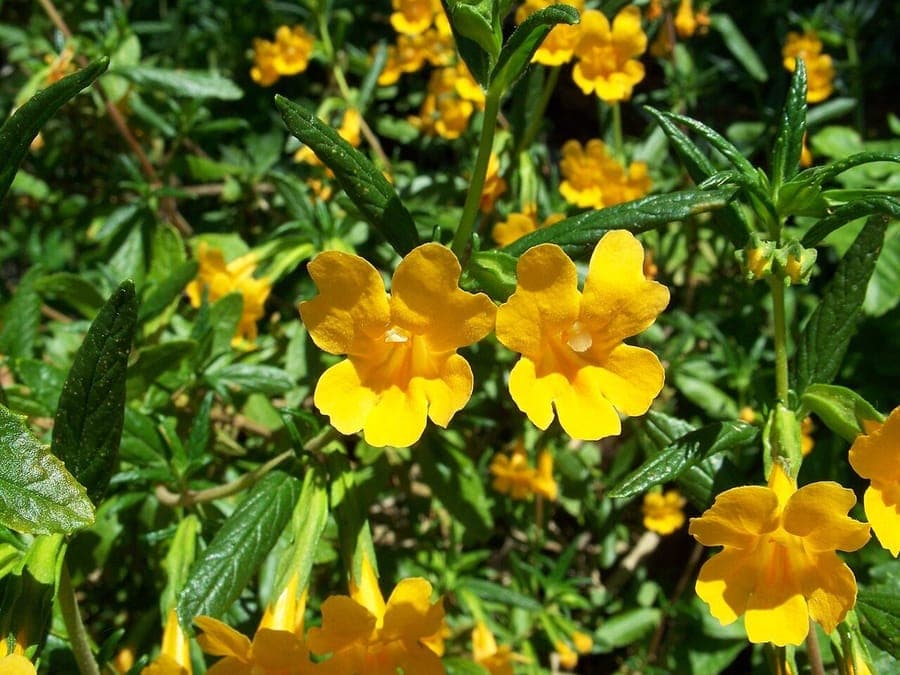
Eugene Zelenko / CC BY-SA 4.0, via Wikimedia Commons
Sticky monkeyflower: complete guide to Diplacus aurantiacus
Diplacus aurantiacus
Want to see Sticky monkeyflower: complete guide to Diplacus aurantiacus in your garden?
Full design in HD: €7.99
Look after your Sticky monkeyflower with the GardenWorld app
Identify plants with your camera and get a care calendar with reminders for this plant.


Overview
Sticky monkeyflower (Diplacus aurantiacus) is a small evergreen shrub from California that flowers for months on end, producing trumpet-shaped blooms in golden yellow, apricot or orange. Garden centres and older books often still list it under its former name, Mimulus aurantiacus. Following DNA studies published in 2012, the shrubby monkeyflowers were moved from Mimulus into the genus Diplacus, although the plant itself is of course unchanged. It is also sold as orange bush monkeyflower, and it holds the RHS Award of Garden Merit.
The plant belongs to the family Phrymaceae and grows wild in south-west Oregon, across much of California and into northern Baja California. There it clings to dry, rocky slopes, chaparral and woodland edges, from the coast up into the foothills of the Sierra Nevada. That tells you a great deal about what it needs in a garden: sun, warmth, sharp drainage and not too much water.
In north-west Europe, Diplacus aurantiacus is above all a patio plant for a container that spends the winter under frost-free cover. In very mild coastal gardens it may survive outdoors against a warm wall, but that is a gamble. If you are planning a sunny terrace, gardenworld.app can create a garden design for you in which containers, seating and permanent planting work together.
Appearance and bloom cycle
Diplacus aurantiacus forms an upright to slightly arching shrub 60–120 cm tall, occasionally reaching 1.5 m in the wild. In a pot it usually stays at around 60–80 cm. The stems are woody at the base, while young shoots are green and slightly tacky.
The foliage explains the common name. The leaves are narrow and lance-shaped, 3–7 cm long, glossy dark green and distinctly sticky thanks to a resinous coating. That resin protects the plant from drying out and discourages caterpillars. The margins are often rolled under, and the underside is paler and finely hairy. During prolonged drought the plant sheds part of its foliage, a normal summer rest in its native habitat.
The flowers appear in the leaf axils, often in pairs. They are 3–5 cm long and tubular, opening into five broad, slightly notched lobes. Colours range from pale and golden yellow, as in the photograph, through apricot and salmon to orange and occasionally almost red. In a pot on a sunny patio, flowering runs from May to September, continuing into October if you trim the plant lightly after the first flush. In California, hummingbirds and bees are the pollinators. As in other monkeyflowers, the two-lobed stigma closes when touched.
Ideal location
Give Diplacus aurantiacus the sunniest spot you have. At least six hours of direct sun a day is needed for generous flowering and compact growth. A south- or west-facing patio, ideally against a wall that radiates warmth, is perfect. In partial shade the plant still grows, but it becomes lax and flowers less.
Because it is not hardy, it is best grown in a container that can be moved in autumn. A terracotta pot 30–40 cm across suits a mature plant, and the porous clay helps excess moisture evaporate. Raise the pot on feet so water drains freely.
Planting in open ground is realistic only in the mildest areas, in a sheltered, dry spot at the foot of a south-facing wall, and with the understanding that a hard winter may kill it.
Soil requirements
Soil is where most people go wrong. In the wild, Diplacus aurantiacus grows in poor, stony ground and will not tolerate wet, heavy soil. For containers, mix two parts good peat-free compost with one part grit, coarse sand or pumice. A Mediterranean or cactus compost blended with some multipurpose compost also works well.
The pH can range from slightly acidic to slightly alkaline, roughly 6 to 8. Feed sparingly: rich soil leads to long, floppy shoots and fewer flowers. A half-strength liquid flowering-plant feed once a month from May to August is ample.
If you do plant it in the ground, work plenty of grit into the top 30 cm and plant slightly proud of the surrounding soil, so the base of the stem never sits in water.
Free preview
Want to see Sticky monkeyflower: complete guide to Diplacus aurantiacus in your garden? Make a free preview of your design.
Watering
In its homeland this shrub goes for months without summer rain. In a pot it does need watering, but in moderation. Let the top 3–4 cm of compost dry out between waterings, then water thoroughly until it runs from the drainage holes. Never leave water standing in the saucer.
In a warm summer that usually means watering a pot about twice a week, a little more often in a heatwave. If the leaves droop and the compost is bone dry, water immediately; the plant recovers quickly. Far more problems come from overwatering: yellowing, falling leaves and blackened stem bases point to root rot.
In winter, in a cool room, water very sparingly, just enough to stop the rootball drying out completely, roughly once every two to three weeks.
Pruning
Left unpruned, Diplacus aurantiacus becomes leggy and bare at the base after a few years. Regular, light pruning keeps it compact and free-flowering.
After the first big flush of flowers, usually in July, cut the flowered shoots back by about a third. A fresh flush follows within a few weeks. In March or early April, before the plant goes back outside, give it a second shaping: remove dead and weak twigs and shorten the rest into a neat, rounded outline. Do not cut back beyond the green, leafy part of the stems.
The shrub is naturally short-lived and often runs out of steam after five to eight years, so take cuttings now and then. Softwood tip cuttings 8–10 cm long, taken in May or June, root readily in a mix of sand and cutting compost in a warm, bright spot.
Maintenance calendar
March–April: Shape the plant and repot if the container is full of roots. Gradually increase water and light.
May: Move the plant outdoors to a sunny spot once frosts are over. Start monthly light feeding. A good time to take cuttings.
June–July: Main flowering. Water when the top few centimetres are dry. Trim lightly after the first flush.
August–September: Second flush. Stop feeding at the end of August so the wood can ripen.
October: Bring the plant under cover before the first night frost. Check for aphids and red spider mite before it moves to its winter spot.
November–February: Overwinter in a bright, cool place at 5–10 °C, such as an unheated conservatory, a cool stairwell or a frost-free garage with a window. Water very little.
The planting calendar on gardenworld.app helps you remember these moments, from moving the pot outside in May to bringing it in again in October.
Winter hardiness
Diplacus aurantiacus is not hardy in most of north-west Europe. The Royal Horticultural Society rates it H2, meaning it needs a cool but frost-free place at around 1–5 °C. In practice a dry, well-ripened plant may survive a brief light frost of a few degrees, but cold, wet conditions and longer frosts are fatal. Do not take the risk; bring the pot in on time.
There is no known toxicity. Diplacus aurantiacus is not recorded as poisonous to people, dogs or cats, and Native Californian peoples used parts of the plant medicinally. It remains an ornamental, not an edible plant. While some relatives, such as the yellow monkeyflower, have naturalised in parts of Europe, this species has no known invasive behaviour here.
Companion plants
Diplacus aurantiacus looks at home among other plants from warm, dry regions. On a patio, an olive tree (Olea europaea) and lavender (Lavandula angustifolia) make a Mediterranean group of containers that all need the same care. Rosemary (Rosmarinus officinalis) adds grey-green foliage and scent, while the shrub's orange or yellow flowers provide warm colour.
To strengthen the Californian theme, add California poppy (Eschscholzia californica), which flowers in similar shades and thrives in the same lean, dry soil. Autumn sage (Salvia greggii) is another good partner: a small shrub from south-western North America, with red or pink flowers that continue into autumn.
Avoid pairing it with thirsty plants such as hydrangeas or ferns. Their moist compost is exactly what Diplacus aurantiacus cannot tolerate.
Final thoughts
Diplacus aurantiacus, still widely known as Mimulus aurantiacus, is a striking and rewarding container shrub for anyone with a sunny terrace and a liking for warm colours. Lean, free-draining compost, moderate watering, a light trim after flowering and a cool, frost-free winter home are all it asks.
Plant one in a terracotta pot beside your seating area and watch the trumpets keep coming from May into autumn. Take a few cuttings each summer so you always have a young plant ready to replace an older one.
Frequently asked questions about Sticky monkeyflower
Is Sticky monkeyflower winter hardy?
Diplacus aurantiacus is not hardy in most of north-west Europe. The Royal Horticultural Society rates it H2, meaning it needs a cool but frost-free place at around 1–5 °C.
When and how do you prune Sticky monkeyflower?
Left unpruned, Diplacus aurantiacus becomes leggy and bare at the base after a few years. Regular, light pruning keeps it compact and free-flowering.
How much water does Sticky monkeyflower need?
In its homeland this shrub goes for months without summer rain. In a pot it does need watering, but in moderation.
Where does Sticky monkeyflower grow best?
Give Diplacus aurantiacus the sunniest spot you have. At least six hours of direct sun a day is needed for generous flowering and compact growth.
What soil does Sticky monkeyflower need?
Soil is where most people go wrong. In the wild, Diplacus aurantiacus grows in poor, stony ground and will not tolerate wet, heavy soil.

See it in your garden
See Sticky monkeyflower in your garden
One photo of your garden and a few questions. You see the result in about a minute.
Try it with a photoIdentify this plant in your own garden. Identify a plant
Similar plants
Salvia greggii: complete guide
Salvia greggii
Discover the benefits of Salvia greggii, a vibrant autumn sage with attractive flowers and minimal maintenance needs. Perfect bird plant for Mediterranean gardens.
California-poppy: complete guide
Eschscholzia californica
Everything you need to grow California-poppy: care, sowing, hardiness, and companion plants. Ideal for dry, sunny gardens.
English Lavender: complete guide
Lavandula angustifolia
Everything about English Lavender (Lavandula angustifolia): planting, pruning, care and overwintering. Practical tips for lush purple blooms.
