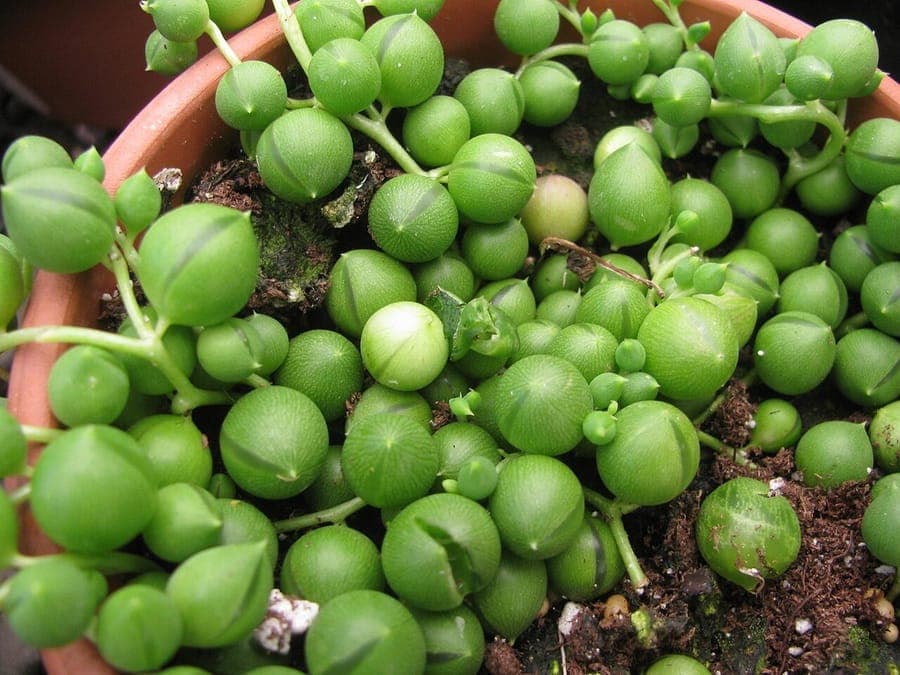
Flickr user Forest and Kim Starr / CC BY 2.0, via Wikimedia Commons
String of pearls (Curio rowleyanus): care guide
Curio rowleyanus
Want to see String of pearls (Curio rowleyanus): care guide in your garden?
Full design in HD: €7.99
Look after your String of pearls with the GardenWorld app
Identify plants with your camera and get a care calendar with reminders for this plant.


Overview
String of pearls (Curio rowleyanus) is the succulent with the unmistakable beads. Thin trailing stems carry spheres about half a centimetre across that look like peas or pearls on a necklace. After a couple of years in a hanging pot it forms a green curtain several tens of centimetres long, and few houseplants draw as many questions from visitors.
Many labels still show the old name Senecio rowleyanus. Around the turn of the century the plant was moved, along with several related succulents, into the genus Curio, and that is the name most botanists now use. It is exactly the same plant. It belongs to the daisy family (Asteraceae), alongside daisies and sunflowers, which becomes obvious once you see its small flower heads.
In the wild it grows in the drier regions of southern Africa. There it creeps along the ground, often in the shade of shrubs or rocks, rooting wherever a stem touches the soil. That background matters: it copes with drought, likes plenty of light but not the harshest sun, and has shallow roots that rot quickly in wet compost. If you move houseplants onto a terrace or balcony in summer, you can have a garden design made on gardenworld.app so those summer spots get a sensible place in the plan too.
Appearance and bloom cycle
The stems are thin and green and on a healthy plant reach 60 cm to well over 1 m. The leaves are spherical, 5 to 8 mm across, with a tiny point at the tip. Look closely and you will see a narrow translucent stripe on each bead. This is a so-called window: light passes through the clear strip deep into the leaf, so the plant can photosynthesise well despite having so little leaf surface. The round shape keeps water loss to a minimum.
String of pearls usually flowers from late winter into spring, especially after a cooler resting period. Short stalks of a few centimetres rise from the stems, each topped with a white, brush-like flower head around 1 cm across. The stamens and styles carry purple to reddish tips, so the flowers look surprisingly refined up close. They are sweetly scented, with a note many people liken to cinnamon or cloves.
A few relatives are sometimes confused with it. String of bananas (Curio radicans) has elongated, banana-shaped leaves, and Curio herreanus has oval, striped leaves. True string of pearls has round beads with a short point.
Ideal location
Give the plant a very bright spot with a few hours of gentle sun, ideally in the morning or late afternoon. An east- or west-facing window is ideal. In a south-facing window draw a sheer curtain in summer, or the beads may scorch and develop brown patches. Too little light shows up as long bare sections of stem between the beads and smaller, paler leaves.
Hang the pot so the stems can trail freely. Strands lying on a cold windowsill or on wet compost rot more easily. In summer the plant can go outside in a sheltered, bright spot out of the strong midday sun. Bring it back in once nights fall below 10 °C, and certainly before the first frost.
Potting mix
An open, gritty mix is essential. Use cactus compost, or blend multipurpose compost with at least a third perlite, pumice or coarse grit. Because the roots stay shallow, a wide, shallow pot works better than a tall one. Terracotta helps the mix dry out faster, and a drainage hole is non-negotiable.
Do not plant too deeply. The point where the stems emerge, the crown, should sit just above the surface. Lay some of the stems around the rim on top of the compost: they will root again and keep the top of the pot full. Repot every other year in spring, gently, as the stems snap easily.
Free preview
Want to see String of pearls (Curio rowleyanus): care guide in your garden? Make a free preview of your design.
Watering
The beads are water reservoirs, and they tell you when the plant is thirsty. Plump, firm pearls mean all is well. When they wrinkle slightly or develop a small dent, it is time to water. In spring and summer water once the top few centimetres of compost are dry, usually every one to two weeks. Water slowly and thoroughly, let the excess drain and empty the saucer.
In autumn and winter water far less, roughly every three to four weeks. Overwatering is the main enemy. Soft, glassy or brown beads and stems starting to rot at the base are clear signs. Let the compost dry out completely and take a few healthy cuttings as insurance. Feed from April to August once a month with half-strength cactus fertiliser.
Pruning and propagation
Pruning is mostly tidying: remove bare or dried-out stems and shorten strands that have grown too long. Propagation could hardly be easier. Cut an 8 to 10 cm length of stem, strip the lowest few beads and let the cut end dry for a day. Then lay the cutting on moist cactus compost with the bare section pressed lightly into the surface or held down with a bent paper clip. Roots form within a few weeks. You can also drape a long stem from the parent plant over a second pot; wherever it touches the compost it will root by itself.
Plant several cuttings together for a full pot. Propagation works best from spring to late summer.
Maintenance calendar
- January and February: cool and bright, little water. Watch for flower buds.
- March: flowering continues; gradually increase watering.
- April: repot if needed, take cuttings, start feeding.
- May and June: move outdoors to a sheltered, bright spot if you like.
- July and August: water when the beads soften slightly, feed monthly.
- September: bring indoors and check for mealybug and aphids.
- October to December: less water, no feeding, a cooler rest at 10 to 15 °C.
The plant calendar on gardenworld.app helps you keep track of tasks like these month by month, with a reminder when it is time to repot or bring the plant inside.
Temperature and overwintering
String of pearls does not tolerate frost. In summer normal room temperatures are fine, up to around 27 °C. In winter a cooler spell at 10 to 15 °C suits it well: the plant rests, needs less water and is more likely to flower in late winter. Below 7 °C it becomes risky, especially if the compost is damp.
Avoid hanging it above a radiator or close to a stove. Dry heat attracts mealybug and spider mite and makes the stems shrivel.
Toxicity to pets
String of pearls is mildly toxic to both animals and people. The ASPCA notes that cats and dogs can suffer vomiting, diarrhoea, drooling and lethargy after eating it. Serious poisoning is rare, because pets usually eat only a few beads, but the symptoms are unpleasant. To a cat, dangling beads are also an irresistible toy. Hang the plant well out of reach, not on a windowsill the cat uses.
In people the sap can mildly irritate sensitive skin. Wear gloves if you take a lot of cuttings and wash your hands afterwards. Keep small children away from the beads, which look a lot like peas or sweets. If your pet has eaten some and shows symptoms, contact your vet.
Companion plants
Group string of pearls with other succulents that need the same care. Burro's tail (Sedum morganianum) is a lovely trailing partner. A jade plant (Crassula ovata) and Echeveria elegans suit the same bright windowsill, and aloe vera and the felty panda plant (Kalanchoe tomentosa) complete the group. Avoid sharing a pot with thirsty plants.
Final thoughts
Curio rowleyanus stands out wherever it hangs, and with the right approach it is not difficult. Light without fierce midday sun, a gritty, shallow pot and water only when the beads ask for it: those are the three rules. Bear the mild toxicity in mind if you have cats or dogs and hang the pot high, and you will enjoy a green string of pearls for years.
Frequently asked questions about String of pearls
When and how do you prune String of pearls?
Pruning is mostly tidying: remove bare or dried-out stems and shorten strands that have grown too long. Propagation could hardly be easier.
How much water does String of pearls need?
The beads are water reservoirs, and they tell you when the plant is thirsty. Plump, firm pearls mean all is well.
Where does String of pearls grow best?
Give the plant a very bright spot with a few hours of gentle sun, ideally in the morning or late afternoon. An east- or west-facing window is ideal.

See it in your garden
See String of pearls in your garden
One photo of your garden and a few questions. You see the result in about a minute.
Try it with a photoIdentify this plant in your own garden. Identify a plant
Similar plants
Sedum morganianum: complete guide
Sedum morganianum
Burro's-tail succulent from Mexico: elegant trailing plant with watery-green, bead-like foliage. Perfect for hanging baskets and living walls.
Jade plant: complete guide
Crassula ovata
Discover how to care for Crassula ovata: ideal lighting, watering, and seasonal care. A low-maintenance succulent perfect for homes and gardens on gardenworld.app.
Echeveria elegans: complete guide
Echeveria elegans
Echeveria elegans, known as Pearl Echeveria, is a beautiful rosette-forming succulent. Learn complete care guide, watering, soil and ideal locations.
