Daderot / CC0, via Wikimedia Commons
Chilean lantern tree (Crinodendron hookerianum): complete guide
Crinodendron hookerianum
Want to see Chilean lantern tree (Crinodendron hookerianum): complete guide in your garden?
Full design in HD: €7.99
Look after your Chilean lantern tree with the GardenWorld app
Identify plants with your camera and get a care calendar with reminders for this plant.


Overview
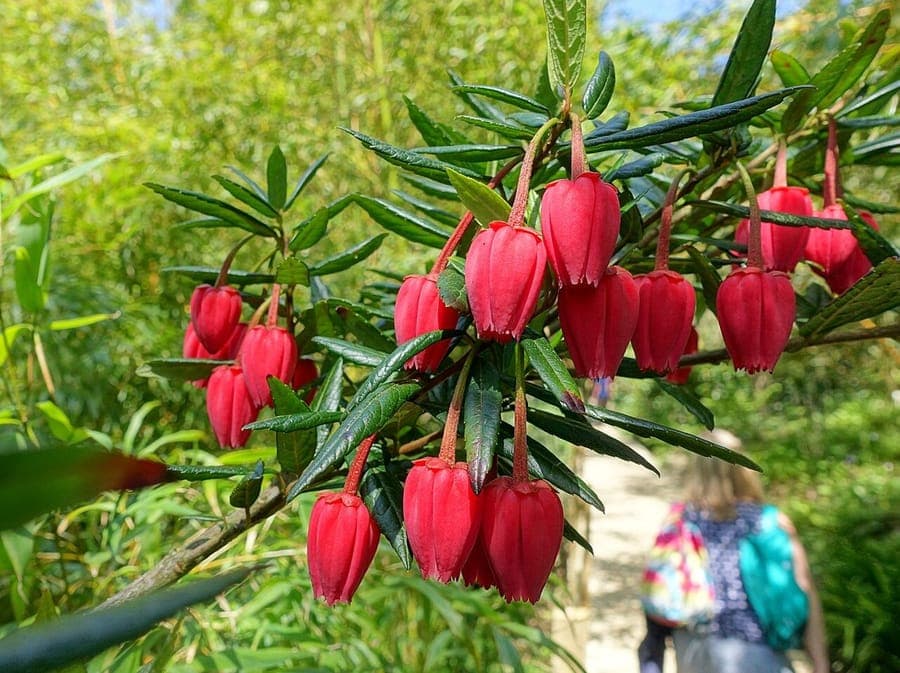
The Chilean lantern tree (Crinodendron hookerianum) is one of those shrubs that stops visitors in their tracks. In late spring its branches are hung with dozens of crimson flowers shaped like tiny Chinese lanterns, dangling beneath glossy evergreen leaves. In its native Chile it is known as chaquihue, and in British gardens it has long been a treasured sight in the mild, damp west, from Cornwall and Devon to the west coast of Scotland and much of Ireland.
The species grows wild in the cool, rain-soaked temperate forests of southern Chile, where it sits in the shade of taller trees on acidic, humus-rich soil that never dries out. In the mildest coastal gardens it can become a small tree of 5 to 8 m. Further inland, and in colder parts of north-west Europe, it usually stays between 2 and 4 m tall and 1.5 to 2.5 m wide, partly because hard winters cut it back from time to time.
It is only fair to say from the outset that this is not a plant for every garden. In an exposed inland garden, on chalky soil or in full sun, it will sulk or die in the first severe winter. In a sheltered, shady spot with acidic soil, especially in a town garden or near the coast, it becomes a real showpiece.
Appearance and bloom cycle
The leaves are narrowly lance-shaped, 3 to 8 cm long, dark green and glossy, with finely toothed margins. They are carried densely along the stems, giving the shrub a full, fresh appearance throughout the year.
What makes it unusual is the timing of the flower buds. They form in late summer and autumn, then hang through the entire winter on long red stalks, first green and gradually flushing red. From late April or May they deepen to crimson and open into fleshy, bell- to urn-shaped flowers about 2 to 3 cm long. Flowering continues into June and sometimes July. Each lantern hangs on a stalk of 5 to 8 cm, so the flowers sway in the breeze, which gives the whole plant a lively, decorative look.
A few cultivars are available: 'Ada Hoffmann' has pink flowers, while 'Alf Robbins' is a selection with rich red flowers offered as a slightly more compact plant. The ordinary red species remains the most widely grown.
Ideal location
The golden rule is cool and sheltered. Crinodendron hookerianum prefers partial to light shade, with at most a little morning sun. Hot afternoon sun scorches the leaves and dries out the root zone. A spot on the north or west side of a house, in the lee of a wall, or beneath the light canopy of larger trees all work well.
Protection from cold, drying easterly and northerly winds matters as much as the temperature itself. A walled town garden, a courtyard or a position among other evergreens provides the necessary shelter. Avoid low-lying frost pockets where cold air collects.
In colder districts a large container is a sensible alternative. That way you can move the plant into a cold greenhouse, an unheated porch or a bright garage during severe frost. Choose a pot of at least 50 litres so that the roots do not dry out or freeze too quickly.
Soil requirements
The Chilean lantern tree is a confirmed lime-hater. The soil must be acidic to slightly acidic, with a pH of roughly 4.5 to 6.5. On alkaline soil the leaves turn yellow between the veins through iron deficiency and the plant struggles. If your soil is neutral, fill a generous planting hole with a mixture of garden soil, leaf mould and ericaceous compost. On genuinely chalky ground, grow it in a container of ericaceous compost instead.
The soil should also be rich in humus, moisture-retentive and yet free-draining. The roots like constant moisture but resent standing water. A mulch of 5 to 7 cm of chipped bark, pine needles or leaf mould keeps the root zone cool and damp and steadily tops up the organic matter.
Feeding needs are modest. A handful of fertiliser for acid-loving plants in April is plenty.
Watering
Water is the main concern in the first few years. After planting, give 10 to 15 litres a week during dry spells so that the root ball never dries out. Use rainwater wherever possible: tap water in many areas is hard and will gradually raise the pH around the roots.
Established plants also dislike drought. In warm, dry summers, check the soil with your finger; if it feels dry 5 cm down, water thoroughly. A plant in a container may need watering daily in high summer. Make sure the pot drains freely, though, because waterlogged roots in winter are just as harmful as dryness in summer.
In winter, water only during long, dry, frosty spells, choosing a frost-free day so the leaves can keep taking up moisture.
Free preview
Want to see Chilean lantern tree (Crinodendron hookerianum): complete guide in your garden? Make a free preview of your design.
Pruning
Crinodendron hookerianum needs very little pruning. It naturally forms a fairly dense, upright shrub and improves with age. Prune only to remove dead, damaged or crossing wood, or to shorten an overly long branch.
The best time is straight after flowering, in June or July. Avoid pruning in autumn or winter, because you would remove the buds for next year, which have been hanging on the branches since late summer. After a hard winter, wait until late April or May before cutting out frost damage, as stems that look brown sometimes still break into leaf. If the plant has been badly frosted, it often regrows from the base provided the roots survived, so give it time before giving up on it.
Maintenance calendar
January–February: Check winter protection. In severe frost, drape a double layer of fleece over young plants and knock heavy snow off the branches.
March: Renew the mulch around the base. Open the fleece on milder days so the plant can breathe.
April: Give a light feed for acid-loving plants. Check whether the buds have come through the winter.
May–June: Full flowering. Water in dry weather and enjoy the hanging lanterns.
July: Light shaping straight after flowering, if needed. Keep watering in dry spells.
August–September: New flower buds appear. Water with rainwater during dry periods and stop feeding.
October–November: Prepare container plants for moving under cover. Spring is a better time than autumn for planting new specimens.
December: Protect young plants and the root zone with a thick layer of leaf mould. Move containers to a cool, bright shelter when frost below -5 °C is forecast.
If you would like reminders for these jobs, the plant calendar on gardenworld.app shows what needs doing in your garden each month.
Winter hardiness
Realism is essential here. The Royal Horticultural Society rates Crinodendron hookerianum H4, meaning it tolerates temperatures down to about -10 °C, although prolonged frost below -5 °C can already damage leaves and buds. That roughly equates to USDA zones 8b to 9a.
In practice, it thrives in the milder parts of the British Isles, in sheltered town gardens and along the Atlantic coasts of France and the Low Countries. In colder inland areas, where temperatures regularly fall below -10 °C, growing it in open ground is a gamble. There you are better off with a container that can be brought under cover, or an exceptionally sheltered spot against a north- or west-facing wall.
Protect young plants for their first three winters with fleece over the crown and a thick layer of leaf mould or straw over the roots. Plant in April or May so the shrub has a full season to establish before its first winter.
Companion plants
Because the Chilean lantern tree needs acidic, moist soil and partial shade, it partners best with plants that share those needs. Camellia japonica and Pieris japonica are natural neighbours: evergreen, lime-hating and attractive in shade. Skimmia japonica makes a low evergreen foreground with winter berries and fragrant spring flowers.
For summer colour after the crinodendron has finished, a mophead hydrangea (Hydrangea macrophylla) is a good choice, and on acidic soil the blue varieties colour even better. At the base, ferns such as the soft shield fern (Polystichum setiferum) strengthen the woodland character. To carry on the South American theme, Fuchsia magellanica from the same cool Chilean forests fits in nicely.
Final thoughts
Crinodendron hookerianum rewards the patient gardener who has the right spot. Offer it acidic, moist soil, partial shade and shelter, and you will have an evergreen shrub that hangs with red lanterns every spring, a sight still rare in most gardens. If you garden in a cold inland area, choose a container or a decidedly sheltered corner.
On gardenworld.app you can have a garden design created that maps out those spots and pairs the lantern tree with companions suited to your soil. Get the start right, and this Chilean shrub will give you years of flowering that visitors will not soon forget.
Frequently asked questions about Chilean lantern tree
Is Chilean lantern tree winter hardy?
Realism is essential here. The Royal Horticultural Society rates Crinodendron hookerianum H4, meaning it tolerates temperatures down to about -10 °C, although prolonged frost below -5 °C can already damage leaves and buds.
When and how do you prune Chilean lantern tree?
Crinodendron hookerianum needs very little pruning. It naturally forms a fairly dense, upright shrub and improves with age.
How much water does Chilean lantern tree need?
Water is the main concern in the first few years. After planting, give 10 to 15 litres a week during dry spells so that the root ball never dries out.
Where does Chilean lantern tree grow best?
The golden rule is cool and sheltered. Crinodendron hookerianum prefers partial to light shade, with at most a little morning sun.
What soil does Chilean lantern tree need?
The Chilean lantern tree is a confirmed lime-hater. The soil must be acidic to slightly acidic, with a pH of roughly 4.5 to 6.5.

See it in your garden
See Chilean lantern tree in your garden
One photo of your garden and a few questions. You see the result in about a minute.
Try it with a photoIdentify this plant in your own garden. Identify a plant
Similar plants
Japanese Camellia: complete guide
Camellia japonica
Everything about Japanese Camellia (Camellia japonica): planting, care, pruning and overwintering. Practical tips for stunning winter and spring blooms.
Japanese pieris: complete guide
Pieris japonica
Complete care guide for Japanese pieris (Pieris japonica): ideal location, soil, watering, pruning and companion plants. Perfect for shaded, acidic gardens.
Skimmia japonica: complete guide
Skimmia japonica
Evergreen shrub with red berries and fragrant leaves that remain visible long. Winter hardy to -10C, perfect for shade.
