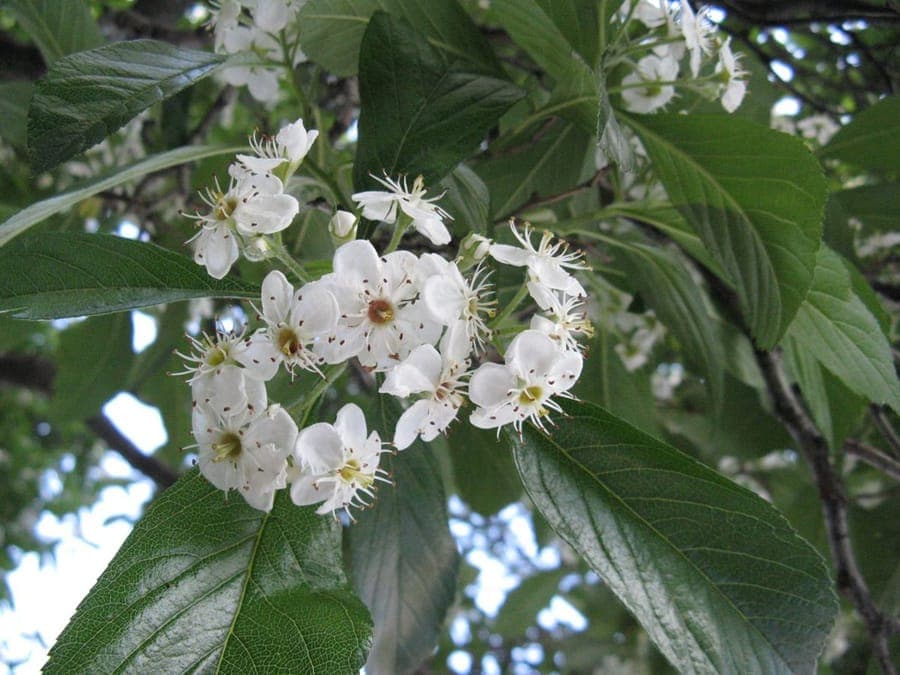
Nadiatalent / Public domain, via Wikimedia Commons
Lavalle hawthorn (Crataegus × lavallei): complete guide
Crataegus × lavallei
Want to see Lavalle hawthorn (Crataegus × lavallei): complete guide in your garden?
Full design in HD: €7.99
Look after your Lavalle hawthorn with the GardenWorld app
Identify plants with your camera and get a care calendar with reminders for this plant.


Overview
Crataegus × lavallei, the Lavalle hawthorn, is the hawthorn you are more likely to meet along a city street or in a car park than in a country hedge, and that tells you a lot about it. It is a small, sturdy tree with glossy, almost leathery leaves, flat heads of white blossom in late spring and large orange-red fruits that hang on well into winter. It copes with wind and urban air, and at 5 to 7 m tall it stays comfortably within the scale of an ordinary garden.
The tree arose around 1870 in the arboretum at Segrez, south of Paris, the collection of the French botanist Alphonse Lavallée. It is a cross between the North American cockspur thorn (Crataegus crus-galli) and the Mexican hawthorn (Crataegus mexicana). Almost everything sold today is the selection 'Carrierei', named after the French nurseryman and writer Élie-Abel Carrière, which holds the RHS Award of Garden Merit. You will also see the spelling Crataegus lavalleei on labels; it is the same plant.
On gardenworld.app you can have a garden design drawn up that gives this hawthorn its proper place, whether as a specimen in the lawn, a shade tree beside the patio or a short avenue along the drive.
Appearance and bloom cycle
Young trees grow fairly narrow and upright; with age the crown broadens into a rounded to slightly flattened dome 4 to 6 m across. The twigs carry occasional thorns of 2 to 5 cm, but far fewer than the native common hawthorn (Crataegus monogyna), and on 'Carrierei' they are often sparse.
The foliage is what sets it apart from wild hawthorns. The leaves are not lobed but oval to obovate, 5 to 10 cm long, finely toothed, dark green and strikingly glossy on top, with a firm, leathery feel. Autumn colour comes late and is understated, bronze to reddish brown, and the leaves often hang on until December. In mild winters some foliage stays even longer.
Flowering falls in May and June, a few weeks after the native hawthorn. The white flowers are 2 to 2.5 cm across, carried in flat clusters of ten to fifteen, and the stamens have pink to red anthers that give the blossom a soft blush up close. Bees, bumblebees and hoverflies work the flowers all day in good weather.
Then come the fruits, which are the real draw. They are round to slightly egg-shaped, 1.5 to 2 cm across, orange-red with fine pale speckles, and they colour from September. Because birds only take a serious interest late in the winter, the tree stays decorated for months. Blackbirds, thrushes and, in hard winters, sometimes waxwings strip them in January and February.
Ideal location
Crataegus × lavallei flowers and fruits best in full sun but also tolerates light shade. Under tall trees the crown becomes thin and you get little blossom or fruit, so give it at least half a day of direct sun.
It is wind-firm and puts up with paving around the trunk, moderate road salt and polluted air, which is why it is so popular as a street tree. In a garden it works well as the single tree in a front garden, beside a terrace where you want summer shade, or as the tallest element in a mixed wildlife hedge. Mind the thorns: do not plant it right next to a play area or a narrow path where you brush past the branches.
Plant it 3 to 4 m from the house and at least 2 m from the boundary so that the crown can spread freely.
Soil requirements
This hawthorn is not fussy. It grows in sand, loam and clay, in chalky and mildly acidic soil, roughly from pH 5.5 to 8. What it does not tolerate is ground that stays waterlogged for long periods. On heavy clay that turns sticky in winter, dig a generous planting hole at least twice the width of the root ball and mix some coarse grit and compost into the backfill.
Plant ideally between November and March, when the ground is not frozen. Set the tree at the same depth as it grew in the nursery, firm the soil well and add an angled stake on the windward side. A 5 cm mulch of wood chips or compost in a circle round the trunk keeps moisture in and grass out. Feeding is barely necessary; a handful of compost in spring is plenty. Too much nitrogen produces soft, sappy growth that is more prone to fireblight.
Free preview
Want to see Lavalle hawthorn (Crataegus × lavallei): complete guide in your garden? Make a free preview of your design.
Watering
Regular watering matters in the first two years after planting. In dry spells give each tree 20 to 30 litres once a week, as one thorough soak rather than frequent splashes, so that the roots head downwards.
Once established, the tree looks after itself. Only in long dry summers, for trees surrounded by paving or on poor sandy soil, should you still give the occasional deep watering. Trees in large containers need closer attention: the compost dries out quickly, so check them weekly in summer.
Pruning
Crataegus × lavallei naturally forms a neat, even crown and needs little pruning. In the early years you shape it: choose five or six well-spaced main branches, remove branches growing inwards or crossing, and take off shoots on the trunk. For an avenue tree or one next to the patio, gradually raise the crown to the clearance you want.
Prune ideally in late winter, in February or early March, in dry weather. Avoid heavy cuts: every large wound is a possible entry point for disease.
Fireblight (Erwinia amylovora) is the main concern with all hawthorns. You recognise it by shoot tips that suddenly wilt, curl over like a shepherd's crook and turn brown-black as if scorched. In dry weather cut affected branches back at least 30 cm into healthy wood and disinfect your secateurs with alcohol after every cut. In some fruit-growing regions there are local rules on planting hawthorn because of fireblight, so check if you live near commercial orchards. Aphids, ermine moth caterpillars and leaf spot can also appear, but they rarely harm a healthy tree.
Maintenance calendar
January-February: Birds eat the last fruits. Formative pruning in dry weather without frost. A good time to plant new trees.
March: Top up the mulch and scatter a handful of compost round the base. Check the stake and tie.
April: Leaves emerge. Watch for aphids and ermine moth webs on the young shoots.
May-June: Full flower. Water young trees during dry spells. Look out for wilted shoot tips, a sign of fireblight.
July-August: Water young trees weekly in drought. Remove suckers at the base of the trunk.
September-October: The fruits turn orange-red. Harvest time if you want to use them in the kitchen.
November-December: The foliage turns bronze and drops late. Planting season begins. For the right timing of these jobs where you live, check the plant calendar on gardenworld.app.
Winter hardiness
Crataegus × lavallei is fully hardy throughout Britain and north-west Europe and withstands temperatures down to about -25 °C. It needs no winter protection; only a tree in a container is better placed against a sheltered wall, because the root ball in a pot freezes much faster than in open ground.
The tree is not poisonous to people or pets. The fruits are edible, although raw they are mealy and bland; they are better in jelly or syrup. As with apple and pear, the seeds contain small amounts of cyanogenic compounds, so do not eat them in quantity. The bigger risk is the thorns: prunings left lying on the ground can injure the paws of dogs and cats.
Companion plants
Beneath the crown, choose low planting that tolerates shade and dry soil. Big-root cranesbill (Geranium macrorrhizum) forms a dense, aromatic ground cover that copes well under trees. Lady's mantle (Alchemilla mollis) and lesser periwinkle (Vinca minor) are other good choices. In spring, crocuses (Crocus tommasinianus) and daffodils give a cheerful start before the leaves open.
In a wildlife border or hedge, pair it with rowan (Sorbus aucuparia), guelder rose (Viburnum opulus) and spindle (Euonymus europaeus): together they provide berries for months. Snowy mespilus (Amelanchier lamarckii) flowers earlier and so lengthens the blossom season. Japanese rose (Rosa rugosa) fits nicely alongside, its large hips echoing the colour of the haws. Avoid crowding too many other fireblight hosts, such as pyracantha and cotoneaster, close together.
Final thoughts
Crataegus × lavallei is one of the best small trees for an ordinary garden: tough, modest in size, with glossy leaves, white blossom, late autumn colour and fruit that brightens the whole winter. It asks for little care and gives birds and insects a well-stocked larder. Plant it in sun, water it through its first two summers and keep an eye out for fireblight, and you will have a tree that lasts for decades.
Frequently asked questions about Lavalle hawthorn
Is Lavalle hawthorn winter hardy?
Crataegus × lavallei is fully hardy throughout Britain and north-west Europe and withstands temperatures down to about -25 °C. It needs no winter protection; only a tree in a container is better placed against a sheltered wall, because the root ball in a pot freezes much faster than in open ground.
When and how do you prune Lavalle hawthorn?
Crataegus × lavallei naturally forms a neat, even crown and needs little pruning. In the early years you shape it: choose five or six well-spaced main branches, remove branches growing inwards or crossing, and take off shoots on the trunk.
How much water does Lavalle hawthorn need?
Regular watering matters in the first two years after planting. In dry spells give each tree 20 to 30 litres once a week, as one thorough soak rather than frequent splashes, so that the roots head downwards.
Where does Lavalle hawthorn grow best?
Crataegus × lavallei flowers and fruits best in full sun but also tolerates light shade. Under tall trees the crown becomes thin and you get little blossom or fruit, so give it at least half a day of direct sun.
What soil does Lavalle hawthorn need?
This hawthorn is not fussy. It grows in sand, loam and clay, in chalky and mildly acidic soil, roughly from pH 5.5 to 8.

See it in your garden
See Lavalle hawthorn in your garden
One photo of your garden and a few questions. You see the result in about a minute.
Try it with a photoIdentify this plant in your own garden. Identify a plant
Similar plants
Hawthorn: complete guide
Crataegus monogyna
Learn how to grow and care for Hawthorn (Crataegus monogyna): ideal location, pruning, soil needs, and companion plants for UK and European gardens.
Quickbeam: complete guide
Sorbus aucuparia
Learn how to grow Sorbus aucuparia, also known as quickbeam, in your garden. A hardy tree that attracts birds and thrives in full sun to partial shade.
Crampbark: complete guide
Viburnum opulus
A detailed guide to Viburnum opulus: growth, care, pruning, and ideal planting conditions. Learn how to grow crampbark successfully in your garden.
