
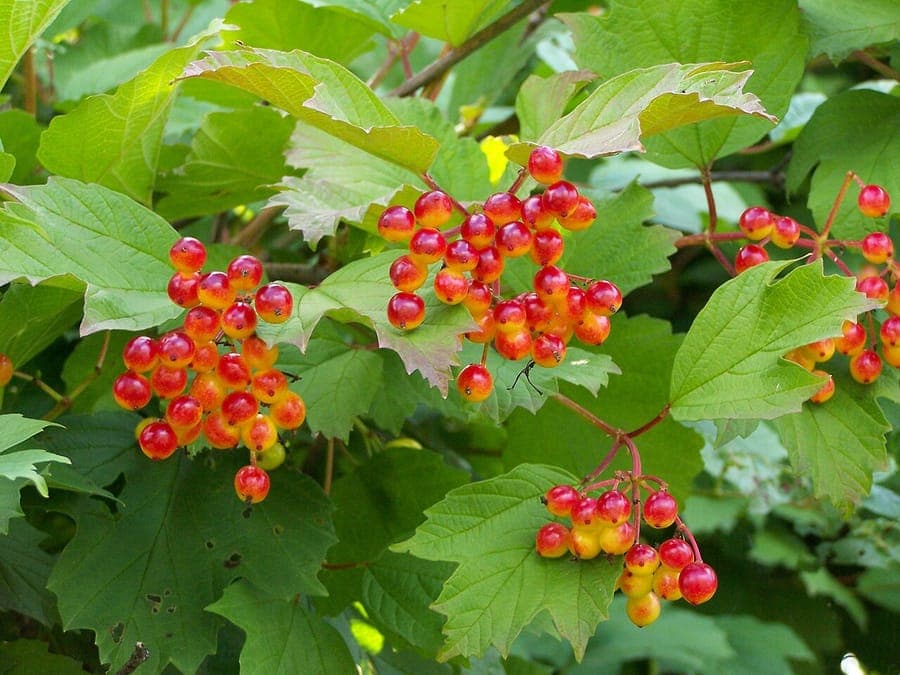
Lestat (Jan Mehlich) / CC BY-SA 3.0, via Wikimedia Commons
Crampbark: complete guide
Viburnum opulus
Want to see Crampbark: complete guide in your garden?
1 minute, no credit card
Overview
Viburnum opulus, commonly known as crampbark, is a resilient deciduous shrub that earns its place in any thoughtful garden design. It's not flashy, but it delivers consistent seasonal interest-spring blooms, vibrant autumn foliage, and persistent red berries that attract birds. Hardy, adaptable, and easy to grow, it's a go-to for both beginner and seasoned gardeners.
On gardenworld.app, you can create a custom garden layout that integrates crampbark with complementary plants based on light, soil, and spacing needs.
Appearance & bloom cycle
Crampbark typically grows 2–4 meters tall and 2.5 meters wide over a decade, with a moderate growth rate of 30–40 cm per year. The leaves are three-lobed, resembling maple foliage, and turn a brilliant scarlet or burgundy from September through October-among the most striking fall displays in the temperate garden.
Flowering occurs from May to June. The flat-topped clusters consist of small fertile flowers in the center, surrounded by larger sterile florets. While the scent may be slightly unpleasant to some, it draws in pollinators like hoverflies and bees. By August, clusters of glossy red berries form. These are mildly toxic to humans but are a valuable food source for birds like thrushes and waxwings through late autumn.
Ideal location
Crampbark thrives in partial shade to light sun (light level 5–6 out of 10). Full sun is acceptable if soil moisture is consistent, but in hot, dry summers, leaf scorch can occur. Full shade reduces flowering and leads to leggy, sparse growth. A spot along a woodland edge, near a fence, or as understory in a mixed shrub border works well.
Allow at least 1.5 meters of space from other plants or structures. It can also be grown in large containers (minimum 60 cm diameter) if drainage is adequate.
Soil requirements
This shrub is adaptable but prefers moist, humus-rich soil with a pH between 5.2 and 7. It tolerates clay and even slightly waterlogged conditions-making it suitable for damp corners. Sandy soils will require more frequent watering and added organic matter to retain moisture.
When planting, mix well-rotted compost or manure into the planting hole. Avoid high-nitrogen fertilizers; crampbark doesn't need heavy feeding.
Watering
Water regularly during the first two growing seasons, especially in dry spells. Weekly deep watering helps establish strong roots. Mature plants are moderately drought-tolerant but perform best in consistently moist soil. Wilting or early leaf drop signals water stress.
Apply a 5–8 cm layer of organic mulch around the base to conserve moisture and suppress weeds. Avoid plastic mulch-it suffocates roots and hinders water penetration.
Free design
Want to see Crampbark: complete guide in your garden? Make a free design now.
Pruning
Prune only when necessary-such as to control size or rejuvenate old growth. The best time is immediately after flowering, from late June to early July. Pruning in late winter or autumn removes next season's flower buds.
Remove dead, damaged, or crossing branches. For older plants, a renewal prune every 3–5 years helps: cut one-third of the oldest stems back to 20 cm above ground. This encourages vigorous new shoots from the base.
Maintenance calendar
- January: Check for winter damage; no pruning
- February: Leave berries for birds; protect young plants if needed
- March: Inspect for pests; clear debris around base
- April: Apply compost mulch as soil warms
- May: Bloom period begins-avoid pruning; watch for aphids
- June: Flowers fading-light shaping possible
- July: Complete any pruning; apply compost top-dressing
- August: Berries ripen; monitor during dry periods
- September: Foliage color intensifies; stop fertilizing
- October: Leaves drop-leave as natural mulch or compost
- November: Check for fungal issues; no pruning
- December: Shop end-of-season sales at garden centres like Wyevale or Dobbies
Winter hardiness
Crampbark is extremely cold-hardy, surviving temperatures down to -25°C. It's suited to USDA zones 3–7. Foliage drops completely, but bare branches add winter structure. Berries may persist into early winter, providing visual interest and food for birds.
No winter protection is needed for mature plants, even in harsh climates. Young specimens in exposed sites may benefit from a light mulch layer, but this is rarely essential.
Companion plants
Pair crampbark with shrubs like Cornus alba or Fothergilla for multi-season appeal. Use shade-tolerant perennials such as Hakonechloa or Geranium phaeum for ground cover. In damp areas, Astilbe and Carex species make excellent partners.
Avoid planting near shallow-rooted competitors like roses or rhododendrons. Crampbark needs space to develop its root system without competition.
Use gardenworld.app to visualize planting combinations that balance moisture needs, root depth, and seasonal interest.
Closing
Crampbark isn't a headline-grabber, but it's a dependable workhorse in the garden. With minimal care, it delivers flowers, color, wildlife value, and structure. It's ideal for naturalistic plantings, bird-friendly gardens, or informal hedges.
Available at major garden centres in spring, typically as 60–80 cm specimens. Choose plants with healthy root balls-avoid dried-out or root-bound stock. Plant in the right spot, give it time, and you'll enjoy decades of reliable performance.
Want to see Crampbark: complete guide in your garden? Make a free design now.
Upload a photo, pick a style, and get a photorealistic design with plant list in under a minute.
No credit card required


Similar plants
Squashberry: complete guide
Viburnum edule
Grow mooseberry (Viburnum edule): ultra-hardy North American shrub with fragrant white flowers and red autumn berries. Perfect for boreal gardens. Zone 3.
Witherod: complete guide to this elegant North American shrub
Viburnum cassinoides
Discover Viburnum cassinoides: an elegant North American shrub with white flowers, yellow fall foliage, and blue berries. Perfect for temperate garden zones.
Buddlejaleaf viburnum: complete guide
Viburnum buddleifolium
Elegant evergreen shrub with delicate foliage and white spring flowers. Perfect for sheltered borders in temperate gardens.