
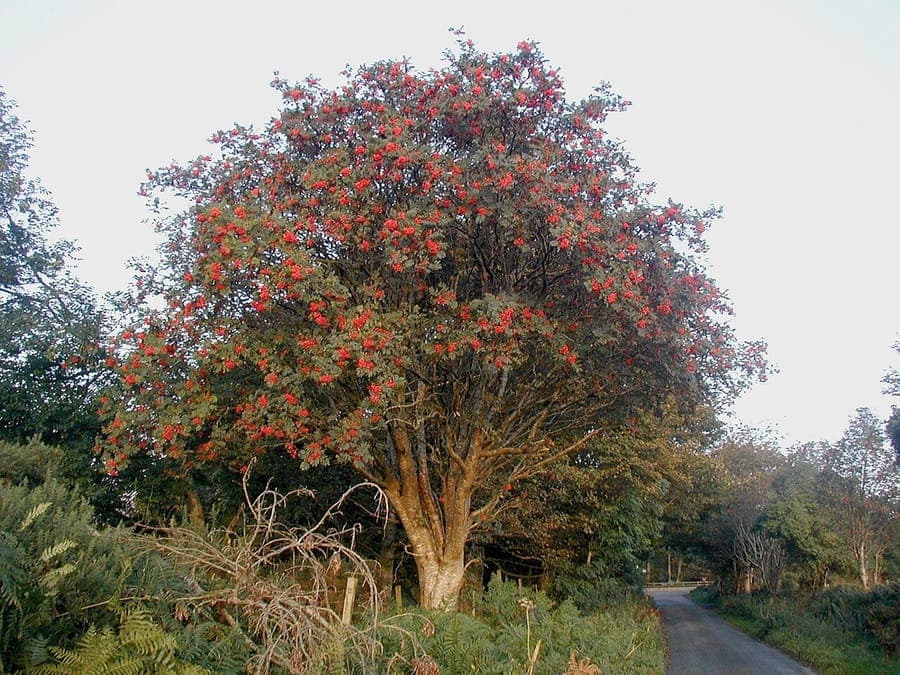
Eeno11 / CC BY-SA 3.0, via Wikimedia Commons
Quickbeam: complete guide
Sorbus aucuparia
Want to see Quickbeam: complete guide in your garden?
1 minute, no credit card
Overview
Sorbus aucuparia, commonly known as quickbeam or rowan, is a resilient and attractive small to medium-sized tree native to much of Europe and western Asia. Belonging to the Rosaceae family, it typically reaches a height of 8 to 15 meters with a spread of 5 to 8 meters, making it suitable for medium to large gardens. Hardy in USDA zones 4 to 7, it tolerates winter lows down to -34°C, which means it performs well across the UK and much of North America. Its upright, open crown and elegant branching structure make it an excellent choice for solitary planting or as part of a mixed woodland edge.
One of the key strengths of this tree is its ecological value. The bright orange to red berries that form in late summer and persist into winter are a vital food source for birds such as thrushes, redwings, and fieldfares. It's worth noting, however, that the berries are mildly toxic when raw to humans, but they can be cooked into a tangy jelly after proper preparation.
On gardenworld.app, you can create a custom garden design that incorporates Sorbus aucuparia as a focal point or background element, helping you visualise how it fits into your space.
Appearance & bloom cycle
In late spring, usually from mid-May to early June, clusters of small white flowers appear at the ends of the branches. These creamy-white blooms have a subtle scent that draws in pollinators like bees and hoverflies. After pollination, green berries develop and gradually turn bright orange by late August, reaching full colour in September and October. The pinnate leaves are a fresh green in summer and transition to vibrant yellow or golden-orange in autumn, adding seasonal interest.
Young trees have smooth grey bark and a conical shape, becoming more irregular and spreading with age. The branches are slender and gracefully arranged, particularly noticeable in winter when the tree is leafless. The overall form is airy and light, avoiding the heaviness of some larger trees.
Ideal location
Quickbeam thrives in full sun to light shade, scoring a 7 out of 10 on the light scale. It needs at least six hours of direct sunlight daily to produce abundant flowers and berries. While it can tolerate partial shade, fruiting will be reduced. Give it a space of at least 5 meters from buildings or other trees to allow for full crown development. Avoid planting too close to drains or foundations due to its spreading root system.
Soil requirements
This tree is adaptable to a range of soil types, including sandy, loamy, and clay soils, as long as they are well-drained. It prefers a pH between 5.5 and 7.5 but tolerates slightly more acidic conditions. While it handles occasional moisture, it does not like waterlogged soil. In heavy clay, amend the planting hole with grit or compost to improve drainage. Young trees benefit from a handful of bone meal or slow-release fertiliser at planting time.
Free design
Want to see Quickbeam: complete guide in your garden? Make a free design now.
Watering
During the first growing season, water deeply once or twice a week, especially during dry spells. Provide 10–15 litres per session. After the first year, established trees rarely need supplemental watering unless under prolonged drought. A layer of organic mulch helps retain moisture and suppress weeds.
Pruning
Pruning is minimal. Only remove dead, damaged, or crossing branches in late winter or early spring before new growth starts. Avoid heavy pruning as it can disrupt flowering and fruiting. Use clean, sharp tools to prevent disease transmission. If shaping is needed, do it gradually over several years.
Maintenance calendar
- Jan: Inspect for structural damage, remove any dead wood
- Feb: Final pruning window, check for rodent damage
- Mar: No action needed, monitor growth space
- Apr: Watch for aphids or fungal spots
- May: Flower buds swell, pollinators active
- Jun: Full bloom, berries begin to set
- Jul: Monitor for drought stress
- Aug: Berries start colouring up
- Sep: Peak berry display, ideal for photos and wildlife
- Oct: Leaf fall begins, clean up debris if needed
- Nov: Add mulch around base for winter protection
- Dec: Final check, protect young trunks from rabbits
Winter hardiness
Sorbus aucuparia is extremely cold-hardy, surviving in USDA zones 4–7. It handles snow load well and does not suffer from winter burn. Young trees may benefit from a tree wrap to prevent bark damage from rodents. In exposed sites, a windbreak can help during harsh winters.
Companion plants
Pair quickbeam with other native trees like birch (Betula pendula) or hawthorn (Crataegus monogyna). Beneath the canopy, plant shade-tolerant perennials such as foxglove (Digitalis purpurea) or wood avens (Geum urbanum). Avoid invasive groundcovers that might compete for nutrients. A well-planned understory adds texture and supports biodiversity.
You can explore companion planting ideas on gardenworld.app, where you can also simulate how Sorbus aucuparia interacts with surrounding plants in your garden layout.
Closing
Quickbeam is a low-maintenance, wildlife-friendly tree that brings year-round interest to the garden. From spring flowers to autumn berries and winter structure, it's a reliable performer. Purchase healthy specimens from reputable garden centres, ensuring the root ball is moist and undamaged. With proper siting and initial care, Sorbus aucuparia will thrive for decades, becoming a beloved feature in your outdoor space.
Want to see Quickbeam: complete guide in your garden? Make a free design now.
Upload a photo, pick a style, and get a photorealistic design with plant list in under a minute.
No credit card required


Similar plants
Siberian crab apple: complete guide
Malus x robusta
Complete guide to the Siberian crab apple (Malus x robusta): location, soil, pruning, winter hardiness and the best companion plants for your garden.
Chinese flowering crabapple (Malus x spectabilis): complete guide
Malus x spectabilis
Meet the Chinese flowering crabapple (Malus x spectabilis): a classic spring bloomer with carmine buds and pink blossom.
Potentilla crassinervia: complete guide
Potentilla crassinervia
Potentilla crassinervia, the Corsican cinquefoil, grows wild on Corsica and Sardinia's peaks. Discover how to grow this hardy alpine rock garden gem.