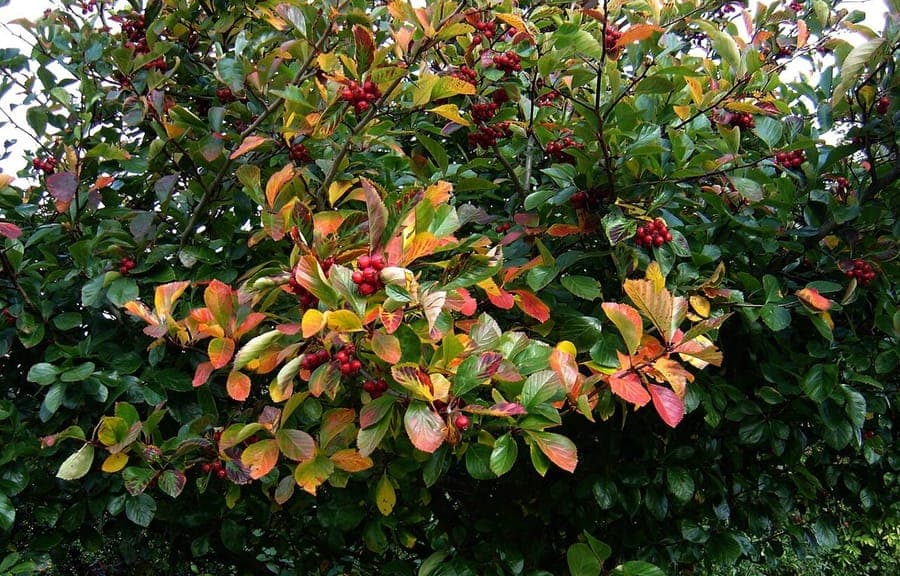
peganum from Small Dole, England / CC BY-SA 2.0, via Wikimedia Commons
Plumleaf hawthorn (Crataegus persimilis): complete guide
Crataegus persimilis
Want to see Plumleaf hawthorn (Crataegus persimilis): complete guide in your garden?
Full design in HD: €7.99
Look after your Plumleaf hawthorn with the GardenWorld app
Identify plants with your camera and get a care calendar with reminders for this plant.


Overview
Crataegus persimilis, the plumleaf hawthorn, is the tree to choose if you want a small tree whose autumn colour you can see from the end of the street. In October the glossy leaves turn orange, scarlet and gold, with bunches of deep red haws hanging among them. In spring it is covered in white blossom, and for the rest of the year it is a dense, dark green dome. At 6 to 8 m tall with a crown just as wide, it suits a medium-sized garden.
Nurseries mostly sell the selections 'Prunifolia' and 'Splendens', often labelled 'Prunifolia Splendens', and sometimes still under the old name Crataegus prunifolia. The name refers to the leaves, which resemble those of a plum. The plant comes from North America and is closely related to, or possibly a hybrid of, the cockspur thorn (Crataegus crus-galli). It has been grown in European gardens since the late eighteenth century, which is why you will also see it written as Crataegus × persimilis. 'Prunifolia' holds the RHS Award of Garden Merit.
On gardenworld.app you can have a garden design drawn up that places this hawthorn where its autumn display shows to best effect, for example against a backdrop of evergreen shrubs.
Appearance and bloom cycle
The tree grows slowly to moderately and forms a broad, rounded to slightly flattened crown. It often has a short trunk and branches low, so it also looks good as a large multi-stemmed shrub. The twigs carry stout thorns of 3 to 5 cm, something to bear in mind when pruning and choosing a spot.
The leaves are elliptic to obovate, 4 to 8 cm long, finely toothed and not lobed. The upper surface is dark green and glossy, almost lacquered. Colouring starts at the end of September and ranks among the finest of all hawthorns: yellow and orange first, then fiery red, often with several shades on one branch, as the photograph at the top shows.
Flowering runs from late May into early June. The white flowers are about 1.5 cm across and sit in dense, flat clusters that draw in bees, bumblebees and hoverflies. From September the round fruits, about 1 to 1.5 cm, ripen bright to deep red. They usually hang on until November, when blackbirds and thrushes clear them.
Ideal location
Give this hawthorn a spot in full sun, where it flowers freely and colours most brightly. It grows in light shade too, but the autumn colour is duller and fewer fruits set.
It is wind-firm, tolerates urban air and paving, and is used as a small street tree for that reason. In a garden it looks good as a lawn specimen, on the corner of a terrace or as the tallest plant in a wildlife hedge. Because of the thorns, keep it away from paths, play areas and benches. Allow at least 3 m from the house and 2 m from the boundary.
Soil requirements
Crataegus persimilis grows in almost any garden soil: sand, loam, clay, chalky or slightly acidic. Once established it handles a dry summer well, but it dislikes sitting in water for long. On heavy, wet ground, improve the planting hole with coarse grit and compost and plant slightly high rather than too deep.
The planting season runs from November to March. Dig a hole twice the width of the root ball, set the tree at the same depth as in the nursery and secure it with an angled stake. A mulch of compost or wood chips round the trunk helps a great deal. Feed sparingly: a handful of compost in March is enough. Excess nitrogen makes the wood soft and more prone to disease.
Free preview
Want to see Plumleaf hawthorn (Crataegus persimilis): complete guide in your garden? Make a free preview of your design.
Watering
Young trees need regular watering for their first two summers. In dry spells give 20 to 30 litres once a week, slowly and in one go, so the water soaks deep into the soil. After that the tree generally fends for itself. Only in long droughts on sandy soil or in paved areas will it need an extra drink.
In a large container regular watering remains essential, sometimes twice a week in summer. A tree that is too dry in August drops its leaves early and misses out on its autumn show.
Pruning
This hawthorn needs little pruning and naturally grows into a pleasing shape. In the early years remove branches growing inwards or crossing, and choose the limbs that will form the framework. If you want clear stem beneath the crown, raise it gradually by removing one or two of the lowest branches each year.
Prune in late winter, in February or early March, in dry weather, and wear thick gloves. Avoid large saw cuts, which let disease in.
As with all hawthorns, watch for fireblight (Erwinia amylovora): shoot tips that suddenly wilt, bend over and blacken. Cut these out in dry weather 30 cm into healthy wood and disinfect your secateurs after every cut. In some fruit-growing regions there are local rules on planting hawthorn because of fireblight, so check if you live close to commercial orchards. Rust, aphids and ermine moth can also turn up, usually without lasting harm.
Maintenance calendar
January-February: Formative pruning in dry weather. Plant new trees when the ground is not frozen.
March: Scatter compost around the base, top up the mulch, check the stake.
April-May: Leaves emerge. Check young shoots for aphids and ermine moth.
Late May-June: Flowering. Watch for wilted shoot tips. Water young trees in dry spells.
July-August: Weekly watering for young trees and trees in containers. Remove suckers at the base.
September-October: Fruits turn red and the foliage colours. The high point of the year.
November-December: Leaf fall. The planting season begins. For when to plant and prune in your area, see the plant calendar on gardenworld.app.
Winter hardiness
Crataegus persimilis is fully hardy and withstands temperatures down to about -29 °C. In Britain and north-west Europe it needs no winter protection at all. Only a tree in a container is better moved against a sheltered wall in severe winters.
The plant is not poisonous to people or pets. The fruits are edible, though mealy and bland when raw; they can go into a jelly. The seeds contain small amounts of cyanogenic compounds, as apple pips do, so do not eat them in quantity. The real hazard is the long thorns: clear up prunings carefully, because thorns hidden in the grass easily injure the paws of dogs and cats.
Companion plants
The fiery autumn colour looks best against dark green. Holly (Ilex aquifolium) and yew make ideal backdrops. In a wildlife hedge combine it with rowan (Sorbus aucuparia), guelder rose (Viburnum opulus), spindle (Euonymus europaeus) and blackthorn (Prunus spinosa), giving you flowers and berries from spring deep into winter.
Beneath the crown, use ground covers that tolerate some dryness, such as big-root cranesbill (Geranium macrorrhizum), lady's mantle (Alchemilla mollis) or lesser periwinkle (Vinca minor). Spring bulbs such as crocuses and snowdrops add colour before the tree comes into leaf. For even more autumn colour nearby, add field maple (Acer campestre). Avoid clustering too many other fireblight hosts, such as pyracantha and cotoneaster.
Final thoughts
Crataegus persimilis is a compact, tough tree that gives you very little work and puts on an autumn spectacle every year. White blossom for bees, red haws for birds and glossy leaves that look as if they are on fire in October: few small trees can match it. Give it sun, a place away from paths and enough water in its first summers.
Frequently asked questions about Plumleaf hawthorn
Is Plumleaf hawthorn winter hardy?
Crataegus persimilis is fully hardy and withstands temperatures down to about -29 °C. In Britain and north-west Europe it needs no winter protection at all.
When and how do you prune Plumleaf hawthorn?
This hawthorn needs little pruning and naturally grows into a pleasing shape. In the early years remove branches growing inwards or crossing, and choose the limbs that will form the framework.
How much water does Plumleaf hawthorn need?
Young trees need regular watering for their first two summers. In dry spells give 20 to 30 litres once a week, slowly and in one go, so the water soaks deep into the soil.
Where does Plumleaf hawthorn grow best?
Give this hawthorn a spot in full sun, where it flowers freely and colours most brightly. It grows in light shade too, but the autumn colour is duller and fewer fruits set.
What soil does Plumleaf hawthorn need?
Crataegus persimilis grows in almost any garden soil: sand, loam, clay, chalky or slightly acidic. Once established it handles a dry summer well, but it dislikes sitting in water for long.

See it in your garden
See Plumleaf hawthorn in your garden
One photo of your garden and a few questions. You see the result in about a minute.
Try it with a photoIdentify this plant in your own garden. Identify a plant
Similar plants
Hawthorn: complete guide
Crataegus monogyna
Learn how to grow and care for Hawthorn (Crataegus monogyna): ideal location, pruning, soil needs, and companion plants for UK and European gardens.
Holly: complete guide
Ilex aquifolium
Discover holly (Ilex aquifolium), the iconic evergreen with red berries. Growing, care tips, and decorative uses for your garden.
Quickbeam: complete guide
Sorbus aucuparia
Learn how to grow Sorbus aucuparia, also known as quickbeam, in your garden. A hardy tree that attracts birds and thrives in full sun to partial shade.
