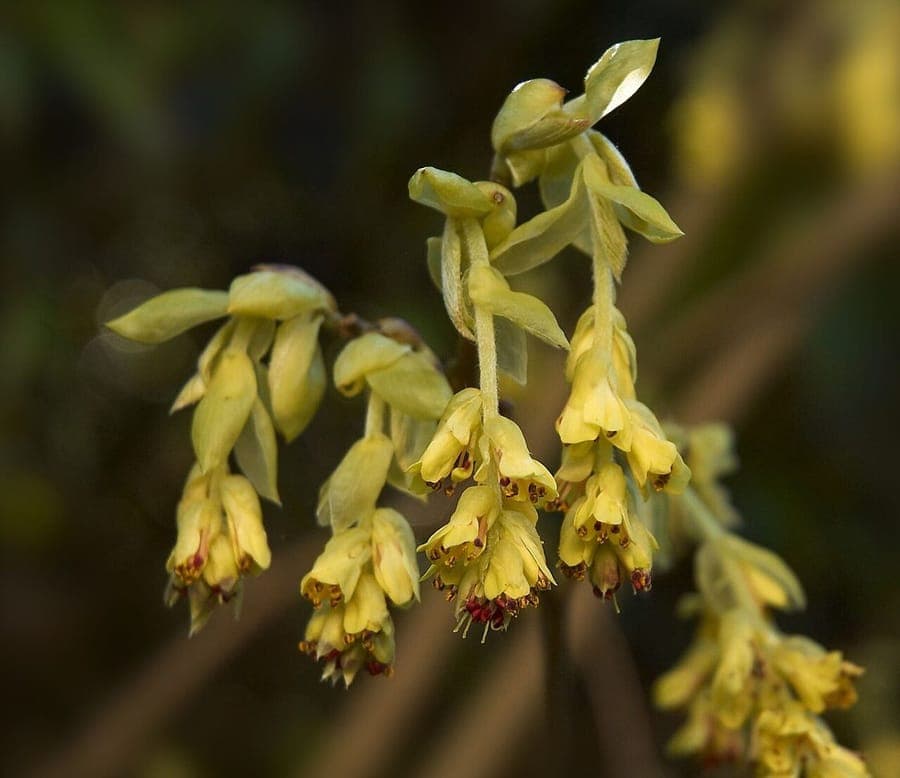
Wouter Hagens / Public domain, via Wikimedia Commons
Buttercup winter hazel (Corylopsis pauciflora): guide
Corylopsis pauciflora
Want to see Buttercup winter hazel (Corylopsis pauciflora): guide in your garden?
Full design in HD: €7.99
Look after your Buttercup winter hazel with the GardenWorld app
Identify plants with your camera and get a care calendar with reminders for this plant.


Overview
Buttercup winter hazel (Corylopsis pauciflora) is one of the most charming spring-flowering shrubs for a partly shaded garden. In March, when most shrubs are still bare, it hangs with short clusters of pale yellow bells that carry a delicate, sweet scent. The yellow is soft, almost primrose, and sits far more gracefully in a quiet garden than the brash yellow of forsythia. Only after flowering do the leaves appear, and they look remarkably like hazel leaves. That is where the name comes from: Corylopsis means something like 'resembling Corylus', the hazel.
The species comes from Japan and Taiwan, where it grows in mountain woodland and on sheltered slopes. It was introduced to Europe in the nineteenth century and holds the Royal Horticultural Society's Award of Garden Merit. The name pauciflora means 'few-flowered'. That does not describe the shrub as a whole, which flowers generously, but each cluster: every little raceme carries only two or three flowers, fewer than in other winter hazels.
Corylopsis pauciflora is the smallest and most graceful of the commonly grown species. It usually stays 1 to 1.5 metres tall and spreads to 1.5 to 2.5 metres, with a loose, finely branched habit. That makes it suitable for smaller gardens, the front of a shrub border or beneath taller trees. On gardenworld.app you can have a garden design created that gives this early bloomer a place alongside witch hazel, star magnolia and spring flowers.
There are no known reports of buttercup winter hazel being toxic to people or animals. That does not make it edible, but it is a reassuring choice for gardens with children or pets.
Appearance and bloom cycle
Flowering usually happens in March, as early as late February in a mild spring and as late as mid-April after a cold winter. The flowers hang in short, nodding clusters from the bare twigs. Each bell is about 1.5 to 2 cm long and pale yellow, with prominent reddish-brown anthers. Pale green to yellowish-green bracts surround the flowers, making the clusters look even lighter. The photograph shows these details well: the drooping bells, the dark anthers and the pale bracts. The fragrance is gentle and sweet, often compared with cowslips. You will notice it most on a calm, sunny day.
After flowering the leaves emerge, at first with a pinkish to bronze flush. They are oval, 3 to 6 cm long, finely toothed and marked with distinct parallel veins, just like hazel. In summer they are fresh green with a bluish-green underside. In autumn they sometimes turn butter yellow, though the autumn colour varies from year to year. The thin, brown, zigzagging twigs give the shrub a fine structure even in winter.
Ideal location
Buttercup winter hazel is a plant for part shade and gentle sun. The ideal position offers morning sun or dappled light beneath tall trees, with shelter from cold winds. In full afternoon sun the leaves can scorch during hot summers, while in deep shade flowering is sparser.
Avoid planting it in a frost pocket, a low-lying spot where cold air settles. The early flowers cope with light frost, but a hard frost while in bloom turns them brown. A position against a hedge, at the edge of a woodland area or by a west- or north-facing wall gives the best protection. Plant it where you will actually see it in March, near a path or within view of a window, so you can enjoy the early flowers and their scent.
Soil requirements
Corylopsis pauciflora prefers humus-rich, moisture-retentive but well-drained soil that is slightly acid to neutral, with a pH between 5 and 6.5. On strongly alkaline soil the leaves yellow and growth suffers. Woodland soil, light loam or sandy soil enriched with leaf mould is ideal.
When planting, dig in plenty of leaf mould or well-rotted compost. On poor sandy soil it helps hold moisture; on heavy clay it improves structure. Do not plant too deeply: the top of the root ball should sit level with the soil surface. A mulch of leaf mould or bark keeps the roots cool.
Free preview
Want to see Buttercup winter hazel (Corylopsis pauciflora): guide in your garden? Make a free preview of your design.
Watering
In the first year after planting, give a generous can of water weekly in dry weather so the roots can establish well. An established shrub tolerates moderate drought but still needs water during long dry summers. Do not let the soil dry out in July and August in particular, when next spring's flower buds are forming.
It is better to water thoroughly once than to give a little every day, so the water reaches deep into the soil. Where tap water is hard, rainwater is preferable. Buttercup winter hazel dislikes waterlogged roots, so avoid boggy spots.
Pruning
Pruning is hardly ever necessary. The shrub has a naturally attractive, open habit that is best left intact. Hard pruning spoils that graceful branch structure and costs you flowers.
If you do need to prune, do it straight after flowering, in April or early May. Remove dead wood, crossing or congested branches and, if needed, a few of the oldest stems at the base to keep the shrub open. Next spring's flower buds form during summer, so later pruning reduces flowering. In late February you can also cut a few budded stems for a vase: they open in a warm room and fill it with scent.
Maintenance calendar
February–March: Flowering time. Protect blooms with fleece during hard frost. Cut a few stems for the house if you like.
April: Prune straight after flowering if necessary. Spread a layer of leaf mould or compost around the shrub.
May–June: Leaves unfold. Keep young plants moist.
July–August: Flower buds form for next spring. Water during dry spells.
September–November: Occasional yellow autumn colour. A good time to plant.
December–January: Dormant season. Admire the fat flower buds on the bare twigs.
Winter hardiness
Buttercup winter hazel is reliably hardy. The Royal Horticultural Society rates it H5, and American sources place it in zone 6, which corresponds to temperatures down to about -20 °C. In Britain and the Low Countries the shrub itself comes through normal winters without protection.
Its weak point is the early flowering. A hard frost in March can damage open blooms, ending that year's display, although the shrub itself is unharmed. A sheltered position away from frost pockets and cold east winds is the best insurance. If a hard frost is forecast during flowering, you can cover a small shrub with fleece.
Companion plants
Buttercup winter hazel looks its best among other early bloomers. Chinese witch hazel (Hamamelis mollis) flowers a little earlier and keeps the show going, and the soft yellow of Corylopsis complements the yellows and oranges of witch hazels beautifully. Star magnolia (Magnolia stellata) often flowers at the same time, its white star-shaped blooms making a lovely contrast.
At the foot of the shrub, plant spring flowers for part shade. Christmas roses (Helleborus niger) and dog's-tooth violets (Erythronium dens-canis) add colour in the same season. Because it is happy in slightly acid soil, it also pairs well with Pieris japonica, which flowers at the same time and provides evergreen structure. Blue spring bulbs underneath complete the picture.
Final thoughts
Buttercup winter hazel is a modest but irresistible herald of spring. Its soft yellow, fragrant bells on bare twigs bring light to the garden when little else is in flower. It needs humus-rich, slightly acid soil and a sheltered spot in part shade, and very little else. Pruning is rarely necessary, and the shrub keeps its graceful shape for many years.
Looking for the right spot for Corylopsis pauciflora? On gardenworld.app you can have a garden design made and see straight away how this early bloomer works with witch hazel, magnolia and spring flowers.
Frequently asked questions about Buttercup winter hazel
Is Buttercup winter hazel winter hardy?
Buttercup winter hazel is reliably hardy. The Royal Horticultural Society rates it H5, and American sources place it in zone 6, which corresponds to temperatures down to about -20 °C.
When and how do you prune Buttercup winter hazel?
Pruning is hardly ever necessary. The shrub has a naturally attractive, open habit that is best left intact.
How much water does Buttercup winter hazel need?
In the first year after planting, give a generous can of water weekly in dry weather so the roots can establish well. An established shrub tolerates moderate drought but still needs water during long dry summers.
Where does Buttercup winter hazel grow best?
Buttercup winter hazel is a plant for part shade and gentle sun. The ideal position offers morning sun or dappled light beneath tall trees, with shelter from cold winds.
What soil does Buttercup winter hazel need?
Corylopsis pauciflora prefers humus-rich, moisture-retentive but well-drained soil that is slightly acid to neutral, with a pH between 5 and 6.5. On strongly alkaline soil the leaves yellow and growth suffers.

See it in your garden
See Buttercup winter hazel in your garden
One photo of your garden and a few questions. You see the result in about a minute.
Try it with a photoIdentify this plant in your own garden. Identify a plant
Similar plants
Chinese Witch Hazel: complete guide
Hamamelis mollis
Chinese witch hazel blooms in January-February with fragrant yellow flowers even in deep winter. Master care, site selection, and pruning to enjoy 30+ years of winter color.
Star Magnolia: complete guide
Magnolia stellata
Everything about Star Magnolia (Magnolia stellata): planting, care, pruning and siting. Practical tips for spectacular star-shaped spring flowers.
Christmas-rose: complete guide
Helleborus niger
The Christmas-rose (Helleborus niger) is an elegant winter-flowering perennial blooming from December to April. Perfect for shady borders and woodland gardens.
