Sajetpa at Malayalam Wikipedia / Public domain, via Wikimedia Commons
Cuban oregano (Coleus amboinicus): growing guide
Coleus amboinicus
Want to see Cuban oregano (Coleus amboinicus): growing guide in your garden?
Full design in HD: €7.99
Look after your Cuban oregano with the GardenWorld app
Identify plants with your camera and get a care calendar with reminders for this plant.


Overview
Coleus amboinicus is a herb that looks more like a succulent at first glance. The leaves are thick, juicy and softly hairy, and if you rub one you immediately smell a powerful blend of oregano, thyme and mint. It is usually sold as Cuban oregano and is also known as Indian borage or Mexican mint, although it is not a true oregano, borage or mint: it is a relative from the same mint family.
The botanical name needs some explaining too. For a long time the plant was known as Plectranthus amboinicus, and you will still come across Coleus aromaticus. Since botanists redefined the genus Coleus in 2019 on the basis of DNA studies, Coleus amboinicus has been the accepted name. The species name refers to the island of Ambon in Indonesia, where the plant was described early on. Its true origin, however, probably lies in eastern and southern Africa, with related forms on the Arabian Peninsula and in India. It has been grown throughout the tropics for centuries, from South East Asia to the Caribbean.
In our climate Coleus amboinicus is not hardy. Grow it as a houseplant on a sunny windowsill and move it outdoors onto a patio or balcony in summer. It reaches 30 to 60 cm and spreads widely, with stems that eventually start to trail. If you want to give herbs a permanent place around your patio, you can have a garden design made on gardenworld.app with a sunny herb corner close to the kitchen.
Appearance and scent
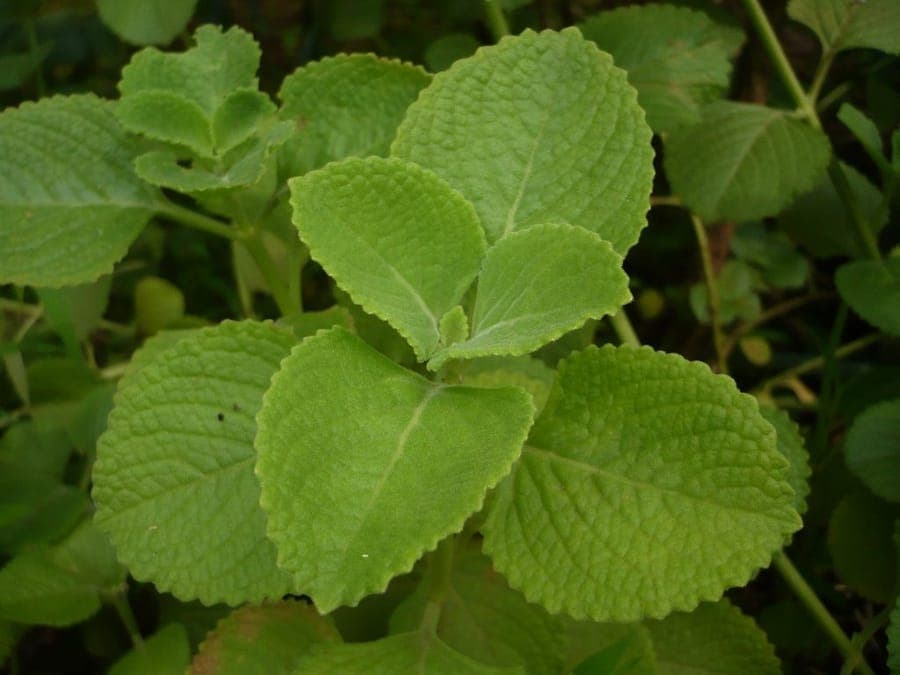
The leaves are opposite, broadly oval to almost round, usually 4 to 8 cm long, with a wavy, scalloped edge. They are thick and fleshy and feel velvety thanks to a dense layer of short hairs. The colour is a fresh light green. The photo shows exactly this: a close-up of young shoots with thick, hairy leaves and the typical scalloped margin. There is also a variegated form with a creamy white edge, often sold as 'Variegata'.
The stems are square and also succulent. Older plants become slightly woody at the base. The scent comes from essential oils in glands on the leaves, including carvacrol and thymol, the same compounds that give oregano and thyme their flavour.
Flowers are rarely seen in our climate. When they do appear, usually in late winter or spring on plants kept indoors, they are small lilac to pale purple lipped flowers in loose spikes. They have little ornamental value.
Ideal location
Cuban oregano loves light and warmth. Indoors it belongs on the sunniest windowsill, facing south or west. With too little light the plant stretches and the leaves become smaller and paler.
From late May to September it can go outside, in a sunny to lightly shaded spot out of the wind. Let it acclimatise for a week in partial shade first, or the leaves may scorch. When nights drop below 10 °C, bring it back in.
Soil and containers
Because the plant stores water in its leaves and stems, good drainage is essential. Mix ordinary potting compost with a third sand, perlite or fine grit, or use a mix for herbs and Mediterranean plants. A pot 15 to 20 cm across with a drainage hole is enough for a young plant. A terracotta pot helps excess moisture escape.
During the growing season, feed once a month with liquid fertiliser at half strength. Too much feed makes the plant soft and the flavour weaker.
Watering
Watering is where things usually go wrong, nearly always through overwatering. Let the compost dry out almost completely between waterings. In summer that means roughly twice a week outdoors and once a week indoors. In winter, a little water every two to three weeks is enough.
Limp, glassy or blackening stems at the base point to wet feet and root rot. Take healthy tips as cuttings straight away, because a rotting plant is hard to save.
Free preview
Want to see Cuban oregano (Coleus amboinicus): growing guide in your garden? Make a free preview of your design.
Harvesting and uses
You can harvest all year round, as long as you never take more than a third of the leaves. Pinch or snip off the top pairs of leaves; this keeps the plant compact at the same time.
The flavour is strong, so use it sparingly. One or two finely chopped leaves already give a pronounced herby aroma to beans, stews, soups, grilled meat or fish. It is a familiar herb in Caribbean and Indian cooking. The leaves are too juicy to dry well, so use them fresh. Sensitive people may develop redness or itching after contact with the sap. Use the plant as a culinary herb in small quantities.
Pruning and cuttings
In spring, cut long, bare stems back to a few pairs of leaves above the pot. The plant regrows quickly. Taking cuttings is child's play: put a tip 8 to 10 cm long in a glass of water or straight into moist sand. Roots appear within one to two weeks. You can let juicy cuttings dry for half a day before inserting them in compost.
Maintenance calendar
March to April: Cut back, repot and take cuttings. Start feeding lightly again.
May: Gradually acclimatise to outdoor light. After mid-May, once nights stay above 10 °C, move outside.
June to August: Harvest regularly, water moderately, feed monthly.
September: Bring indoors before nights turn too cold. Take cuttings as a reserve.
October to February: Sunny windowsill, little water, no feed. Keep harvesting sparingly.
Overwintering
Coleus amboinicus cannot take frost. Leaves are damaged below 5 °C, and ideally the winter temperature stays above 12 °C. An ordinary room by a sunny window is therefore a perfect winter spot; a cold greenhouse or garage is not.
In winter the plant grows slowly. Give little water and no feed, and turn the pot now and then so it does not lean towards the light. If the plant becomes long and bare, take cuttings in spring and start again with young plants. The plant calendar at gardenworld.app shows month by month when to bring herbs indoors, take cuttings and move them outside again.
Toxicity to pets
What is a kitchen herb for us is less harmless for pets. The American ASPCA lists Coleus amboinicus, under the names Indian borage and Spanish thyme, as toxic to dogs, cats and horses. The essential oils can cause vomiting, diarrhoea, lethargy and loss of appetite, sometimes with a little blood. The sap can also irritate animals' skin.
Most animals keep away from the strong smell, but a curious young cat may have a taste. Keep the plant out of reach, for example on a high shelf by the window or in a hanging pot. If you notice symptoms after your pet has eaten the leaves, call your vet.
Companion plants
On a sunny patio, Cuban oregano makes a lovely herb group with basil (Ocimum basilicum), rosemary (Rosmarinus officinalis), thyme (Thymus vulgaris) and common oregano (Origanum vulgare). Bear in mind the difference in hardiness: rosemary, thyme and oregano stay outside, while Coleus amboinicus comes indoors in September. Give it a pot of its own.
Indoors it looks good next to other sun-loving succulent plants such as Aloe vera. Both want plenty of light and little water, and together they make a neat group on the windowsill.
Final thoughts
Coleus amboinicus is a herb with character: easy to grow, quick to root from cuttings and with a flavour that makes a dish instantly recognisable. Give it sun, well-drained compost and above all not too much water. Bring it in before the cold arrives and keep it away from cats and dogs. Then you will have fresh leaves within reach all year round.
Frequently asked questions about Cuban oregano
When and how do you prune Cuban oregano?
In spring, cut long, bare stems back to a few pairs of leaves above the pot. The plant regrows quickly.
How much water does Cuban oregano need?
Watering is where things usually go wrong, nearly always through overwatering. Let the compost dry out almost completely between waterings.
Where does Cuban oregano grow best?
Cuban oregano loves light and warmth. Indoors it belongs on the sunniest windowsill, facing south or west.
What soil does Cuban oregano need?
Because the plant stores water in its leaves and stems, good drainage is essential. Mix ordinary potting compost with a third sand, perlite or fine grit, or use a mix for herbs and Mediterranean plants.

See it in your garden
See Cuban oregano in your garden
One photo of your garden and a few questions. You see the result in about a minute.
Try it with a photoIdentify this plant in your own garden. Identify a plant
Similar plants
Basil: complete guide
Ocimum basilicum
Discover how to grow Ocimum basilicum successfully in your garden or on your balcony. From light needs to harvesting tips, everything you need to know.
Rosemary: complete guide
Rosmarinus officinalis
Everything about Rosemary (Rosmarinus officinalis): planting, care, overwintering and culinary use. Practical tips for a healthy, aromatic shrub.
Thyme (Thymus vulgaris): complete guide
Thymus vulgaris
Everything about common thyme (Thymus vulgaris): planting, care, harvesting and culinary uses. Practical tips for a healthy, aromatic plant in garden and pot.
