
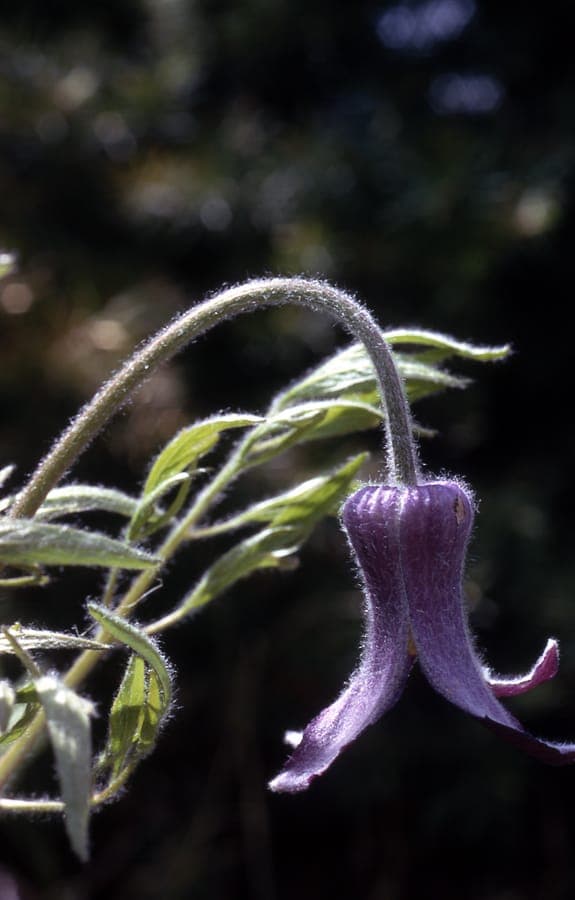
JW Stockert / Public domain, via Wikimedia Commons
Hairy clematis: complete guide
Clematis hirsutissima
Want to see Hairy clematis: complete guide in your garden?
1 minute, no credit card
Overview
Clematis hirsutissima, known as Hairy clematis or Hairy virginsbower, is a unique clematis species native to western North America. This Ranunculaceae family member grows from Colorado to Oregon and Washington, typically on mountain slopes and dry grasslands.
This is not a true climbing vine, but rather a sturdy upright or semi-climbing plant that can reach 60-90 centimeters tall. It distinguishes itself by its silky, dark purple to red flowers with bristles along the sepals (flower parts).
Appearance & Bloom
Hairy clematis grows as a compact, upright plant with thin, hairy stems. The flowers are small, tubular in shape about 1-2 centimeters long, in dark purple to purple-red. Uniquely, the stiffly hairy sepals cover the entire flower, from which this plant derives its name.
Flowers appear May through July, hanging downward in interesting clusters. Later, feathery seed pods with long silky hairs form, remaining decorative into fall.
Ideal Location
Hairy clematis grows best in full sun (6-8 hours daily). It tolerates light shade but thrives in open, sunny settings. The plant is very tolerant of windy environments, making it ideal for mountain gardens or windy side locations.
In warm-temperate climates, it can also function in partial shade, though flowers will be less numerous.
Soil
Hairy clematis is one of the most flexible clematis for soil type. It grows in dry, lean, rocky, sandy to moderately fertile soils. It cannot survive waterlogged ground, so ensure excellent drainage.
Practically no soil amendment required at planting. It thrives in poor soil better than many garden plants, making it ideal for marginal areas.
Free design
Want to see Hairy clematis: complete guide in your garden? Make a free design now.
Watering
Once established, Hairy clematis is extremely drought-tolerant and can survive months without water. During growth and bloom (May-July), you can water somewhat for better flowers, but it is certainly not required.
Ensure drainage is perfect - waterlogged ground will kill the plant. In very dry climates, water monthly during growing season if no rain falls.
Pruning
Hairy clematis can be lightly pruned in early spring (March) to maintain shape. It can be cut back to 30 centimeters above ground without damage. Much pruning is unnecessary.
After flowering (August-September), you can leave seeds for decorative value or cut back for neater appearance.
Maintenance Calendar
March-April: Light pruning for shape; no fertilizer needed. May-June: First flowering period; minimal water. July-August: Flowering decreases; no special attention. September-October: Seed pods ripen; enjoy silky hairs. November-February: Winter dormancy; no maintenance required.
Winter Hardiness
Hairy clematis is very winter-hardy, suitable for USDA zones 3-8. This makes it suitable for many cold climates including northern Europe. It can withstand temperatures down to -35 degrees Celsius.
Companion Plants
Companion plants for Hairy clematis:
- Eryngium: blue thistles provide color contrast
- Artemisia: silvery foliage frames dark purple flowers
- Catananche: blue cornflowers combine color-harmoniously
- Salvia: desert species share drought preference
Closing Thoughts
Clematis hirsutissima deserves more attention from gardeners with dry, windy gardens. With practically no maintenance and fascinating flowers and seed pods, it is an ideal native plant for western North America. Available at plant nurseries. For more landscape inspiration, visit gardenworld.app.
Recognize Hairy clematis by its characteristic dense hairiness on sepals and compact, upright growth habit. This is a truly maintenance-free plant for dry mountain landscapes.
Want to see Hairy clematis: complete guide in your garden? Make a free design now.
Upload a photo, pick a style, and get a photorealistic design with plant list in under a minute.
No credit card required


Similar plants
Crimson clematis: complete guide
Clematis texensis
Discover Clematis texensis with gorgeous red flowers. Texas-native climbing vine, drought-tolerant, long bloom season, warm climate.
Asian virginsbower: complete guide
Clematis florida
Discover Clematis florida with double blooms from East Asia. Elegant climbing vine for warm climates, summer bloomer, long season.
Purple clematis: complete guide
Clematis viticella
How to grow Clematis viticella successfully: ideal conditions, pruning, watering, companion plants and design tips for your garden.