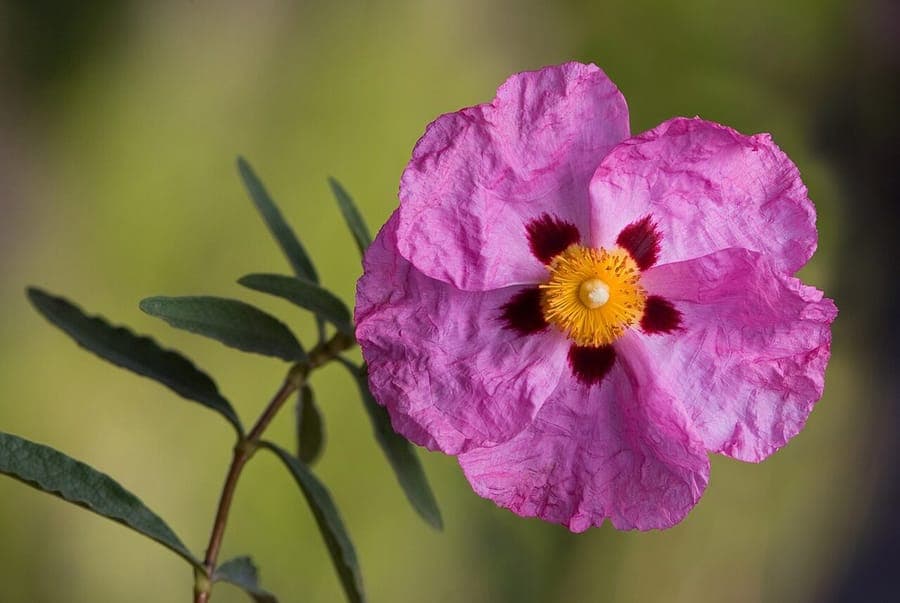
JJ Harrison (https://www.jjharrison.com.au/) / CC BY-SA 3.0, via Wikimedia Commons
Purple rock rose (Cistus × purpureus): complete guide
Cistus × purpureus
Want to see Purple rock rose (Cistus × purpureus): complete guide in your garden?
Full design in HD: €7.99
Look after your Purple rock rose with the GardenWorld app
Identify plants with your camera and get a care calendar with reminders for this plant.


Overview
Purple rock rose, Cistus × purpureus, is one of the finest rock roses for the garden. It brings the Mediterranean hillside into your border: a compact, aromatic shrub that in June and July is covered in large pink to purple flowers, each with five dark red blotches around a centre of golden stamens. The petals look like crumpled tissue paper, which gives the display a wonderfully delicate quality. It is also sold as orchid rock rose.
It is a hybrid between two wild Mediterranean species: Cistus creticus, with pink flowers, and Cistus ladanifer, the large white gum cistus with dark blotches and sticky, strongly scented leaves. From the first it inherited its colour, from the second its blotches and its aromatic, slightly sticky foliage. The plant grows 1 to 1.2 m tall and about as wide, establishes quickly and flowers from its first or second year. It holds the Award of Garden Merit from the Royal Horticultural Society.
Rock roses are not for every garden. They need sun, warmth and above all dry roots in winter. If you can offer those, you gain a very rewarding, low-maintenance shrub. On gardenworld.app you can have a garden design drawn up that shows the warmest, driest spots in your garden, exactly where a cistus belongs.
Appearance and bloom cycle
Cistus × purpureus forms a rounded, dense shrub with upright to slightly arching branches. The leaves are narrow and lance-shaped, 3 to 5 cm long, dark grey-green and slightly rolled at the edges. They feel a little sticky and release a herby, resinous scent on warm days. That fragrance comes from labdanum, a resin found throughout the cistus family and once widely used in perfumery. The plant is evergreen, so it provides structure in winter too.
Flowering starts in June and continues into July, sometimes a little longer in good weather. The flowers are 6 to 8 cm across and saucer-shaped, with five broad pink to magenta petals. At the base of each petal sits a dark maroon to almost black blotch, and in the centre is a dense ring of golden stamens. Each flower opens in the morning and drops by evening or the next day, but because the shrub keeps opening new buds you see flowers for weeks on end. Bees and bumblebees visit mainly in the morning, when pollen is plentiful.
After flowering, small round seed capsules form. You can leave them; they do no harm.
Ideal location
Give this rock rose the warmest, sunniest spot you have. Full sun is essential: at least six to eight hours of direct sunlight a day. In shade it grows thin and hardly flowers. A south-facing slope, a raised bed, a gravel garden or a position in front of a warm wall are all ideal. It tolerates wind and salt well, making it a good choice for coastal gardens.
Shelter from cold, wet northerly and easterly winds helps it through winter. Space plants 80 to 100 cm apart or from other shrubs. It also does well in a large container on a sunny patio, provided the pot drains well. Avoid moving an established cistus: it develops a deep root system and rarely recovers from transplanting.
Soil requirements
Well-drained, poor to moderately fertile soil is ideal. Sand, gravel, stony ground or a lean loam will all do, as long as water drains away quickly. On heavy clay there is a real risk it will not survive its first wet winter. In that case, dig plenty of coarse grit and gravel into the top 30 to 40 cm, or plant on a mound.
Cistus × purpureus is happy on chalky soil and also grows on slightly acidic ground. Feed little or not at all: too much fertiliser produces soft, long growth that is more vulnerable to frost and flops open sooner. A spadeful of compost in the planting hole is plenty. A gravel mulch around the base keeps the collar dry and reflects warmth.
Free preview
Want to see Purple rock rose (Cistus × purpureus): complete guide in your garden? Make a free preview of your design.
Watering
During the first growing season it needs regular watering: in dry spells give 5 to 8 litres once a week. After that, Cistus × purpureus is extremely drought tolerant and in a temperate climate rarely needs extra water. In a container, water in summer whenever the top few centimetres are dry.
The biggest danger is too much water, not too little. Avoid automatic irrigation where it grows, and do not plant it among thirsty neighbours that are watered often. In autumn and winter it needs no extra water.
Pruning
Rock roses reshoot poorly from old, bare wood, so pruning this plant is mainly a matter of little and often. Straight after flowering, in late July or early August, cut back the flowered shoots by about a third, always within the green, leafy part. This keeps the shrub compact and bushy.
On young plants you can pinch out the tips in spring to encourage branching. Never cut hard into old wood to rejuvenate a neglected, leggy shrub; it almost always fails. A cistus lives on average eight to twelve years. If it becomes too bare, replace it. Summer cuttings root easily, so you can always have a successor ready.
Maintenance calendar
March–April: Remove frost-damaged twigs once severe frost has passed. Plant new rock roses from containers.
May: Pinch out the tips of young plants for a fuller shape.
June–July: Full bloom. Water young plants during prolonged drought.
Late July–August: Light trim after flowering, a third of the flowered shoots, never into old wood. Take cuttings if you like.
September–October: No feeding and no heavy pruning, so the wood can ripen.
November–February: Protect the plant with fleece in hard frost and make sure the soil does not stay wet. Keep containers dry and sheltered.
The planting calendar on gardenworld.app helps you carry out these jobs at the right time, alongside the rest of your garden tasks.
Winter hardiness
Cistus × purpureus is one of the hardier rock roses, but it is not indestructible. In a dry, sheltered position it tolerates frost down to around -10 °C, briefly a little lower. Long spells of hard frost, especially combined with wet soil or cold easterly winds, can damage or kill it. Young plants are more vulnerable than established ones.
In most gardens in southern and central England and the milder parts of north-western Europe it does well in a warm, well-drained spot. Keep fleece handy for frosts below -8 °C and cover the plant temporarily. Move a container plant against a sheltered wall in winter, or into a cold, light shed or greenhouse during prolonged freezing weather. Because cuttings root so readily, it is wise to overwinter a few indoors each year as insurance.
Toxicity
Cistus × purpureus is not known to be poisonous to people or pets. The sticky resin on the leaves can occasionally cause mild skin irritation in sensitive people, so wear gloves when pruning if that affects you.
Companion plants
Cistus feels at home among other Mediterranean plants. Lavender (Lavandula angustifolia) flowers at the same time and creates a classic summer picture with the pink blooms. Rosemary (Rosmarinus officinalis) and common sage (Salvia officinalis) suit a herb-rich gravel garden around it. Cotton lavender (Santolina chamaecyparissus), with its silver-grey foliage, contrasts beautifully with the dark cistus leaves.
If you want more rock roses, pair it with the white-flowered Cistus laurifolius, which is hardier and forms a calm backdrop. Low ornamental grasses and bulbs such as alliums fill the spaces between the shrubs.
Final thoughts
Cistus × purpureus gives a great deal for very little: evergreen aromatic leaves, an abundant summer display and excellent drought tolerance. It asks for full sun, well-drained soil and a light trim after flowering. Protect it from wet winters and always keep a cutting in reserve. In the right spot it becomes one of the most rewarding shrubs in a sunny garden.
Frequently asked questions about Purple rock rose
Is Purple rock rose winter hardy?
Cistus × purpureus is one of the hardier rock roses, but it is not indestructible. In a dry, sheltered position it tolerates frost down to around -10 °C, briefly a little lower.
When and how do you prune Purple rock rose?
Rock roses reshoot poorly from old, bare wood, so pruning this plant is mainly a matter of little and often. Straight after flowering, in late July or early August, cut back the flowered shoots by about a third, always within the green, leafy part.
How much water does Purple rock rose need?
During the first growing season it needs regular watering: in dry spells give 5 to 8 litres once a week. After that, Cistus × purpureus is extremely drought tolerant and in a temperate climate rarely needs extra water.
Where does Purple rock rose grow best?
Give this rock rose the warmest, sunniest spot you have. Full sun is essential: at least six to eight hours of direct sunlight a day.
What soil does Purple rock rose need?
Well-drained, poor to moderately fertile soil is ideal. Sand, gravel, stony ground or a lean loam will all do, as long as water drains away quickly.

See it in your garden
See Purple rock rose in your garden
One photo of your garden and a few questions. You see the result in about a minute.
Try it with a photoIdentify this plant in your own garden. Identify a plant
Similar plants
English Lavender: complete guide
Lavandula angustifolia
Everything about English Lavender (Lavandula angustifolia): planting, pruning, care and overwintering. Practical tips for lush purple blooms.
Rosemary: complete guide
Rosmarinus officinalis
Everything about Rosemary (Rosmarinus officinalis): planting, care, overwintering and culinary use. Practical tips for a healthy, aromatic shrub.
Sage: complete guide
Salvia officinalis
Everything you need to grow and care for Salvia officinalis: ideal spot, soil needs, pruning, and winter hardiness for gardens in temperate climates.
