
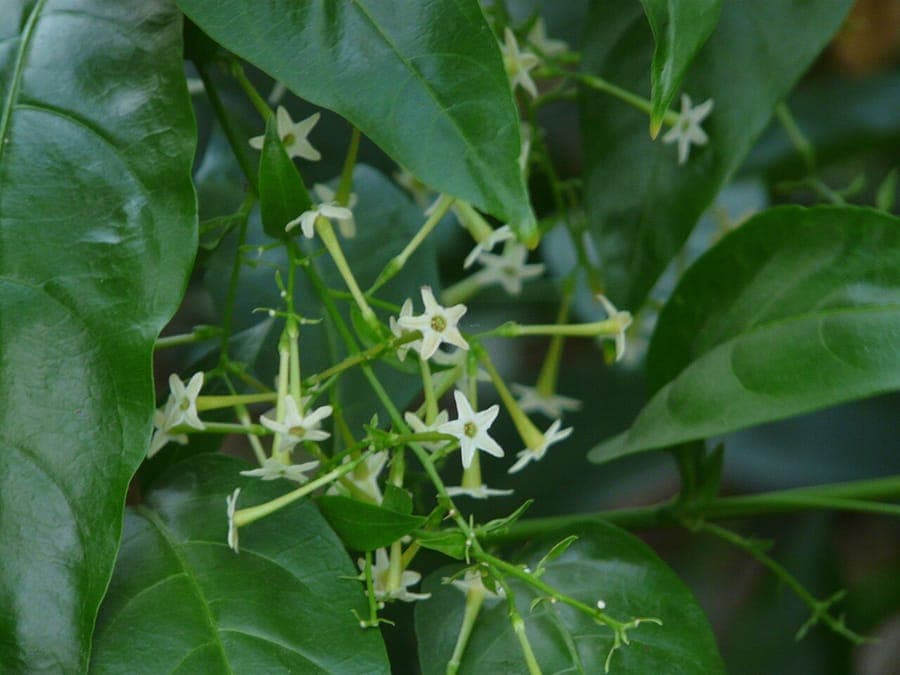
Dinesh Valke from Thane, India / CC BY-SA 2.0, via Wikimedia Commons
Night-jessamine: complete guide
Cestrum nocturnum
Want to see Night-jessamine: complete guide in your garden?
1 minute, no credit card
Overview
Cestrum nocturnum, commonly known as night-jessamine or lady-of-the-night, is a tropical shrub from the Solanaceae family famous for its intensely fragrant, night-blooming white flowers. This plant is native to Mexico and Central America but is now widely distributed in subtropical and warm temperate gardens worldwide.
The plant is particularly valued for its enchanting evening aroma, making it perfect for patios and balconies where you enjoy fresh air in the evening. This article guides you through all aspects of growing this fragrant tropical plant.
Appearance and bloom
Cestrum nocturnum is an undersized to medium-sized shrub that typically reaches 2 to 3 meters in height (sometimes taller under ideal conditions). The plant has dark green, oval leaves that give it a fine texture.
The main attraction, however, is the blooming. The plant produces clusters of small, star-like white flowers primarily in spring and summer, but also sporadically into autumn. These flowers are odorless during the day, but in the evening and at night (especially around sunset), they emit a strong, sweet, and pleasant aroma often compared to jasmine.
After flowering, small black berries appear that are poisonous and should not be eaten.
Ideal location
Cestrum nocturnum thrives in full sunlight with at least 6 hours of direct sun per day. The more sun, the more flowers. In very hot climates, some afternoon shade may be beneficial, but full sun is preferred.
The plant is very cold-sensitive and only grows in areas with minimum winter temperatures above zero. In northern European countries, it grows only as a potted plant or in heated greenhouses. In southern France, Spain, and further south, outdoor cultivation is possible.
Provide protection from strong winds that can damage branches.
Soil
Cestrum nocturnum thrives on virtually all soils provided they drain well. The plant prefers nutrient-rich, humus-rich soil with good water retention.
Optimal is a soil mix of 40% garden or nursery soil, 40% compost, and 20% sand or perlite for drainage. The pH should be neutral to slightly acidic (6 to 7).
Add organic material when planting. For container culture, use quality potting soil with compost. This plant is hungry for nutrients.
Free design
Want to see Night-jessamine: complete guide in your garden? Make a free design now.
Watering
Cestrum nocturnum loves consistently moist but not wet soil. Regular watering is essential during the growing season. In very warm conditions, daily watering may be needed.
Ensure good drainage; waterlogging causes root rot. In winter, especially in cooler climates, reduce watering.
Blooming is better with somewhat moist soil. Do not let the plant dry out between waterings.
Pruning
Cestrum nocturnum responds well to pruning and becomes more compact and flower-rich. Prune after flowering (August-September) to encourage more compact growth.
Hard pruning in spring can be done. Always remove dead branches. Old, thick stems can be completely removed to stimulate new growth.
Maintenance calendar
- Spring (March-April): Pruning, thinning branches, start watering and feeding
- Summer (May-August): Regular watering and feeding, deadhead after clusters
- Autumn (September-October): Reduce watering, hard pruning
- Winter (November-February): Minimal watering, no feeding, frost protection
Winter hardiness
Cestrum nocturnum is cold-sensitive and cannot tolerate temperatures below approximately 5 degrees Celsius. With prolonged exposure to temperatures below 0 degrees, the plant will die.
In outdoor cultivation outside warm climates, container culture in a greenhouse is necessary. Winter over in a heated space with a minimum temperature of 10-15 degrees.
Companion plants
Cestrum nocturnum combines well with:
- Jasmine sambac (Arabian jasmine) - similar night fragrance
- Cestrum diurnum (day-jessamine) - daytime blooms
- Trachelospermum (star jasmine) - for similar fragrance effect
- Bougainvillea - contrast in color and bloom pattern
- Lantana - for color and butterflies
Closing thoughts
Cestrum nocturnum is a unique choice for those seeking a fragrant, tropical plant that enriches the garden experience in the evening. While it requires care in temperate climates (container culture in a greenhouse), the reward of its enchanting aroma is overwhelming.
For gardenworld.app users: this plant is perfect for Mediterranean and southern European gardens, or as a summer plant on a terrace in more northern areas. The evening fragrance makes it ideal for patios where you enjoy summer evenings.
Gardenworld.app offers more exotic plant information. Discover how to integrate this enchanting night-jessamine into your garden design.
Available in northern Europe as a potted plant from major garden retailers. In southern Europe from local garden centers.
Want to see Night-jessamine: complete guide in your garden? Make a free design now.
Upload a photo, pick a style, and get a photorealistic design with plant list in under a minute.
No credit card required


Similar plants
Solanum dolichosepalum: complete guide
Solanum dolichosepalum
Discover Solanum dolichosepalum, an Andean nightshade with striking long sepals. Growing tips, hardiness, and companion planting for your patio.
Solanum ripense: complete guide
Solanum ripense
Discover Solanum ripense, a moisture-loving Andean nightshade for pond edges and conservatories. Growing tips, hardiness, and companions.
Solanum tomentosum: complete guide
Solanum tomentosum
Discover Solanum tomentosum, a thorny South African nightshade with felted leaves. Growing tips, hardiness, and companion planting ideas.