
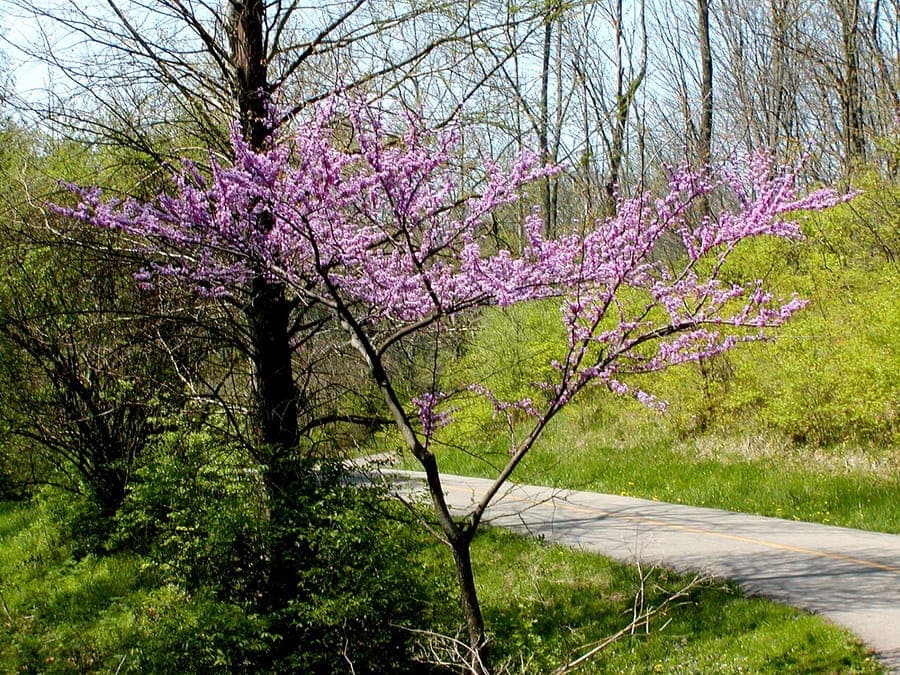
Greg Hume / CC BY-SA 3.0, via Wikimedia Commons
Eastern Redbud (Cercis canadensis): complete guide
Cercis canadensis
Want to see Eastern Redbud (Cercis canadensis): complete guide in your garden?
1 minute, no credit card
Overview
Eastern Redbud (Cercis canadensis) is one of the most spectacular spring-flowering trees you can plant in a garden. This is a tree that literally explodes into colour: in March-April, before the foliage appears, thousands of small pink-purple flowers cover the bare branches and even the trunk itself - a phenomenon known as cauliflory. The effect is breathtaking and transforms this modest tree into an unforgettable spectacle that stops every passer-by in their tracks.
Cercis canadensis is a deciduous tree from the pea family (Fabaceae), originally native to eastern North America. In temperate European gardens the tree reaches 6-10 metres with a broadly spreading, often multi-stemmed crown that takes on an elegant, vase-like form. On gardenworld.app you can create a garden design where the redbud forms the undisputed centrepiece - as a specimen in a lawn, as an eye-catcher at the entrance, or as a canopy tree above a terrace. Beyond the spectacular bloom, Cercis canadensis offers heart-shaped leaves that turn glorious golden-yellow in autumn, giving the tree two seasons of show-stopping performance.
Appearance and seasonal interest
The flowering of Eastern Redbud is the highlight of the garden year. In March-April, often when the forsythia is just beginning to flower, the blooms open - small, pea-like flowers of 1-1.5 cm in dense clusters that emerge directly from the wood. The flowers sit on the twigs, the larger branches, and even the trunk, shrouding the entire tree in a pink-purple haze. Flowering lasts two to three weeks and provides an important early food source for bees and bumblebees.
After flowering the foliage appears: beautiful heart-shaped leaves 8-12 cm wide that often emerge with a bronze tint before turning fresh green. In the cultivar 'Forest Pansy' the foliage remains deep purple-red throughout the season, one of the most stunning leaf colours in the plant kingdom. In autumn the species colours warm golden-yellow to orange-yellow, creating a second peak of interest. After leaf fall, the characteristic flat, brown seed pods become visible, hanging on the tree well into winter.
Top cultivars
The range of Cercis canadensis cultivars has expanded enormously in recent decades, with selections varying in leaf colour, growth habit, and flowering intensity. 'Forest Pansy' is by far the most popular cultivar and is rightly considered one of the most beautiful ornamental trees in the world. The foliage emerges glossy crimson-red and deepens to purple-brown through summer. The pink-purple flowers against the dark wood are of unrivalled beauty.
'Hearts of Gold' is a relatively recent selection with spectacularly golden-yellow foliage that retains its colour throughout summer. The contrast between the pink spring flowers and the golden foliage that follows is stunning. 'The Rising Sun' offers a kaleidoscope of leaf colours: new foliage is orange-red, turning golden-yellow and eventually maturing to chartreuse green. Each branch simultaneously displays multiple tones, making the tree resemble a living painting. Specialist tree nurseries and well-stocked garden centres carry these cultivars, though the rarer selections may not always be in stock.
Ideal location
Eastern Redbud needs a sheltered, sunny to partially shaded position. The tree flowers most profusely in full sun but tolerates light shade - in the wild it often grows as an understorey tree in open deciduous woodland. A spot with morning sun and protection from cold north-easterly winds is ideal. Avoid fully shaded positions and wind tunnels between buildings.
The tree performs superbly as a lawn specimen, as a focal point in a front garden, or as a canopy tree above a terrace or seating area. The broadly spreading crown casts light, filtered shade that is pleasant to sit under and admits enough light for underplanting. In small gardens, Cercis canadensis is one of the best choices due to its modest size (6-10 metres), multi-season interest, and elegant growth form.
Soil requirements
Cercis canadensis is surprisingly tolerant of soil type and grows on most ground: clay, sand, loam, and mildly chalky soil. The ideal soil is moisture-retentive but well-drained, slightly acidic to alkaline (pH 5.5-8.0), and moderately fertile. The tree tolerates both slightly dry and temporarily wet soil, but permanently waterlogged ground must be avoided.
When planting in heavy clay, it is wise to dig the planting hole extra wide (three times the root-ball diameter) and mix the soil with compost and coarse sand to improve drainage. On poor sandy soil, a generous spadeful of compost helps improve moisture retention. Mulch with a layer of 5-8 cm around the trunk (but not touching it) to regulate soil moisture and suppress weeds.
Planting
The best planting time for Eastern Redbud is early spring (March-April) or autumn (October-November). Spring planting is preferred in colder regions, giving the tree a full growing season to root before winter. Choose a quality container-grown plant - Cercis transplants poorly as a bare-root specimen due to its sensitive taproot.
Dig a planting hole twice as wide and the same depth as the container root ball. Mix the excavated soil with compost at a ratio of three to one but do not add synthetic fertiliser. Plant the tree at exactly the same depth as it sat in the container - planting too deeply can cause stem and root rot. Water generously immediately after planting with 15-20 litres and apply a mulch layer. Support the tree in its first year with a sturdy stake placed at an angle into the prevailing wind.
Watering
During the first and second years after planting, regular watering is essential to establish the root system. Give 10-15 litres per week in dry weather, preferably slowly at the base so the water penetrates deeply. Avoid daily small amounts - this encourages shallow roots that make the tree vulnerable to drought.
From the third year onward, Eastern Redbud is reasonably drought-tolerant and needs no supplementary water in a normal season. During prolonged drought (more than three weeks without rain), give a generous soaking of 20-30 litres at a time. Trees in containers need regular water year-round - check weekly and water when the top 5 cm of soil feels dry.
Free design
Want to see Eastern Redbud (Cercis canadensis): complete guide in your garden? Make a free design now.
Pruning
Eastern Redbud has a naturally elegant growth form and needs little pruning. In the early years you can guide the shape by choosing either single-stemmed or multi-stemmed form. For a single-stemmed tree, gradually remove the lowest side branches until the desired clear trunk height is reached (usually 150-200 cm). For a multi-stemmed tree, retain three to five strong stems and remove the rest.
Always prune immediately after flowering (April-May) - the tree flowers on the previous year's wood, so pruning in winter or early spring removes flower buds. Remove crossing branches, deadwood, and any water sprouts (steeply upward-growing shoots). Avoid large pruning wounds: Cercis regenerates slowly and large wounds heal poorly, increasing the risk of fungal infection.
Maintenance calendar
March-April: Flowering begins. Enjoy the spectacle. Plant new trees. Remove winter protection from young trees.
May: Foliage appears. Immediately after flowering is the ideal pruning window. Apply a light dressing of compost around the root zone.
June-July: The tree is in full leaf. Enjoy the decorative foliage, particularly in cultivars such as 'Forest Pansy' and 'Hearts of Gold'. Water during dry spells.
August-September: Seed pods develop. Foliage begins its gradual colour change.
October-November: Peak autumn colour. Plant new trees. Apply a mulch layer before winter.
December-February: Dormancy. For young trees (first three to four years), protect the trunk with hessian wrap when severe frost is forecast. Admire the decorative pods hanging from the bare branches.
Winter hardiness
Cercis canadensis is hardy to approximately -25 to -30 degrees C (USDA zones 4-9), making it considerably hardier than its European cousin Cercis siliquastrum (the Judas Tree, USDA 6-9). Across the British Isles and Western Europe, Eastern Redbud is fully hardy, though young trees in their first three to four years benefit from some protection.
Protect young trees by wrapping the trunk base with hessian or tree wrap and applying an extra-thick mulch layer of 10-15 cm around the root zone. Once established (three to four years), the tree is completely self-sufficient. The greatest risk is not winter cold but late spring frost that can damage flower buds - a sheltered position significantly reduces this risk. The cultivar 'Forest Pansy' is slightly less hardy than the species and performs best in a protected spot.
Pests and diseases
Eastern Redbud is generally a healthy tree with few serious problems. The most common disease is verticillium wilt (Verticillium dahliae), a soil-borne fungus that causes branch dieback. Symptoms include suddenly wilting foliage on one or more branches, often on one side of the tree. Prune affected branches 30 cm below the visibly diseased wood and disinfect your secateurs. No chemical control is available.
Canker (Botryosphaeria) can occur as sunken, dark patches on the trunk and branches, often following pruning wounds or storm damage. Prevent canker by pruning only with sharp, clean tools and avoiding large cuts. Aphids sometimes appear on young foliage but are rarely serious and do not diminish the tree's ornamental value.
Autumn colour
The autumn colour of Cercis canadensis is the second great highlight after the spring bloom. The heart-shaped leaves turn gradually from green to warm golden-yellow, sometimes with orange tints, from early October. The effect is subtle but long-lasting - autumn colour persists for three to four weeks. In 'Forest Pansy' the purple-brown foliage transforms into shades of orange and red, an even more spectacular autumn display.
Autumn colour is finest in years with a warm, dry autumn followed by cool nights. In a sheltered spot, protected from early autumn storms, the foliage holds longest. After leaf fall, the graceful crown shape and hanging seed pods provide winter interest. The tree therefore offers something in every season - a quality that few trees possess.
Companion plants
Eastern Redbud is a rewarding tree to combine with other plants thanks to its light, filtered shade and modest size. Beneath the tree, shade plants such as hostas, brunnera, ferns, and shade grasses thrive. The combination of pink redbud blossom above a carpet of blue brunnera foliage (Brunnera macrophylla 'Jack Frost') is one of the most beautiful spring scenes you can create.
As a companion tree, Cercis canadensis pairs beautifully with serviceberry (Amelanchier lamarckii) - both flower in early spring, and the white Amelanchier bloom alongside the pink Cercis blossom creates an enchanting colour palette. Japanese maple (Acer palmatum) is an excellent partner for autumn colour, and Japanese dogwood (Cornus kousa) for summer bloom. In the border around the tree, plant spring-flowering bulbs - daffodils, grape hyacinths, and scilla - that bloom alongside the tree.
Final thoughts
Eastern Redbud is one of those rare trees that genuinely impresses in every season: overwhelming spring blossom, decorative heart-shaped summer foliage, golden autumn colour, and an elegant silhouette in winter. It is a tree that lifts any garden to a higher level and delivers years of joy with minimal maintenance.
Choose your Cercis canadensis from a reputable garden centre or specialist tree nursery - for distinctive cultivars such as 'Forest Pansy' and 'Hearts of Gold', a specialist is often the best source. On gardenworld.app you can create a garden design that combines the redbud with the right underplanting and companion trees for your specific garden. Plant a Cercis this spring and give your garden a tree that astonishes anew every year.
Want to see Eastern Redbud (Cercis canadensis): complete guide in your garden? Make a free design now.
Upload a photo, pick a style, and get a photorealistic design with plant list in under a minute.
No credit card required


Similar plants
Juneberry: complete guide
Amelanchier lamarckii
Everything about the Juneberry (Amelanchier lamarckii): spring blossom, autumn colour, edible berries and care. Expert tips for this versatile four-season tree.
Japanese Maple: complete guide
Acer palmatum
Everything about Japanese Maple (Acer palmatum): planting, pruning, cultivars and autumn colour. Expert tips for a spectacular ornamental tree in your garden.
Japanese dogwood: complete guide
Cornus kousa
Everything about the Japanese dogwood (Cornus kousa): spectacular bracts, autumn colour, edible fruits and care. Expert tips for this elegant ornamental tree.