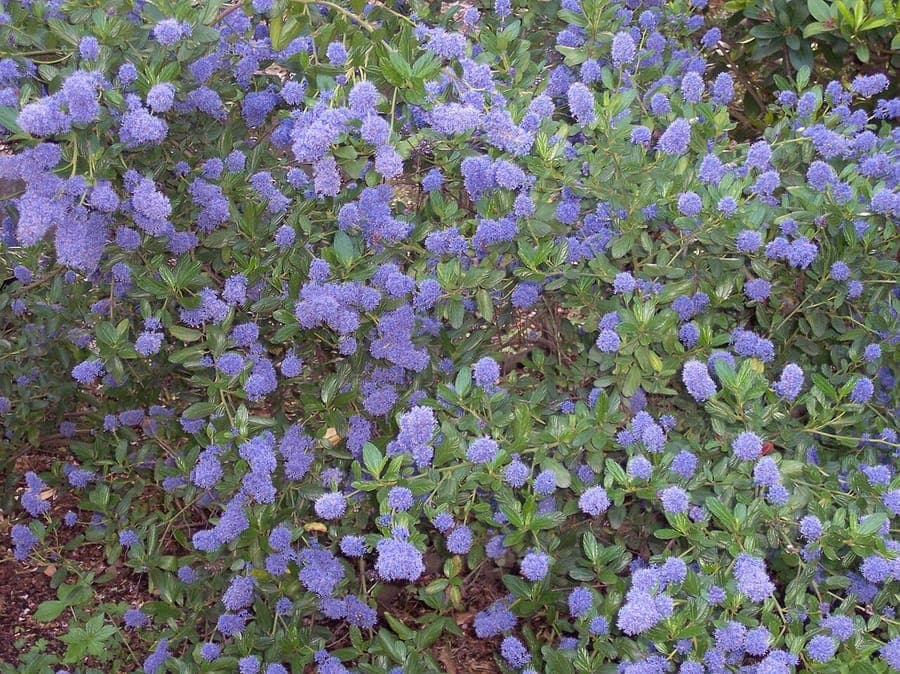
A. Barra / CC BY 3.0, via Wikimedia Commons
Blueblossom (Ceanothus thyrsiflorus): growing guide
Ceanothus thyrsiflorus
Want to see Blueblossom (Ceanothus thyrsiflorus): growing guide in your garden?
Full design in HD: €7.99
Look after your Blueblossom with the GardenWorld app
Identify plants with your camera and get a care calendar with reminders for this plant.


Overview
Blueblossom (Ceanothus thyrsiflorus) is an evergreen shrub from the buckthorn family, Rhamnaceae, and in May it disappears almost entirely beneath a haze of sky-blue flower clusters. It grows wild along the coast of California and south-western Oregon, on sunny slopes, in coastal scrub and along the edges of redwood forest. The genus as a whole is sold as Californian lilac, although it has nothing to do with true lilacs.
Among the many species of Ceanothus, this is one of the most vigorous and widely grown. In gardens in Britain and the Low Countries it usually reaches 2 to 4 metres in height and spread, a little more when trained against a warm wall. There is also a creeping form, var. repens, sold simply as 'Repens', which makes a low mound about 1 metre high and 2 to 3 metres across. Another popular choice is 'Skylark', a compact selection of 1.5 to 2.5 metres with deep blue flowers that open slightly later than most. On gardenworld.app you can have a garden design created that gives a blue shrub like this the warm, sheltered spot it needs, together with partners that enjoy the same dry, sunny conditions.
One feature sets the genus apart: its roots carry nodules containing Frankia bacteria that fix nitrogen from the air. That is why blueblossom copes so well on poor ground and rarely needs feeding.
Appearance and flowering season
The leaves are oval to oblong, 2.5 to 5 cm long, glossy dark green above and finely toothed along the edge. Look closely and you will see three prominent veins fanning out from the base of each leaf, a reliable way to recognise this group of Ceanothus. Young shoots are green, angled and stay supple for some time.
The species name thyrsiflorus refers to the thyrse, a branched, roughly cone-shaped flower cluster. Each cluster is 3 to 8 cm long and made up of hundreds of tiny flowers in pale to mid blue, as in the photograph, with the odd whitish plant turning up in the wild. In north-west Europe it flowers from late April into June, with the peak in May. Honeybees, bumblebees and hoverflies arrive in large numbers, and a shrub in full flower hums audibly on a sunny day. The scent is light and faintly honeyed.
After flowering, small three-lobed seed capsules form, which split open when ripe and flick out their seeds. They are inconspicuous and have no ornamental value. Ceanothus grows quickly but is not long-lived: in a garden, 10 to 20 good years is a fair expectation. Knowing this, many gardeners take a few cuttings in summer or plant a successor in good time.
Ideal position
Give Ceanothus thyrsiflorus the warmest, sunniest spot you have. Full sun is essential for a generous display and keeps the plant dense. A south- or west-facing wall is ideal: the brickwork releases warmth at night and breaks cold easterly and northerly winds, which dry out the evergreen leaves in winter. On an open, exposed site inland the shrub suffers far more from frost than it needs to.
It does well by the sea, as it tolerates salt-laden wind. When planting, allow for the final spread: a shrub 3 metres across after four or five years is quite normal. Against a wall, plant at least 40 to 50 cm out from the base so the roots are not stuck in the dry rain shadow of the building. Ceanothus dislikes being moved, so choose the right spot first time and buy a young pot-grown plant, which establishes far better than a large specimen.
Soil requirements
Free drainage matters much more than fertility. Sandy soil, light loam and stony ground all suit it well. On heavy clay that becomes waterlogged in winter the roots rot, and plants often die suddenly, particularly after a wet winter. Improve heavy ground generously with coarse grit and gravel, or plant on a slightly raised bed.
Blueblossom tolerates neutral to moderately alkaline soil, although on very shallow chalk the leaves may turn yellow through iron deficiency. Feeding is rarely needed because the nitrogen-fixing bacteria supply the basics; too much fertiliser produces soft, frost-tender growth and fewer flowers. A thin layer of compost at planting time is plenty.
Free preview
Want to see Blueblossom (Ceanothus thyrsiflorus): growing guide in your garden? Make a free preview of your design.
Watering
In the first year after planting, water regularly, roughly 10 litres once a week in dry weather, until the roots have spread into the surrounding soil. After that, Ceanothus thyrsiflorus is remarkably drought tolerant and usually gets through a warm summer without help.
Overwatering is a bigger risk than drought. In its native range it receives very little summer rain, and warm, wet soil in July and August encourages root rot caused by Phytophthora. During a prolonged dry spell, give one thorough soak rather than a little every day. Plants in large containers do need more attention: check the compost every few days in summer and make sure surplus water drains away freely.
Pruning
Prune Ceanothus thyrsiflorus straight after flowering, in June or early July. Shorten the flowered shoots by a third to a half to keep the shrub bushy and encourage plenty of young wood to carry next year's flowers. Never cut back hard into old, bare wood: it rarely sprouts again, and drastic renovation usually finishes the plant off.
On a wall, tie the long shoots in to wires or a trellis after flowering and trim back any branches growing straight out from the wall. An old, leggy specimen is better replaced with a young plant than rescued. Avoid pruning in late summer or autumn, as the soft growth that follows rarely survives the winter.
Maintenance calendar
March to April: Cut out frost damage once the weather turns mild, taking damaged shoots back to healthy green wood. A good time to plant new pot-grown shrubs.
May: Peak flowering. Water young plants in dry spells and enjoy the bees.
June to July: Prune flowered shoots straight after flowering. Tie in wall-trained plants. Take semi-ripe cuttings if you want a replacement.
August to September: No more pruning or feeding. Water only during long droughts.
October to November: Keep the base clear of thick, wet layers of fallen leaves. Give young plants an open mulch of gravel or bark.
December to February: In severe frost and cold winds, wrap young plants temporarily in horticultural fleece. Shake heavy snow off the branches, which break easily.
Winter hardiness
Blueblossom is among the hardiest of the evergreen Ceanothus, but it is not indestructible. The Royal Horticultural Society rates it H4, which in practice means it copes with temperatures down to about -10 °C. Older, well-established plants in a sheltered, well-drained spot can survive short spells of harder frost, often losing some leaves that are replaced in spring. Young plants and those in wet soil are far more vulnerable.
In coastal and urban gardens it usually thrives. In colder inland or upland areas, plant it only against a sheltered south-facing wall. When temperatures drop below -10 °C, protect a young plant with a double layer of fleece and remove it as soon as the weather softens, so the foliage does not sweat.
Toxicity is not a known issue with this species. There are no reports of poisoning in people or pets, although the flowers contain saponins (they lather in water) and should not be eaten. Nor is there any record of the species spreading invasively from seed in Europe.
Companion plants
Ceanothus thyrsiflorus looks superb with plants that share its love of sun and sharp drainage. Rosemary (Rosmarinus officinalis) and English lavender (Lavandula angustifolia) provide a grey-green base that makes the blue glow. The Mediterranean spurge Euphorbia characias adds lime-green flower heads in spring, a striking contrast with the blue clusters.
For a Mediterranean mood, add a rock rose such as Cistus ladanifer, with its large white flowers marked with dark blotches. For a calmer evergreen backdrop, Mexican orange blossom (Choisya ternata) flowers in scented white at the same time. Yellow and cream flowers, such as brooms and yellow roses, intensify the blue, but avoid thirsty neighbours such as hydrangeas, which want moist soil. The planting calendar on gardenworld.app helps you choose these partners so that something is in flower around your blue shrub from April well into autumn.
Final thoughts
Ceanothus thyrsiflorus is a shrub for anyone who loves a generous show of blue and is willing to give it a warm, free-draining spot. With full sun, dry roots, a light trim after flowering and shelter from cold winds, it rewards you every spring with a cloud of flowers alive with bees. Accept that it will not last forever, plant a successor in good time, and you will enjoy one of the finest blue-flowered shrubs a temperate garden can grow.
Frequently asked questions about Blueblossom
Is Blueblossom winter hardy?
Blueblossom is among the hardiest of the evergreen Ceanothus, but it is not indestructible. The Royal Horticultural Society rates it H4, which in practice means it copes with temperatures down to about -10 °C.
When and how do you prune Blueblossom?
Prune Ceanothus thyrsiflorus straight after flowering, in June or early July. Shorten the flowered shoots by a third to a half to keep the shrub bushy and encourage plenty of young wood to carry next year's flowers.
How much water does Blueblossom need?
In the first year after planting, water regularly, roughly 10 litres once a week in dry weather, until the roots have spread into the surrounding soil. After that, Ceanothus thyrsiflorus is remarkably drought tolerant and usually gets through a warm summer without help.
What soil does Blueblossom need?
Free drainage matters much more than fertility. Sandy soil, light loam and stony ground all suit it well.

See it in your garden
See Blueblossom in your garden
One photo of your garden and a few questions. You see the result in about a minute.
Try it with a photoIdentify this plant in your own garden. Identify a plant
Similar plants
Rosemary: complete guide
Rosmarinus officinalis
Everything about Rosemary (Rosmarinus officinalis): planting, care, overwintering and culinary use. Practical tips for a healthy, aromatic shrub.
English Lavender: complete guide
Lavandula angustifolia
Everything about English Lavender (Lavandula angustifolia): planting, pruning, care and overwintering. Practical tips for lush purple blooms.
Mediterranean spurge: complete guide
Euphorbia characias
Everything you need to know about Euphorbia characias: care, blooming cycle, ideal placement, and companion plants for dry gardens.
