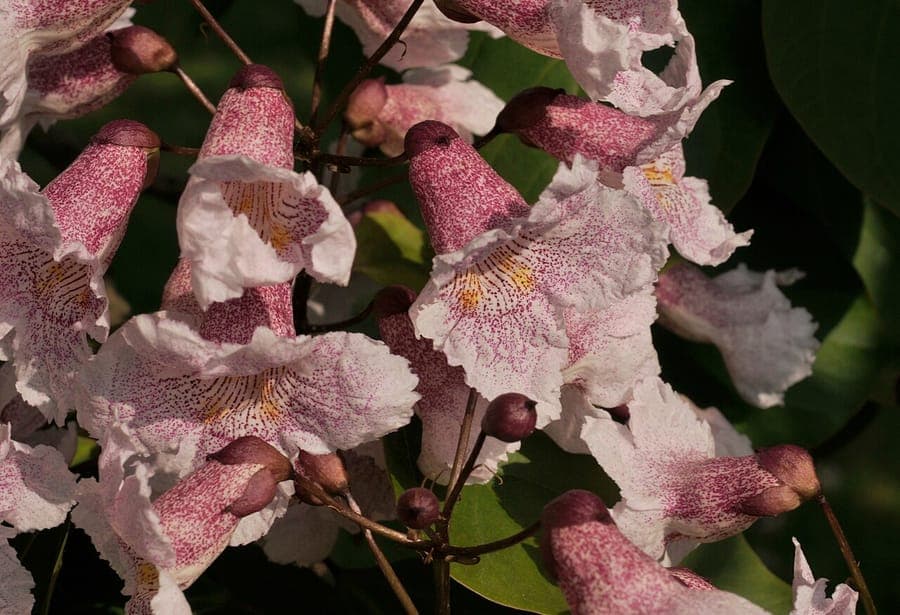
HorsePunchKid / CC BY-SA 3.0, via Wikimedia Commons
Catalpa bungei: complete guide
Catalpa bungei
Want to see Catalpa bungei: complete guide in your garden?
Full design in HD: €7.99
Look after your Catalpa bungei with the GardenWorld app
Identify plants with your camera and get a care calendar with reminders for this plant.


Overview
Catalpa bungei, commonly known as Manchurian catalpa or Bunges trumpet tree, is an elegant tree from the Bignoniaceae family (trumpet vine family). Originally from central and south-central China, this is a striking ornament for large gardens and estates. The tree adds dramatic form, large leaf texture, and early bloom to landscape plans.
Appearance and Bloom
Manchurian catalpa reaches 6 to 12 meters height in temperate climates, though it can grow larger in China. The tree has a broad, rounded crown shape. The leaves are unusually large - typically 12 to 20 centimeters long - and heart-shaped, with irregular margins. The leaves are dull green, slightly downy on the undersides.
The flowers appear in May-June, directly after leaf unfolding. They are small, white to light purple, in upright panicles growing 20-30 centimeters long. The flowers have a sweet, delicate fragrance. Following bloom, long, thin seed pods form (up to 40 centimeters) that ripen in October.
Ideal Location
Manchurian catalpa grows best in full sun. The tree requires at least six hours direct sunlight daily. Protection from strong wind is beneficial - the tree can suffer top damage in windy areas. Plant in sheltered locations.
The tree suits large gardens, parks, and estates. Do not plant in confined spaces or near houses where falling seed pods create hazard.
Soil
Manchurian catalpa prefers well-draining soil. The tree accepts acidic to neutral soils with pH 5.5 to 7.0. The tree can tolerate moderately dry conditions once established, but prefers regularly moist soil during the growing period.
Adding compost or organic matter improves growth at planting. The tree is not particularly soil nutrient sensitive.
Free preview
Want to see Catalpa bungei: complete guide in your garden? Make a free preview of your design.
Watering
During the first growing year water regularly (weekly). Once established, the tree can tolerate dry periods, though regular watering stimulates better growth. In hot summers, spraying foliage helps reduce heat stress.
Avoid waterlogging and stagnant water.
Pruning
Manchurian catalpa requires minimal pruning. Remove only dead or damaged branches in early spring (March). Formal pruning does not suit the tree well - it leads to poor branch structure and diseases.
If the tree grows irregularly, you can gently train wandering branches, but avoid strict forming.
Maintenance Calendar
March: Inspect for winter damage. Prune dead branches.
April-May: Monitor growth and bloom.
June-August: Water regularly in dry periods.
September-October: Reduce watering as leaf drop begins.
November-February: Winter phase; no active maintenance.
Winter Hardiness
Manchurian catalpa is hardy to about -15 degrees Celsius (zone 6). In stricter winters, flowering may be damaged. Young trees should be protected during their first winter with shade cloths or mulch around the base.
Special Care
The tree is largely disease-free in temperate climates. Very rarely can leaf spot or rust occur, especially in warm, humid conditions. Prevention via good air circulation is preferred.
Seed pods can be annoying in urban areas through falling material. Consider this when choosing location.
Companion Plants
Manchurian catalpa works well as a solitary tree (alone). It can also be supported by shade-tolerant shrubs such as weigela, viburnum, and deutzia. In larger estates, combine with other ornamental trees like flowering crabapple and ever-blooming magnolia.
Conclusion
Catalpa bungei is an excellent choice for temperate gardens desiring dramatic, Asian form. With its large leaves, early bloom, and long seed pods, it adds interest and texture. Plant it as a statement tree, and enjoy years of garden pleasure.
Frequently asked questions about Catalpa bungei
Is Catalpa bungei winter hardy?
Manchurian catalpa is hardy to about -15 degrees Celsius (zone 6). In stricter winters, flowering may be damaged.
When and how do you prune Catalpa bungei?
Manchurian catalpa requires minimal pruning. Remove only dead or damaged branches in early spring (March).
How much water does Catalpa bungei need?
During the first growing year water regularly (weekly). Once established, the tree can tolerate dry periods, though regular watering stimulates better growth.
Where does Catalpa bungei grow best?
Manchurian catalpa grows best in full sun. The tree requires at least six hours direct sunlight daily.
What soil does Catalpa bungei need?
Manchurian catalpa prefers well-draining soil. The tree accepts acidic to neutral soils with pH 5.5 to 7.0.

See it in your garden
See Catalpa bungei in your garden
One photo of your garden and a few questions. You see the result in about a minute.
Try it with a photoIdentify this plant in your own garden. Identify a plant
Similar plants
Chinese trumpet vine (Campsis grandiflora): complete guide
Campsis grandiflora
Chinese trumpet vine (Campsis grandiflora): large apricot flowers, a warm wall, support for a climber without aerial roots, pruning, skin irritation and frost.
Hybrid trumpet vine (Campsis × tagliabuana): complete guide
Campsis × tagliabuana
Hybrid trumpet vine (Campsis × tagliabuana), such as 'Madame Galen': sturdy support, spur pruning, root suckers, skin irritation and winter hardiness.
Chilean glory flower (Eccremocarpus scaber): complete guide
Eccremocarpus scaber
How to grow Chilean glory flower (Eccremocarpus scaber): sowing, supports, position, watering, pruning and overwintering this fast climber with orange-red tubular flowers.
