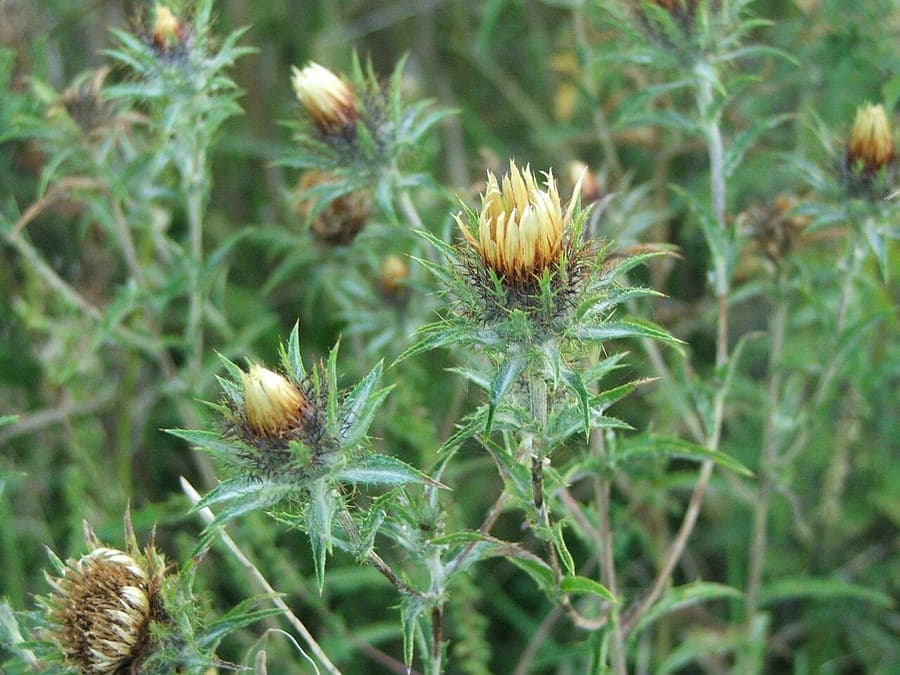
User:Pipi69e / Public domain, via Wikimedia Commons
Carlina biebersteinii: complete guide
Carlina biebersteinii
Want to see Carlina biebersteinii: complete guide in your garden?
Full design in HD: €7.99
Look after your Carlina biebersteinii with the GardenWorld app
Identify plants with your camera and get a care calendar with reminders for this plant.


Overview
Carlina biebersteinii, also known as Long-leaved Carline Thistle or Stiff Carline Thistle, is a striking thistle-like plant native to Europe through Siberia and Turkey. This characteristic plant belongs to the Aster family and grows naturally in dry, sunny slopes and rocky areas. In the front garden, it provides structure, interesting flowers, and unexpected natural character that adds real beauty to Mediterranean and contemporary garden styles.
Carlina biebersteinii is renowned for its drought tolerance and adaptability. It flourishes in full sun and tolerates dry, poor soils that would exhaust many other plants. This makes it a perfect choice for low-maintenance front garden designs.
Appearance and Bloom
Carlina biebersteinii grows as a compact, upright herb reaching approximately 40-60 cm in height. The leaves are long and narrow, explaining the German name "Langblatt". They display a grayish-green appearance with stiff spines along the margins. The beautiful yellow flowers appear in July and August, consisting of numerous small florets forming a large, striking flowerhead.
The flowers remain ornamentally valuable for weeks and attract many pollinators. After flowering, spectacular feathery seeds form that retain ornamental interest in autumn. This keeps the plant interesting across multiple seasons.
Ideal Location
Carlina biebersteinii grows best in full sunlight. Choose a location with at least six to eight hours of direct sunshine daily. The plant thrives in open, exposed locations with good air circulation.
This is an ideal choice for south-facing yards or west-oriented borders. It tolerates wind better than many plants and grows well in coastal and windy areas. Avoid full shade, where flowering will be minimal.
Soil
Carlina biebersteinii grows optimally in dry, well-draining soils. The plant tolerates even poor, stony soils that many other crops reject. Heavy, water-holding soils can lead to root rot.
The plant tolerates neutral to slightly alkaline soils well (pH 7.5-8). Add sand or gravel if your soil is heavy and clayey. Adding organic matter is less important than ensuring good drainage.
Free preview
Want to see Carlina biebersteinii: complete guide in your garden? Make a free preview of your design.
Watering
Carlina biebersteinii is drought-tolerant. Once established, it requires very little water. Water only during extreme drought or in the first growing year after planting.
Excessive water is the primary threat. Ensure the plant dries thoroughly between rains and irrigation. In Mediterranean climates, it can grow entirely without supplemental water.
Pruning
Pruning is not essential for Carlina biebersteinii. Remove spent flowerheads after blooming to maintain a neater appearance. Leave the feathery seeds for autumn interest and bird food.
In spring, dead stems can be removed at ground level. Avoid heavy pruning; this plant recovers slowly from aggressive cutting.
Maintenance Calendar
Spring: Remove dead stems. Summer: Enjoy flowering, no maintenance needed. Autumn: Leave dried flowerheads for interest. Winter: No maintenance needed, plant is hardy.
Winter Hardiness
Carlina biebersteinii is hardy to zone 5-6. In mild winters, it can remain nearly evergreen. In very cold winters, above-ground parts may die back, but the plant typically recovers from the root stock in spring.
Companion Plants
Carlina biebersteinii combines well with other drought-tolerant plants such as lavender, santolina, salvias, and other thistles. Also works with ornamental grasses like stipa and miscanthus. In full sun, it partners with roses, perennial families, and other sun-worshippers.
Avoid wet sites and shade-dependent plants. Choose drought-tolerant partners.
Closing Thoughts
Carlina biebersteinii offers garden designers a beautiful, structural plant with golden-yellow flowers and low-maintenance characteristics. It is perfect for dry, sunny front garden designs and fits well into Mediterranean, contemporary, and rustic garden styles. Upload your front garden photo to GardenWorld and receive a design featuring this elegant thistle. Visit quality garden centers for availability.
Frequently asked questions about Carlina biebersteinii
Is Carlina biebersteinii winter hardy?
Carlina biebersteinii is hardy to zone 5-6. In mild winters, it can remain nearly evergreen.
When and how do you prune Carlina biebersteinii?
Pruning is not essential for Carlina biebersteinii. Remove spent flowerheads after blooming to maintain a neater appearance.
How much water does Carlina biebersteinii need?
Carlina biebersteinii is drought-tolerant. Once established, it requires very little water.
Where does Carlina biebersteinii grow best?
Carlina biebersteinii grows best in full sunlight. Choose a location with at least six to eight hours of direct sunshine daily.
What soil does Carlina biebersteinii need?
Carlina biebersteinii grows optimally in dry, well-draining soils. The plant tolerates even poor, stony soils that many other crops reject.

See it in your garden
See Carlina biebersteinii in your garden
One photo of your garden and a few questions. You see the result in about a minute.
Try it with a photoIdentify this plant in your own garden. Identify a plant
Similar plants
Frikart's aster (Aster × frikartii): complete guide
Aster × frikartii
Everything about Frikart's aster (Aster × frikartii): position, soil, pruning and hardiness of the aster that flowers lavender-blue from July to October.
False aster (Boltonia asteroides): complete guide
Boltonia asteroides
False aster (Boltonia asteroides) covers itself in white daisies from late August to October. How to plant, cut back and combine this tough, tall perennial.
Daisy bush (Brachyglottis greyi): care guide
Brachyglottis greyi
Brachyglottis greyi, formerly Senecio greyi, pairs silver felted leaves with yellow summer daisies. Advice on position, soil, pruning, hardiness and companions.
