
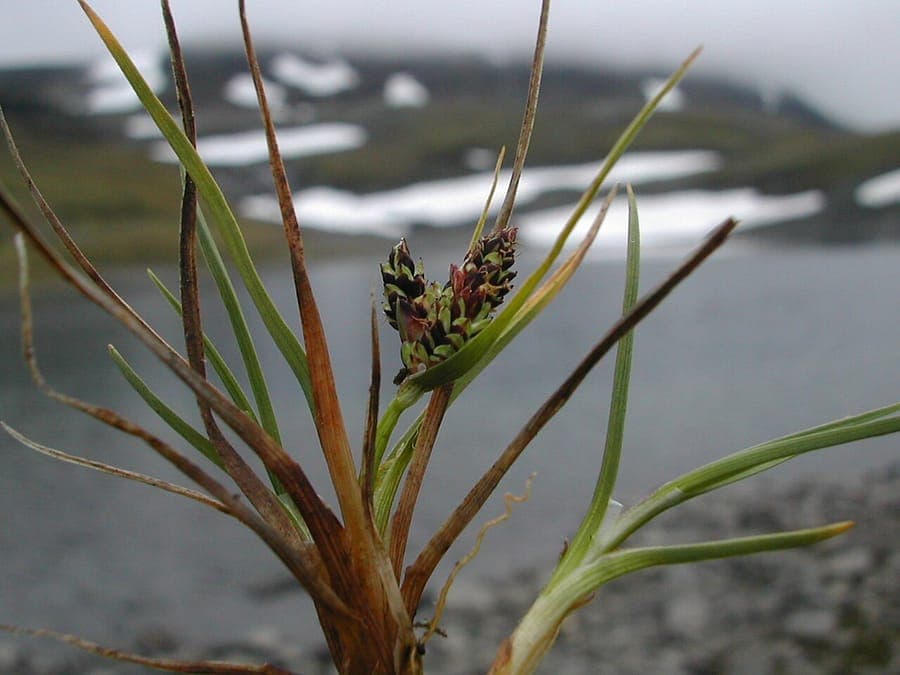
IdaBokmal / CC BY-SA 3.0, via Wikimedia Commons
Carex rufina: complete guide
Carex rufina
Want to see Carex rufina: complete guide in your garden?
1 minute, no credit card
Overview
Carex rufina, commonly called snowbed sedge or reddish sedge, is a boreal-arctic sedge native to northern North America, Greenland, Iceland, Norway, and Sweden. This is a true mountain plant adapted to extreme cold and short growing seasons.
The species thrives in subarctic environments where most garden plants fail. For gardeners in cold climates or alpine terrain, this sedge is an excellent choice for snowbed gardens and high-altitude planting schemes.
Appearance and Bloom
Carex rufina grows as a compact, low-spreading mat 10-25 centimeters tall. Leaves are narrow, linear, and gray-green in color, typical of arctic sedges. The plant forms loose mats rather than dense tufts, making it suitable for alpine troughs and specialized planting designs.
Flower spikes appear June-July, relatively late in the season. The distinctive reddish-brown colored bracts and fruits are easily visible against the foliage, giving the sedge visual interest during its brief blooming window.
Ideal Location
Carex rufina grows in alpine and subarctic settings on sunny, steep slopes where snow slides regularly during winter. In gardens, position it in cool, frost-prone locations in full sun to light shade.
This is not a plant for warm, dry sites. Rather, it thrives in alpine gardens and elevated beds where night frosts occur regularly. Limestone stone troughs and raised alpine beds are ideal.
Soil
Carex rufina thrives in lean, well-drained alpine soil with low nutrient content. Slightly acidic to neutral pH (5.5-7.0) is suitable. The plant tolerates limestone-rich substrates.
Excessive organic matter works against the plant. Instead: grit, fine gravel, and mineral components should comprise high percentages. Drainage must be rapid; waterlogging is not tolerated.
In natural habitats, it grows in steep, skeletal mountain soils with minimal organic matter.
Free design
Want to see Carex rufina: complete guide in your garden? Make a free design now.
Watering
Despite preferring moist snowbeds in nature, Carex rufina tolerates moderately dry conditions in gardens. Regular watering during the growing season (April-July) is advisable, though it allows drier conditions than lowland sedges.
In winter: minimal watering. Snow cover naturally protects the plant from desiccation stress. Heavy mulch is counterproductive; cold and good drainage is preferred.
Pruning
Minimal maintenance required. This plant doesn't spread aggressively and requires no shaping. Simply remove dead winter material in spring. The compact growth maintains itself naturally.
Maintenance Calendar
- January-February: Snow cover provides protection; no action needed.
- March: Carefully remove dead foliage as snow melts.
- April-May: Growth begins; regular watering.
- June-July: Flowering period; continue moisture management.
- August-September: Growth slows; watering can be reduced.
- October-December: Winter preparation; no extra care needed.
Winter Hardiness
Carex rufina is extremely winter-hardy. This plant actually prefers snow and cold. In alpine environments, it's completely self-sustaining. Temperatures to -30C pose no threat.
If growing without natural snow cover, provide protection against winter wind and strong sun.
Companion Plants
Carex rufina combines well with other alpine sedges and alpine plants:
- Carex firma (rocky mountain sedge)
- Silene acaulis (moss campion)
- Armeria maritima alpine forms (sea thrift)
- Saxifraga species (saxifrages)
- Sempervivum species (houseleeks)
- Draba species (alpine draba)
In snowbeds: provide contrast in texture; this low mat works well with more ragged forms.
Conclusion
Carex rufina is essential for mountain gardeners. With its arctic heritage and preference for cold, mineral conditions, it offers a unique way to tackle difficult alpine terrain. Find it through specialized alpine nurseries. Visit www.gardenworld.app for more ideas on alpine garden design and other mountain plants.
Its reddish flower spikes offer subtle ornamental interest while its hardiness under extreme conditions makes it invaluable for alpine gardens.
Want to see Carex rufina: complete guide in your garden? Make a free design now.
Upload a photo, pick a style, and get a photorealistic design with plant list in under a minute.
No credit card required


Similar plants
Flat-stemmed club-rush: complete guide
Bolboschoenus planiculmis
Everything about Bolboschoenus planiculmis: growing conditions, watering, care, and use as a pond margin or wetland plant in garden design.
Great Plains flatsedge: complete guide
Cyperus lupulinus
Everything about Great Plains flatsedge (Cyperus lupulinus): growing conditions, care, garden uses, and ecological value. Tips for pond margins and dry sandy soils.
Golden beak sedge: complete guide
Rhynchospora corymbosa
Everything about golden beak sedge (Rhynchospora corymbosa): a dramatic tropical marginal for pond edges, bog gardens, and wet habitats.