
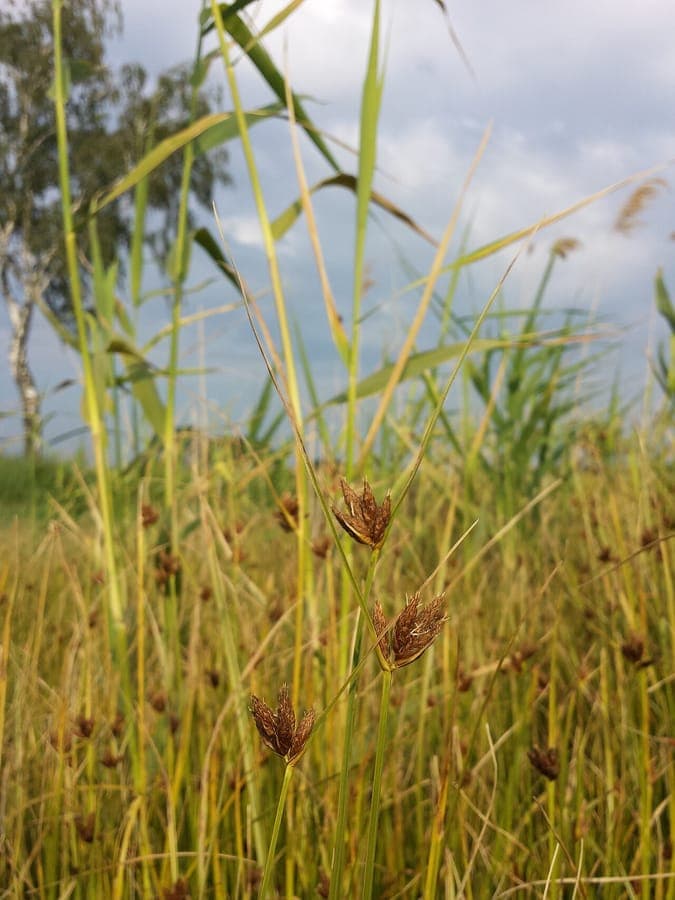
Stefan.lefnaer / CC BY-SA 4.0, via Wikimedia Commons
Flat-stemmed club-rush: complete guide
Bolboschoenus planiculmis
Want to see Flat-stemmed club-rush: complete guide in your garden?
1 minute, no credit card
Overview
Bolboschoenus planiculmis, commonly called the flat-stemmed club-rush or eastern bulrush, is a perennial rhizomatous sedge belonging to the family Cyperaceae. Described formally in 1967 by Russian botanist T.V. Egorova, the species carries the prior work of F. Schmidt, who collected specimens across the Far East. Its natural range spans much of Eurasia - from central Europe through Russia, Kazakhstan, China, Japan and Korea, down to the Philippines and New Guinea. In the Netherlands the plant is considered an introduction, appearing in wetland fringes along brackish and freshwater channels.
As a wetland plant, the flat-stemmed club-rush fulfils a vital ecological function. Its dense stem clusters shelter invertebrates, small fish, and amphibians. Reed buntings and warblers nest among its stems, and waterfowl probe the sediment around its rhizomes. For the garden owner, the plant adds a primeval, naturalistic character to the pond edge - an honest plant that simply does what it does without fuss.
On gardenworld.app you can upload a photo of your garden and instantly receive design suggestions showing how pond-edge plants like the flat-stemmed club-rush fit your specific layout and style preferences.
Appearance and bloom cycle
Bolboschoenus planiculmis forms clumping tussocks of upright, markedly flat or slightly triangular stems - the name 'planiculmis' derives from Latin for flat culm. Stems typically reach 60 to 120 cm in height, occasionally exceeding 150 cm in rich, waterlogged conditions. They are deep green, slightly glossy, and carry a characteristic compressed cross-section that immediately distinguishes the species from rounder-stemmed relatives like Bolboschoenus maritimus.
The leaves are narrow, keeled, and folded lengthwise; the leaf margins are rough and can cause small cuts when handled without gloves. The inflorescence is a compact brownish spikelet cluster seated at the apex of the stem, surrounded by one or two leaf-like bracts. Flowering occurs from June through August. The small, flattened nutlets ripen through September and are dispersed by water currents and waterfowl.
Above-ground stems die back in autumn, but the underground rhizomes and small tubers persist through winter. New growth emerges reliably in March or April as temperatures rise. Standing dead stems provide winter structure and wildlife value throughout the cold months.
Ideal location
The flat-stemmed club-rush demands full sun to very light partial shade. Good light exposure is non-negotiable: stems become lax and flowering declines markedly in shadier spots. In nature the plant occupies the margins of lakes, slow rivers, and shallow seasonal marshes. It tolerates mildly brackish water, making it useful in coastal gardens or in areas where soil contains trace amounts of salt.
The plant grows well in permanently waterlogged conditions and in zones subject to fluctuating water levels. At the pond margin, an ideal planting depth ranges from 0 to 30 cm below the water surface; it tolerates temporary submersion to 50 cm. In garden settings it is well suited for aquatic planters, wide pond baskets, or naturalistic bog gardens.
For a layered, naturalistic pond margin, position the club-rush at the back or mid-level, then fill in with shorter companions in front. This creates a convincing wetland gradient from deep water to the drier bank.
Soil
Bolboschoenus planiculmis thrives in heavy clay and loamy soils that retain moisture well. An optimal pH of 7.0 to 7.5 suits slightly alkaline or neutral conditions; growth on acidic peat is possible but less vigorous. Avoid coarse sandy substrates that drain too freely.
For pond basket cultivation, use dedicated aquatic compost or a mixture of loam-based garden soil and clay without peat. Do not add fertiliser to the planting medium: excess nutrients encourage overly lush top growth and contribute to algae problems in the pond. A small, slow-release fertiliser tablet pressed into the basket at planting time is sufficient for the first growing season.
Keep the root zone consistently moist. The rhizomes dislike drying out even briefly during the establishment phase, so water new plantings generously until they show active new growth.
Free design
Want to see Flat-stemmed club-rush: complete guide in your garden? Make a free design now.
Watering
As a true aquatic, the flat-stemmed club-rush needs no supplemental irrigation when planted at the pond margin or in a water feature. It draws moisture continuously from the substrate and the surrounding water column. During the first few weeks after planting, ensure the root ball never dries out completely.
In a pot or container on a terrace, check moisture levels daily during hot summer spells. Standing water in a drip tray can help maintain humidity but should be refreshed regularly to avoid stagnation. During wet periods or at a well-maintained pond, no additional water is needed.
In mildly brackish situations, avoid flushing the root zone with large volumes of fresh water, as this can dilute salinity levels the plant has adapted to and temporarily disrupt root function.
Pruning
The flat-stemmed club-rush requires very little active cutting. In autumn, once the stems have turned straw-yellow and the foliage is dying back, cut them down to 10 to 15 cm above the water surface or ground level. This keeps the pond tidy and prevents decaying organic matter from accumulating on the bottom.
For a more naturalistic approach, leave the standing stems through winter. They shelter overwintering insects and provide food sources for seed-eating birds. Remove them by late February or early March, before new shoots emerge, to avoid damaging fresh growth.
Avoid cutting during the main growing season from May to August; this weakens the plant and may leave unsightly stubs. Always use sharp, clean secateurs or a garden knife to make clean cuts.
Maintenance calendar
January - February: Keep ice off the pond to allow gas exchange. Old stems can remain standing. March: Remove previous year's dead stems before fresh shoots appear. Check planting depth. April: First new shoots emerge. This is the best time for division or replanting. May - June: Strong growth phase. Check that rhizomes are not escaping the basket. Apply a minimal slow-release fertiliser if needed. July - August: Flowering period. Maintain pond water level during hot, dry spells. September: Seeds ripen and disperse. Begin trimming dying stems if pond cleanliness is a priority. October - November: Growth ceases. No mulching needed for in-ground plantings. December: Dormancy. Check container-grown plants for frost exposure; move to deeper water if necessary.
Winter hardiness
Bolboschoenus planiculmis is extremely cold-tolerant. Its natural range extends across Siberia and Kamchatka, where winter temperatures regularly plunge well below -20 degrees Celsius. In temperate northwest European gardens - Netherlands, Belgium, northern France, the UK - the plant is fully reliable outdoors.
It is rated for USDA hardiness zones 4 to 9, meaning it withstands winter lows down to around -34 degrees Celsius (zone 4). In-ground plantings and those submerged in a pond require no special winter protection. Plants in small, shallow containers that could freeze solid should be moved to a deeper part of the pond or to a frost-free but unheated space.
Look for the flat-stemmed club-rush at specialist aquatic plant nurseries and well-stocked garden centres, particularly during the spring and summer selling season from April through September.
Companion plants
The flat-stemmed club-rush partners well with a wide range of aquatic and marginal plants:
- Lesser bulrush (Typha angustifolia): tall architectural form, excellent winter silhouette.
- Yellow flag iris (Iris pseudacorus): bold yellow flowers in May-June, similar water requirements.
- Water mint (Mentha aquatica): low, spreading, aromatic, purple-flowered.
- Arrowhead (Sagittaria sagittifolia): white flowers and decorative arrow-shaped leaves.
- Marsh marigold (Caltha palustris): early golden flowers at the water's edge.
- Sweet flag (Acorus calamus): broad strap leaves with a pleasant scent when crushed.
Avoid planting next to vigorous spreaders such as common reed (Phragmites australis), which can swamp the club-rush over time. At gardenworld.app, your uploaded garden photo is transformed into a personalised planting plan that balances structural plants, seasonal colour, and ecological value at the pond margin.
Closing
The flat-stemmed club-rush is an unpretentious, ecologically valuable, and frost-tolerant wetland plant that rewards any pond or bog garden with years of reliable structure and wildlife interest. It asks only for a sunny, wet position and a soil that stays consistently moist. In return it offers handsome vertical stems, late-season brown flower heads, and a flourishing micro-habitat for the creatures that share your garden. Whether your water feature is a spacious wildlife pond or a modest terrace container, Bolboschoenus planiculmis brings genuine character to the water's edge.
Want to see Flat-stemmed club-rush: complete guide in your garden? Make a free design now.
Upload a photo, pick a style, and get a photorealistic design with plant list in under a minute.
10,000+ gardens designed already
No credit card required

