
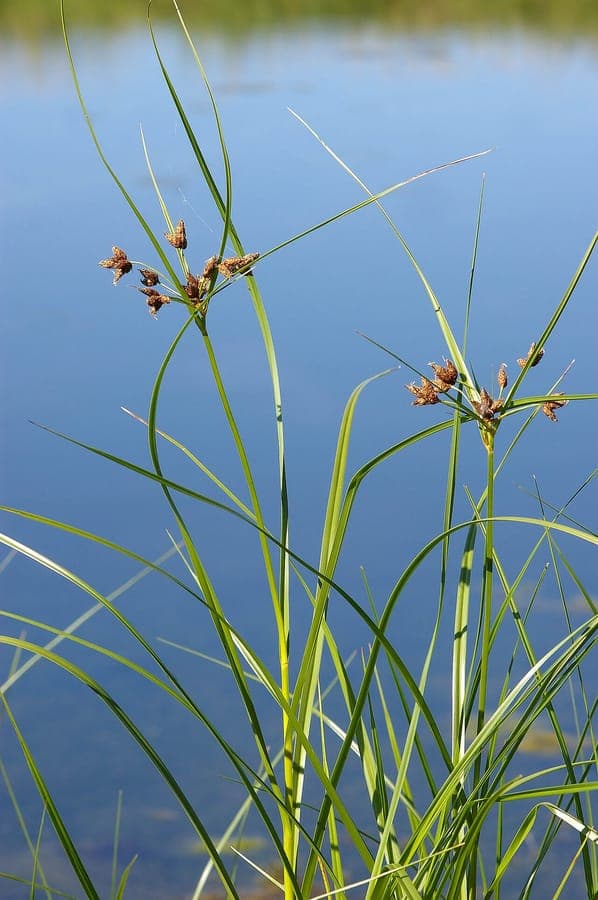
Christian Fischer / CC BY-SA 3.0, via Wikimedia Commons
Sea club-rush: complete guide
Bolboschoenus maritimus
Want to see Sea club-rush: complete guide in your garden?
1 minute, no credit card
Overview
Sea club-rush (Bolboschoenus maritimus) is a resilient, grass-like perennial native to coastal marshes, brackish wetlands, and tidal zones across temperate regions. In garden settings, it's increasingly popular for naturalistic pond edges, rain gardens, and water retention basins. Its upright form, salt tolerance, and ability to thrive in saturated soils make it a standout choice for challenging, wet sites. Hardy and low-maintenance, it establishes quickly when given the right conditions.
On gardenworld.app, you can design a waterside planting scheme that integrates sea club-rush with complementary species, ensuring balanced texture and seasonal interest.
Appearance & bloom cycle
Sea club-rush grows in dense, upright clumps reaching 90–120 cm in height. The thick, triangular stems are bright green and support minimal foliage, mostly reduced to sheaths. From June to August, it produces compact, dark brown, spherical flower heads about 2–3 cm wide at the stem tips. These are not true flowers but spikelets composed of bracts and scales. After flowering, small nutlets form, providing food for birds like rails and sparrows.
In autumn, the foliage fades to a warm bronze, adding structure to the winter garden. The plant spreads slowly via rhizomes, forming expanding clumps over time.
Ideal location
Sea club-rush needs at least 8 hours of direct sunlight daily (light level 8/10). It performs best in full sun; in partial shade, stems become weak and flop over. Ideal spots include shallow pond margins (up to 20 cm deep), wet ditches, or bog gardens. It can also be grown in submerged containers.
Its salt tolerance makes it a smart choice for coastal gardens or areas exposed to road salt. Avoid deep water - it prefers saturated soil or shallow inundation.
Soil requirements
This plant thrives in alkaline soils with a pH of 7.5–8.0. It handles clay, sandy loam, or organic-rich substrates as long as they stay consistently wet. It's particularly suited to calcareous or lime-rich soils common in coastal and limestone areas. Avoid acidic soils below pH 6.5.
If your soil is too acidic, consider planting in a liner basket filled with a mix of clay, river sand, and crushed oyster shell to raise pH. No drainage is needed - in fact, poor drainage is ideal.
Watering
Sea club-rush requires constantly moist to flooded conditions. In nature, it grows with roots submerged in still or slow-moving water. In the garden, maintain a water level of 5–20 cm above the crown. During dry spells, top up ponds or water bog areas deeply twice a week.
Use rainwater when possible. While tolerant of alkalinity, it can suffer from high sodium levels in tap water, especially in hard water areas. Refill ponds with collected rain to avoid mineral buildup.
Free design
Want to see Sea club-rush: complete guide in your garden? Make a free design now.
Pruning
Minimal pruning is needed. In late winter or early spring, cut back dead foliage to 10 cm above the crown to encourage fresh growth. Avoid cutting in autumn - standing stems provide winter habitat for insects and add visual interest.
Watch for aggressive spreading via rhizomes. In small gardens, contain it with a 50 cm deep root barrier or grow it in a submerged pot to prevent overcrowding.
Maintenance calendar
Jan: Cut back old growth if not done in spring Feb: Monitor crown health, prepare for new growth Mar: New shoots emerge; check moisture levels Apr: Growth accelerates; maintain water depth May: Divide or transplant if needed Jun: Bloom begins; ensure full sun exposure Jul: Peak flowering; inspect for pests or algae Aug: Flowering ends; maintain water Sep: Foliage begins to bronze; reduce watering slightly Oct: Leave standing for winter structure Nov: Check plant stability Dec: Minimal care; protect potted plants from deep freeze
Winter hardiness
Sea club-rush is hardy in USDA zones 5–9. In zone 8 conditions (like most of the UK and Pacific Northwest), it overwinters easily. Top growth dies back, but rhizomes survive in wet soil or shallow water. In zones 5–6, a mulch of reed or leaf litter can provide extra insulation during prolonged freezes below -15°C.
Potted plants are more vulnerable. Submerge containers in deeper pond areas or move to a frost-free, cool greenhouse if freezing is expected.
Companion plants
Pair sea club-rush with other moisture-loving plants like common reed (Phragmites australis), yellow flag iris (Iris pseudacorus), and soft rush (Juncus effusus). For contrast, plant with flowering species such as water mint (Mentha aquatica) or flowering rush (Butomus umbellatus).
Submerged companions like hornwort (Ceratophyllum) improve water quality. The dense stems attract dragonflies and offer cover for amphibians.
On gardenworld.app, use the companion planner to match sea club-rush with plants that share its water depth and light needs, creating a balanced, wildlife-friendly scheme.
Closing
Sea club-rush is a dependable, architectural plant that brings year-round structure to wet areas. With full sun, constant moisture, and alkaline soil, it thrives with little intervention. Its salt tolerance and ecological value make it ideal for coastal or urban gardens. Once established, it asks for little but gives much in form and function.
Find sea club-rush at garden centres across the UK and North America. Look for healthy, green crowns with firm rhizomes. Plant immediately after purchase to prevent drying out.
Want to see Sea club-rush: complete guide in your garden? Make a free design now.
Upload a photo, pick a style, and get a photorealistic design with plant list in under a minute.
No credit card required


Similar plants
Flat-stemmed club-rush: complete guide
Bolboschoenus planiculmis
Everything about Bolboschoenus planiculmis: growing conditions, watering, care, and use as a pond margin or wetland plant in garden design.
Great Plains flatsedge: complete guide
Cyperus lupulinus
Everything about Great Plains flatsedge (Cyperus lupulinus): growing conditions, care, garden uses, and ecological value. Tips for pond margins and dry sandy soils.
Golden beak sedge: complete guide
Rhynchospora corymbosa
Everything about golden beak sedge (Rhynchospora corymbosa): a dramatic tropical marginal for pond edges, bog gardens, and wet habitats.