
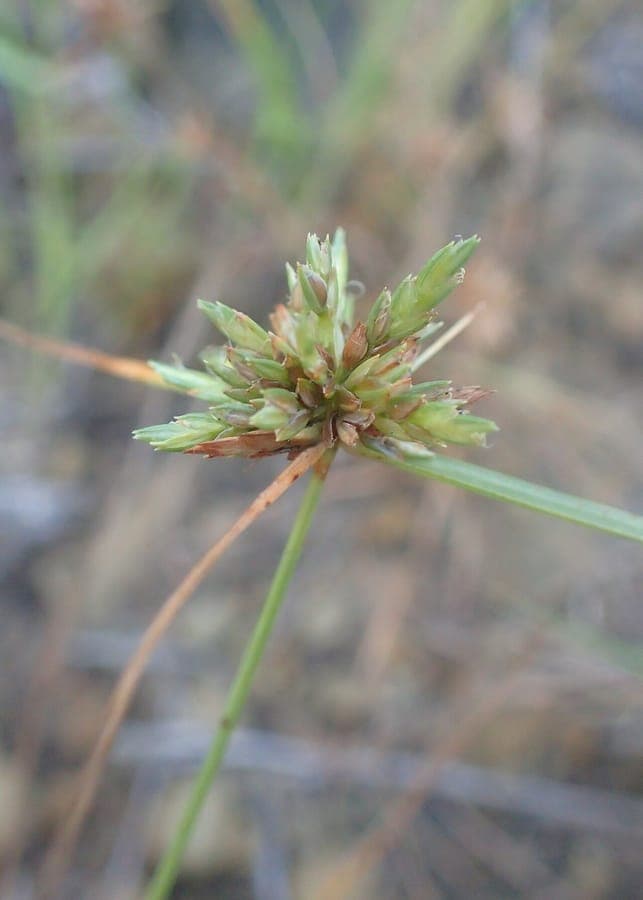
Krzysztof Ziarnek, Kenraiz / CC BY-SA 4.0, via Wikimedia Commons
Great Plains flatsedge: complete guide
Cyperus lupulinus
Want to see Great Plains flatsedge: complete guide in your garden?
1 minute, no credit card
Overview
Great Plains flatsedge - botanically Cyperus lupulinus - is a modest but ecologically valuable sedge belonging to the family Cyperaceae. The species is native to eastern Canada and the United States, ranging from the Great Plains to the Atlantic seaboard, and is known by several common names including hop flatsedge, slender cyperus and slender sand sedge. The botanical name references the hop-like appearance of the flattened spikelets: lupulinus means 'resembling hops'.
In its native range Cyperus lupulinus grows on sandy, dry to moderately dry soils along forest edges, roadsides and open grasslands. This makes it a surprisingly drought-tolerant sedge compared to many relatives that prefer wet habitats. Yet it also thrives along pond margins and in moist sandy soils, giving it a wider range of garden uses than its modest appearance suggests. On gardenworld.app you can discover garden designs where sedge species add textural interest along water features and pond margins.
The species was formally described in 1974 and is classified in the flat sedge group (Cyperus subgenus Cyperus). It is native across a broad sweep of North America encompassing 36 US states and four Canadian provinces. In Europe it has been recorded as an introduction in Italy only, making it a botanical curiosity for adventurous gardeners on this side of the Atlantic.
Appearance and bloom cycle
Cyperus lupulinus is a compact, clump-forming annual or short-lived perennial sedge that typically reaches 15 to 50 cm in height. The stems are triangular in cross-section - characteristic of the family Cyperaceae - and erect to slightly arching. The leaves are narrow strap-shaped, 2 to 4 mm wide, and green to dark green. Longer bracts at the base of the flower stem surround and exceed the inflorescence.
The inflorescence is a compound umbel of angular, oval to oblong spikelets. The spikelets are 5 to 15 mm long, yellowish-brown to reddish-brown, and laterally compressed. They somewhat resemble the scales of a hop strobilus - which explains the common name hop flatsedge. In North America the plant blooms from June to September; in cultivation in northern Europe flowers typically appear in July and August.
The fruit is a small, three-angled nutlet. After flowering, the dried spikelets remain decorative on the plant for many weeks. The overall inflorescence has an open, airy structure that contrasts attractively with the straight, dark-green stems.
Fresh foliage emerges bright green in spring; during summer the plant becomes more robust and darker in colour. In cool autumn nights the leaves may yellow before dying back. In mild seasons the plant can overwinter via the rootstock as well as by self-seeding.
Ideal location
Cyperus lupulinus is more versatile in terms of location than most other flat sedges. In the wild it grows on open, sandy soils in full sun to light partial shade. In the garden, place it in a spot receiving four to six hours of direct sunlight daily, with some protection from the hottest midday sun in warmer regions.
The species is suitable for pond margins and the edges of garden streams but stands apart from most marginal plants in its tolerance for dry spells. At a sandy pond edge, half in the water and half out, it excels. It can also serve as a textural accent plant in a herbaceous border.
In temperate European gardens, place Cyperus lupulinus in a sheltered, semi-sunny position. Avoid spots subject to prolonged, severe frost without protection. A position near water helps moderate root temperature in winter, reducing the risk of frost damage.
In a container, the plant grows well provided there is enough room for the clump and the pot does not dry out too quickly. Use a pot without excessively large drainage holes if you want to keep the root environment consistently moist.
Soil
In its natural North American habitat, Cyperus lupulinus grows especially well on sandy, nutrient-poor soils - a trait that distinguishes it from most of its relatives. The plant tolerates low nutrient levels well and does not require heavy, clay-rich soil.
For garden cultivation, light to medium-weight, free-draining soil is ideal. On heavier soils, incorporate coarse sand (around 30 percent by volume) to improve drainage. A pH of 5.5 to 7.0 is suitable. In moisture-retentive sandy soils near water the plant grows most vigorously.
Avoid heavily fertilised, nitrogen-rich soils: on overly fertile ground Cyperus lupulinus grows fast but becomes more disease-prone and loses its characteristic compact form. A modest dressing of well-rotted compost at planting time is sufficient for a healthy start.
In pond margin cultivation, plant with the roots in very shallow water (up to 5 cm) or at the moist edge of a pond or stream. Deeper water (more than 10 cm) suits genuine aquatic plants better than this sedge.
Watering
As a pond-margin or moist-site plant, Cyperus lupulinus needs consistent moisture during the growing season. Near water this is naturally provided. In a border or container, water when the top layer of soil begins to dry out: the plant tolerates brief drought but shows this quickly through yellowing leaf tips.
During hot summers, watering two to three times per week may be needed. In moderate conditions, once a week or even less is sufficient. In winter, when the plant is dormant, watering is minimised; overly wet roots combined with cold temperatures increase the risk of root rot.
Rainwater is preferable to tap water, especially for long-term use. In extreme heat, misting the foliage with water helps to limit moisture loss through transpiration.
On gardenworld.app you will find inspiring pond and waterside planting designs where sedge-family plants play a central role.
Free design
Want to see Great Plains flatsedge: complete guide in your garden? Make a free design now.
Pruning
Cyperus lupulinus requires little pruning. In early spring (March to April) remove all dead leaves and stems from the previous year, cutting them as close to the base as possible. This gives new shoots space to develop and keeps the plant tidy.
During the growing season, trim any dried or damaged leaves. Leave the decorative flower heads on the plant as long as possible: the dried spikelets add textural interest well into autumn and early winter and provide seed food for birds such as sparrows and finches.
In autumn, after the first frost, cut the plant back to about 5 to 10 cm above the ground. In a milder climate or indoors in a container you can delay this until early spring. The cut stems and spikelets are attractive in dried arrangements.
Propagation is straightforward: sow ripe nutlets in autumn (cold stratification outdoors) or divide the clump in early spring. Each clump section with some active roots grows quickly into a new independent plant.
Maintenance calendar
March-April: Remove all remaining dead stems and foliage. Check whether the clump has come through winter well. Apply a thin layer of well-rotted compost around the plant if needed. Divide oversized clumps as the opportunity allows.
May-June: Growth gets underway as temperatures rise. Adjust watering to weather conditions. Watch for aphids or other insects. Sow any saved seed from the previous summer if desired.
July-August: Peak growth and flowering. The open flower heads are at their finest. Increase watering during drought. Allow flowers to set seed if you want to encourage self-seeding or attract seed-eating birds.
September-October: After the first frost the plant begins to yellow. Leave the dried spikelets as winter decoration. Apply mulch over the root zone if needed.
November-February: In milder areas the plant may lightly overwinter. Under colder conditions the roots are best protected by a mulch layer. No watering or feeding needed.
Winter hardiness
Cyperus lupulinus is native across USDA zones 4 to 8 in North America, which makes it theoretically cold-hardy in much of the Netherlands and Belgium (predominantly USDA zones 7 to 8). In its North American homeland the plant survives harsh winters thanks to the insulating effect of snow cover and the relatively dry winter climate.
In the Netherlands and Belgium, where winters are wetter and snow cover less reliable, winter hardiness is slightly less certain. In USDA zone 7b and warmer the plant can be grown as a perennial; in colder zones and wet winters, mulching the root zone with 10 to 15 cm of leaves or straw is advisable.
In a container, it is wise to move the plant to a frost-free but cool space during persistent frost (more than a week below -5 degrees Celsius). The plant does not need light when fully dormant indoors. Return it outdoors in early spring at the beginning of the thaw season.
A practical tip for temperate climate gardeners: leave the dead stems standing through winter. They provide light insulation to the root crown against cold and frost damage, and offer food and shelter for insects and birds.
Companion plants
Cyperus lupulinus fits beautifully in a pond or wetland garden alongside other low-growing, textural plants. On gardenworld.app you will find pond-margin planting designs where height variation and textural contrast create lively, naturalistic garden compositions.
Good companion plants for a pond or stream bank include: Carex (true sedges) in diverse forms and colours, which have similar site requirements; Iris pseudacorus (yellow flag iris) for dramatic yellow blooms in spring; Lythrum salicaria (purple loosestrife) for rich purple-pink summer colour; Juncus effusus (soft rush) as a companion on wet sandy soils; and Eriophorum (cotton grass) for those distinctive fluffy white flower heads.
In a dry to moderately dry border, Cyperus lupulinus combines unexpectedly well with lavender, thyme and other drought-tolerant plants - an unusual but decorative combination that takes advantage of this sedge's drought tolerance. Avoid combining with vigorous, aggressively spreading marginal plants such as Phragmites australis (common reed) or large Typha species (bulrush), which will quickly overwhelm the smaller Cyperus lupulinus. Good garden centres stock a range of sedge-family plants for pond margins alongside aquatic planting collections.
Closing
Cyperus lupulinus, Great Plains flatsedge, is a charming, ecologically valuable plant that deserves wider attention in European gardens. The combination of drought tolerance and moisture appreciation, the attractive hop-like flower heads and the modest size make it suitable for a wide range of applications, from pond margin to dry border.
Look for the plant at specialist nurseries dealing in native and North American species; seed is also available through botanical garden seed exchanges and seed libraries. Propagation is easy by clump division in spring or by sowing ripe nutlets in autumn.
For anyone seeking a low-growing, texturally rich marginal plant with ecological value - for insects, seed-eating birds and a lively pond ecosystem - Cyperus lupulinus is a surprisingly versatile choice, undemanding in care and rewarding in garden presence with its subtle, hop-like bloom.
Want to see Great Plains flatsedge: complete guide in your garden? Make a free design now.
Upload a photo, pick a style, and get a photorealistic design with plant list in under a minute.
10,000+ gardens designed already
No credit card required


Similar plants
Sweet cyperus: complete guide
Cyperus longus
Discover how to grow and care for Sweet cyperus (Cyperus longus), from planting to winter care. Ideal for wet gardens, pond edges, and naturalistic planting schemes.
Earth-almond: complete guide
Cyperus esculentus
Cyperus esculentus, or Earth-almond, is a sun-loving, drought-tolerant grass that thrives in well-drained soils. Ideal for gardeners in USDA zones 8-11.
Egyptian paperplant: complete guide
Cyperus papyrus
Discover how to grow and care for Cyperus papyrus in your garden. Full details on light, water, winter care, and ideal planting partners.