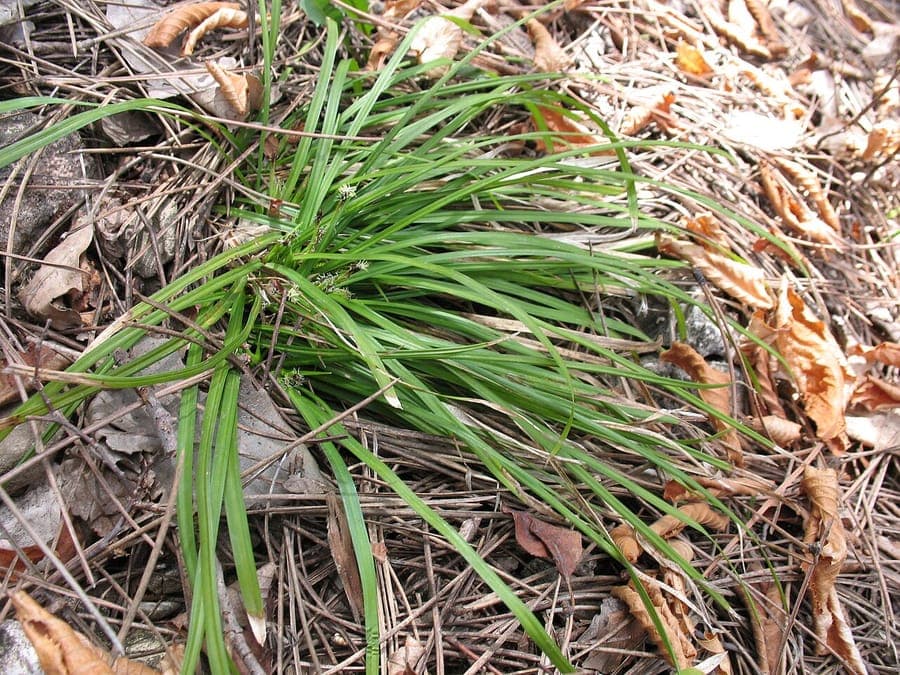
Cheryl Mayer, Black Hills National Forest / Public domain, via Wikimedia Commons
Longstalk Sedge: complete guide
Carex pedunculata
Want to see Longstalk Sedge: complete guide in your garden?
Full design in HD: €7.99
Look after your Longstalk Sedge with the GardenWorld app
Identify plants with your camera and get a care calendar with reminders for this plant.


Overview
Longstalk Sedge (Carex pedunculata) is a refined grass-like sedge native to North America. This moisture-loving plant is renowned for its elegant, long stems bearing small seed heads. It is a perfect groundcover candidate for dark, wet locations where other plants struggle. The plant grows slowly but eventually forms beautiful, dense mats of grass-like foliage.
Appearance and Bloom
Carex pedunculata grows low, approximately 15-20 cm tall, with a broad spreading growth pattern working as a groundcover. The leaves are exceptionally fine-textured and delicately wavy, dark green in color. In May-June, long, thin, elegantly arching stems appear with small green female flowers at the tips. This characteristic feature gives the plant its English name. The seed heads are small and inconspicuous brownish-green.
Ideal Location
Carex pedunculata is exclusively suited to shade to dappled shade and moist soils. In full sun, the foliage discolors and the plant grows only very slowly. It is ideal beneath large trees, along wet streams, in marshes, and under shrubs where little else grows. The plant appreciates sheltered locations where its delicate stems are not constantly damaged.
Soil
The plant thrives best in wet to very wet soils, preferably heavy clay or peat. pH 5.0 to 6.5 is ideal. Do not add compost, as it prefers natural, nutrient-poor conditions. The plant grows better in pure, undisturbed ground conditions. Drainage is less important than for other sedges, since Longstalk Sedge is a true wetland plant.
Watering
Ensure the growing medium remains constantly very moist to wet throughout the growing season (March through October). In very wet locations (marshes, pond edges), supplemental watering is virtually never needed. In normal moist gardens, deep watering weekly is necessary, especially in July-August. Avoid complete drying out - the plant tolerates drought very poorly and does not recover easily.
Free preview
Want to see Longstalk Sedge: complete guide in your garden? Make a free preview of your design.
Pruning
Carex pedunculata requires minimal pruning. In March, gently remove dead foliage from the previous year using hands or a soft comb. Do not cut the long stems in October-November as they remain ornamental through winter. Large tufts can be carefully divided every 4-5 years after the growing season, although division is not always necessary as the plant eventually forms a nice mat.
Maintenance Calendar
March: Remove dead foliage from last year; April-May: Growth period, water regularly; June-July: Long stems appear, maintain moisture; August-September: Seed development, keep plant well-watered; October-November: Ornamental seed stems remain standing, reduce watering somewhat; December-February: Rest period, minimal water, can be drier than other seasons.
Winter Hardiness
Carex pedunculata is hardy to USDA zone 3a (-35 to -40C), very suitable for the UK, Ireland, and northern France. The plant remains largely evergreen and provides structure in wet winter gardens. Freezing of wet areas causes no damage.
Companion Plants
Combine Longstalk Sedge with other shade-loving moisture plants: Astilbe minor (small red plumes), Carex oshimensis Evergold (yellow foliage), Dryopteris erythrosora (red fern), Hosta species (foliage variety), Osmunda regalis (royal fern). In wetter sections: Iris versicolor (blue swamp iris), Acorus gramineus (grasslike). Ideal in woodland edges and wet shadowed situations.
Closing
Carex pedunculata is a highly refined and elegant sedge for the most challenging, wet, dark garden corners. Its slow growth is completely justified by its elegance. For online ordering, seek specialized sedge nurseries or native plant suppliers. Gardenworld.app helps you integrate this special plant effectively into your woodland edge or marsh garden development.
Frequently asked questions about Longstalk Sedge
Is Longstalk Sedge winter hardy?
Carex pedunculata is hardy to USDA zone 3a (-35 to -40C), very suitable for the UK, Ireland, and northern France. The plant remains largely evergreen and provides structure in wet winter gardens.
When and how do you prune Longstalk Sedge?
Carex pedunculata requires minimal pruning. In March, gently remove dead foliage from the previous year using hands or a soft comb.
How much water does Longstalk Sedge need?
Ensure the growing medium remains constantly very moist to wet throughout the growing season (March through October). In very wet locations (marshes, pond edges), supplemental watering is virtually never needed.
Where does Longstalk Sedge grow best?
Carex pedunculata is exclusively suited to shade to dappled shade and moist soils. In full sun, the foliage discolors and the plant grows only very slowly.
What soil does Longstalk Sedge need?
The plant thrives best in wet to very wet soils, preferably heavy clay or peat. pH 5.0 to 6.5 is ideal. Do not add compost, as it prefers natural, nutrient-poor conditions.

See it in your garden
See Longstalk Sedge in your garden
One photo of your garden and a few questions. You see the result in about a minute.
Try it with a photoIdentify this plant in your own garden. Identify a plant
Similar plants
Carex conica: a small evergreen sedge for edges
Carex conica
Carex conica is a compact evergreen sedge from Japan and Korea. A guide to 'Snowline', where to plant it, soil, tidying, dividing and how hardy it really is.
Carex oshimensis: the evergreen striped sedge
Carex oshimensis
Carex oshimensis is an evergreen Japanese sedge with fine, striped leaves. How to plant, place, tidy and divide 'Evergold' and the EverColor series in your garden.
Orange New Zealand sedge (Carex testacea): a guide
Carex testacea
Orange New Zealand sedge (Carex testacea) turns copper and orange in sun and cold. Where to plant it, which soil it likes, how to tidy it and how hardy it is.
