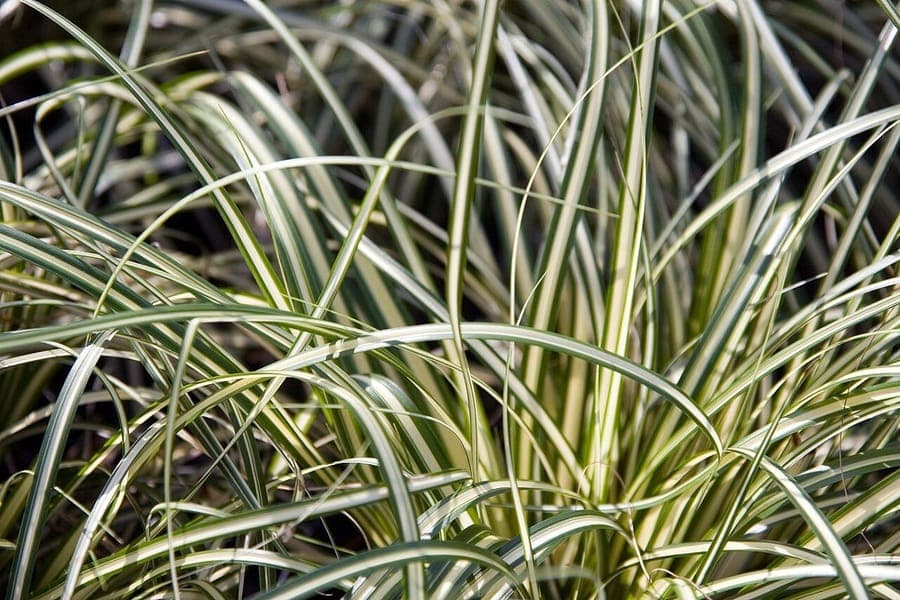
Photo by David J. Stang / CC BY-SA 4.0, via Wikimedia Commons
Carex oshimensis: the evergreen striped sedge
Carex oshimensis
Want to see Carex oshimensis: the evergreen striped sedge in your garden?
Full design in HD: €7.99
Look after your Carex oshimensis with the GardenWorld app
Identify plants with your camera and get a care calendar with reminders for this plant.


Overview
Carex oshimensis is a compact evergreen sedge from Japan, and in its striped forms it has become one of the most widely sold foliage plants in British and European garden centres. In the wild it grows on wooded slopes and rocky ground in central and southern Honshu, including the island of Oshima that gave it its name. In gardens it is valued for one simple reason: it looks fresh in every month of the year, including the grey stretch between December and March when most borders have very little to offer.
Although it is often grouped with ornamental grasses, it is a true sedge in the family Cyperaceae. Sedges have solid, three-sided stems without the joints you find on grasses, and in practice they behave differently. Carex oshimensis does not want a hard annual chop, it prefers a little moisture at the roots, and it is happiest in dappled light rather than baking sun.
What you buy is almost always a named cultivar. 'Evergold' is the classic, with a broad creamy-yellow central stripe and narrow green margins; it holds the RHS Award of Garden Merit. Its exact parentage has been debated, and you will still see it labelled Carex hachijoensis or Carex morrowii, but it is now generally placed under Carex oshimensis. The newer EverColor series adds 'Everest' (green with crisp white edges), 'Everillo' (bright lime-gold) and 'Eversheen', among others. If you are reworking a shady bed, gardenworld.app can create a garden design for you that uses a sedge like this to stitch together the front of a border or a group of pots by the back door.
Appearance, foliage and spikes
A mature plant forms a mound 20 to 30 cm tall and 30 to 50 cm across. The leaves are narrow, about 3 to 6 mm wide, fairly firm and arch outwards like a fountain, so the clump looks wider at the top than at the base. The surface is smooth, but the edges carry tiny teeth; run a leaf through your fingers from tip to base and it feels fine, the other way round it rasps.
Leaf colour depends on the cultivar. In 'Evergold' the central band is brightest in spring and fades towards cream over summer. Hard frost may bleach the foliage slightly, but the leaves stay on the plant and keep their shape, which is exactly why this sedge is so useful in winter planting schemes.
The flower spikes appear in April and May. They are modest affairs that sit among or just above the leaves: a slender brownish male spike at the top of each stem, dusted with yellow anthers, and a few shorter female spikes below it. Most gardeners barely notice them. Seedlings are rare in cultivation, and cultivars do not come true from seed anyway.
Carex oshimensis is not known to be toxic to people, dogs or cats, and it does not appear on the usual poisonous-plant lists.
Ideal location
Partial shade gives the best results. Morning sun followed by afternoon shade is ideal, as is the light shade beneath tall deciduous trees. In deep shade the plant still grows, though the variegated forms become greener and slower. Full sun is tolerated only where the soil stays moist; on a hot, dry site the leaf tips scorch and the clump can look tired by August.
Use it as an edging along a woodland path, as ground cover in drifts of five to nine plants, on the cool side of a rock garden or in containers. Space plants 30 to 40 cm apart and they will knit together within two seasons. In pots and window boxes it makes a dependable permanent backbone, with seasonal bedding changed around it.
Soil requirements
Aim for a humus-rich soil that holds moisture without becoming waterlogged. Ordinary garden loam improved with leaf mould is ideal. Clay is acceptable as long as water drains away in winter, but a clump sitting in cold, saturated ground will rot at the crown. On light sandy soils, dig in a few spadefuls of compost or well-rotted leaf mould before planting to help the soil hold water. A slightly acid to neutral pH, roughly 5.5 to 7.0, suits it well.
Plant in spring or early autumn at the same depth as the pot, firm the soil and water thoroughly. Feeding is hardly needed: a thin mulch of compost in March is enough. Too much nitrogen makes the leaves floppy and dulls the variegation. For containers, use a peat-free multipurpose compost with some grit or fine clay granules mixed in.
Free preview
Want to see Carex oshimensis: the evergreen striped sedge in your garden? Make a free preview of your design.
Watering
Regular watering in the first year matters more than anything else. Keep the soil lightly moist until the roots have spread into the surrounding ground, especially if spring is dry. Once established in a border, the plant usually copes on its own apart from long hot dry spells in July and August. Brown leaf tips and slightly rolled leaves are the usual signs of thirst.
Containers dry out much faster. In summer, check them every two or three days by pushing a finger into the compost. In winter the opposite problem appears: pots stay too wet. Raise them on pot feet so excess water drains freely, and water only during long dry spells when there is no frost.
Pruning
Do not treat Carex oshimensis like a deciduous grass. It keeps its leaves and produces new growth from the centre, so cutting it to the ground leaves you with a bare stump for months. Instead, in March or April, comb out the dead and brown leaves with gloved fingers or a small hand rake.
If an older clump looks genuinely shabby after a hard winter, you can cut it back by about half in early spring, just before new growth starts, but never lower than 8 to 10 cm. On variegated cultivars, watch for shoots that revert to plain green and remove them as soon as you see them, otherwise they slowly take over.
After five to seven years the centre of the clump often thins out. That is the moment to divide. Lift the plant in April or May, split it into pieces with a good root ball each, and replant the young outer sections.
Maintenance calendar
January–February: The plant brings colour to a bare garden. Check that pots are not waterlogged and move them to shelter if necessary.
March–April: Comb out dead foliage, apply a thin compost mulch and cut back tatty old clumps by half if needed. A good time to plant.
April–May: The small flower spikes appear. Divide old clumps and replant the pieces.
June–August: Water during dry spells, especially containers. Remove reverted green shoots from variegated plants.
September–October: The second planting window. Mulch plants on sandy soils with leaf mould.
November–December: Clear fallen tree leaves out of the clump so the centre does not rot.
The planting calendar on gardenworld.app keeps these moments in view and reminds you when it is time to tidy or divide.
Winter hardiness
Planted in the ground, Carex oshimensis is reliably hardy across most of Britain and north-west Europe. It tolerates frost down to roughly -15 °C and stays evergreen through an average winter. After prolonged hard frost and drying easterly winds some leaves may brown, but the plant regrows from the centre in April.
Wet soil is a greater threat than cold. In a spot where water lies in winter, the crown rots. Roots in containers freeze much faster than those in the ground, so choose a pot at least 25 cm across, stand it against a wall and wrap it in hessian or bubble wrap during severe cold.
Companion plants
The fine striped leaves of Carex oshimensis contrast beautifully with broad, rounded foliage. Hostas such as Hosta sieboldiana, the heart-shaped leaves of Brunnera macrophylla and the coloured rosettes of Heuchera micrantha are natural partners. In an evergreen corner it sits well beside the coppery young fronds of the autumn fern Dryopteris erythrosora and the leathery leaves of Helleborus orientalis, which flowers in February just when the sedge is giving the most light.
In containers, pair 'Evergold' or 'Everillo' with snowdrops and crocuses for spring and with trailing fuchsias or begonias for summer.
Final thoughts
Carex oshimensis will never stop anyone in their tracks with its flowers, but it quietly earns its place all year: it edges borders, lifts shady corners and looks as tidy in January as it does in June. Give it light shade, a soil that stays moist but drains, and a quick comb-through each spring, and it will need very little else. For anyone who wants a shady bed or a group of pots that never looks empty, it is a reliable foundation.
Frequently asked questions about Carex oshimensis
Is Carex oshimensis winter hardy?
Planted in the ground, Carex oshimensis is reliably hardy across most of Britain and north-west Europe. It tolerates frost down to roughly -15 °C and stays evergreen through an average winter.
When and how do you prune Carex oshimensis?
Do not treat Carex oshimensis like a deciduous grass. It keeps its leaves and produces new growth from the centre, so cutting it to the ground leaves you with a bare stump for months.
How much water does Carex oshimensis need?
Regular watering in the first year matters more than anything else. Keep the soil lightly moist until the roots have spread into the surrounding ground, especially if spring is dry.
Where does Carex oshimensis grow best?
Partial shade gives the best results. Morning sun followed by afternoon shade is ideal, as is the light shade beneath tall deciduous trees.
What soil does Carex oshimensis need?
Aim for a humus-rich soil that holds moisture without becoming waterlogged. Ordinary garden loam improved with leaf mould is ideal.

See it in your garden
See Carex oshimensis in your garden
One photo of your garden and a few questions. You see the result in about a minute.
Try it with a photoIdentify this plant in your own garden. Identify a plant
Similar plants
Alumroot: complete guide
Heuchera micrantha
Discover how to grow and care for Heuchera micrantha: ideal light, soil, watering, and seasonal maintenance for thriving plants in your garden.
Hosta sieboldiana: complete guide
Hosta sieboldiana
Hosta sieboldiana growing guide: large blue-green shade plant from Japan. Complete care tips, placement and maintenance for shady gardens and woodland areas.
Great forget-me-not: complete guide
Brunnera macrophylla
Brunnera macrophylla, also known as Great forget-me-not, is a shade-loving perennial with heart-shaped leaves and spring blue flowers. Learn care, soil and planting tips.
