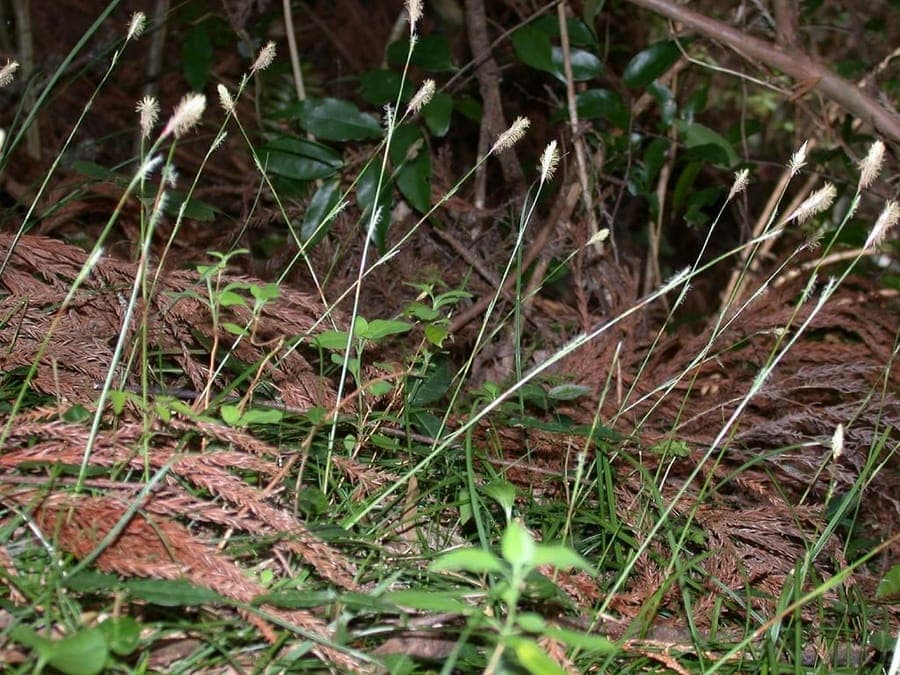
No machine-readable author provided. Keisotyo assumed (based on copyright claims). / CC BY-SA 3.0, via Wikimedia Commons
Carex conica: a small evergreen sedge for edges
Carex conica
Want to see Carex conica: a small evergreen sedge for edges in your garden?
Full design in HD: €7.99
Look after your Carex conica with the GardenWorld app
Identify plants with your camera and get a care calendar with reminders for this plant.


Overview
Carex conica is one of the smallest sedges you can buy for the garden, and that is exactly what makes it useful. Where many grasses and sedges need room to spread, this species from Japan and Korea stays a low, neat tuft no more than a hand's span high. In the wild it grows in open woodland, on shaded slopes and among rocks, often where the ground is carpeted with fallen conifer needles. Its Japanese name, hime-kan-suge, translates roughly as 'little winter sedge', a nod both to its size and to the fact that it stays green through the cold months.
Like all true sedges it belongs to the family Cyperaceae. In gardens you will almost always meet the cultivar 'Snowline', also sold as 'Marginata' or 'Variegata', with dark green leaves edged in a thin, crisp line of white. The plain green species is mostly grown by collectors and botanic gardens. Both are slow-growing and compact, and ideal wherever larger sedges would soon become overbearing: the very front of a shady border, a stone trough, a small rock garden or a container on a north-facing balcony.
In a small town garden every square metre counts. If you are planning one, gardenworld.app can create a garden design for you in which a compact sedge like this finishes the edges without crowding its neighbours.
Appearance, foliage and spikes
Carex conica makes a dense, rounded tuft 15 to 25 cm tall and 25 to 40 cm across. The leaves are narrow, about 2 to 4 mm wide, firm and a glossy deep green. On 'Snowline' a fine white margin runs along each leaf, so from a distance the clump reads as soft silvery green and brightens a dark corner. The leaves rise at first and then arch gently outward, giving a tidy dome that does not flop open.
In spring, usually from April into June, thin flowering stems rise just above the foliage. At the top of each is a slender male spike that looks pale and fluffy while it is shedding pollen, because of its many protruding stamens; the photo at the top of this page shows those pale spikes clearly. Lower down sit one or two small cylindrical female spikes. The species name conica simply means cone-shaped. It is hardly a showy display, but if you walk round the garden in May and spot those little pale tufts catching the light in the shade, it is a lovely detail.
After flowering the stems settle back among the leaves and the seed drops. Seedlings are scarce, and in the case of 'Snowline' they will not match the parent. As far as is known, Carex conica is not toxic to people, dogs or cats.
Ideal location
Choose partial or light shade, ideally out of cold, drying winds. Morning sun is welcome, but strong midday sun in summer scorches the leaf edges and turns the white margin of 'Snowline' a dull yellow. In deep shade it still grows, if a little more loosely. It is perfect under low shrubs, between stones in a shady rock garden, alongside a paved path on the north side of a house, or as underplanting in large pots with a small tree.
Because it stays small, you can plant it closely: 20 to 25 cm apart gives a continuous edge within two years. It looks its best in stone troughs and small containers, where you can admire the fine white margins up close.
Soil requirements
A loose, humus-rich soil that holds moisture yet drains well is ideal; think woodland floor, with leaf mould, a little sand and no standing water. On heavy clay, mix fine compost and grit into the top 20 cm before planting. On dry sandy soil, a mulch of leaf mould or compost helps keep the root run cool and moist. It is happiest in slightly acid to neutral soil, roughly pH 5.5 to 7.
Feeding is hardly necessary. A thin layer of compost or leaf mould each spring keeps the soil rich enough. For troughs and pots, use a mix of peat-free compost, leaf mould and some fine gravel so water drains away freely.
Free preview
Want to see Carex conica: a small evergreen sedge for edges in your garden? Make a free preview of your design.
Watering
Carex conica likes evenly moist soil. Never let it dry out completely in its first year. Once established in the shade of trees or shrubs it usually manages on rainfall, though in a dry summer it will appreciate an occasional thorough soaking. Brown leaf tips are the first sign that it is going short.
Under dense trees the soil catches little rain and roots compete for moisture, so extra watering is needed even after the first year. In troughs and pots, check the compost every couple of days in summer. In winter, water containers only during long dry spells when there is no frost.
Pruning
As with other evergreen sedges, never cut it down to the ground. In March, use gloved fingers to pull out withered leaves along with any tree leaves that blew into the tuft in autumn; on a plant this size it takes a couple of minutes. If the clump looks genuinely damaged after a hard winter, trim off the brown leaf tips, but stay above 5 cm.
After a few years the middle of the clump may thin. Divide it in April or early September: lift the plant, ease it apart into two or three pieces, each with a good share of roots, and replant straight away at the same depth. Keep the divisions watered for a few weeks. 'Snowline' occasionally throws a plain green shoot; cut it out to keep the variegation.
Maintenance calendar
January–February: The plant stays green. Check pots and troughs are not waterlogged.
March: Pull out dead foliage and fallen tree leaves. Apply a thin layer of leaf mould around the base.
April–May: Pale flower spikes rise above the leaves. A good time to plant or divide.
June–August: Water in dry weather, especially in pots and under trees. Remove reverted green shoots on 'Snowline'.
September: A second window for planting or dividing, so pieces root before winter.
October–December: Clear fallen leaves so the small tuft is not smothered.
The planting calendar on gardenworld.app keeps these jobs in view and reminds you when it is time to tidy or divide.
Winter hardiness
The Royal Horticultural Society rates Carex conica 'Snowline' H5, which corresponds to frost down to about -10 to -15 °C. Other sources quote USDA zone 5, so in practice it often tolerates more. Across most of Britain and the Low Countries it overwinters in the ground without protection, especially in a sheltered spot. Prolonged frost combined with drying wind can brown the leaf tips; simply trim them off in spring.
In pots and troughs the root ball freezes more quickly. Move containers against a wall or into a corner out of the wind for winter, and wrap small pots in hessian during severe cold. Here too, cold combined with wet is the real danger, so make sure drainage is good.
Companion plants
Its modest height means Carex conica belongs at the front, alongside other low shade plants. Ajuga reptans, with dark leaf rosettes and blue spikes in May, makes a fine contrast, as do the foamy white flowers of Tiarella cordifolia. Behind the sedge, the finely cut soft shield fern Polystichum setiferum adds a gentle evergreen backdrop.
In autumn and winter Cyclamen hederifolium brings marbled leaves and pink flowers to the foot of the sedge, and in February snowdrops (Galanthus nivalis) push up through the clumps. Together they create a small shady corner with something to offer all year.
Final thoughts
Carex conica is the sedge for anyone short of space who still wants structure in the shade. It stays small, grows slowly and looks neat all year for very little effort: a moist, open soil, shelter from harsh sun and a quick tidy in March. In a trough, along a north-facing path or among spring bulbs beneath shrubs, this little winter sedge proves its worth year after year.
Frequently asked questions about Carex conica
Is Carex conica winter hardy?
The Royal Horticultural Society rates Carex conica 'Snowline' H5, which corresponds to frost down to about -10 to -15 °C. Other sources quote USDA zone 5, so in practice it often tolerates more.
When and how do you prune Carex conica?
As with other evergreen sedges, never cut it down to the ground. In March, use gloved fingers to pull out withered leaves along with any tree leaves that blew into the tuft in autumn; on a plant this size it takes a couple of minutes.
How much water does Carex conica need?
Carex conica likes evenly moist soil. Never let it dry out completely in its first year.
Where does Carex conica grow best?
Choose partial or light shade, ideally out of cold, drying winds. Morning sun is welcome, but strong midday sun in summer scorches the leaf edges and turns the white margin of 'Snowline' a dull yellow.
What soil does Carex conica need?
A loose, humus-rich soil that holds moisture yet drains well is ideal; think woodland floor, with leaf mould, a little sand and no standing water. On heavy clay, mix fine compost and grit into the top 20 cm before planting.

See it in your garden
See Carex conica in your garden
One photo of your garden and a few questions. You see the result in about a minute.
Try it with a photoIdentify this plant in your own garden. Identify a plant
Similar plants
Ajuga: complete guide
Ajuga reptans
A comprehensive guide to Ajuga reptans: growing conditions, care tips, soil needs, and ideal planting locations for this hardy ground cover.
Tiarella cordifolia: complete guide
Tiarella cordifolia
Discover heart-leaf foamflower (Tiarella cordifolia), the elegant groundcover with distinctive heart-shaped leaves and frothy spring blooms. Care, placement, and growing tips.
Soft shield-fern: complete guide
Polystichum setiferum
How to grow and care for Polystichum setiferum in your garden. Ideal for shady borders, with soft, arching fronds and year-round interest.
