
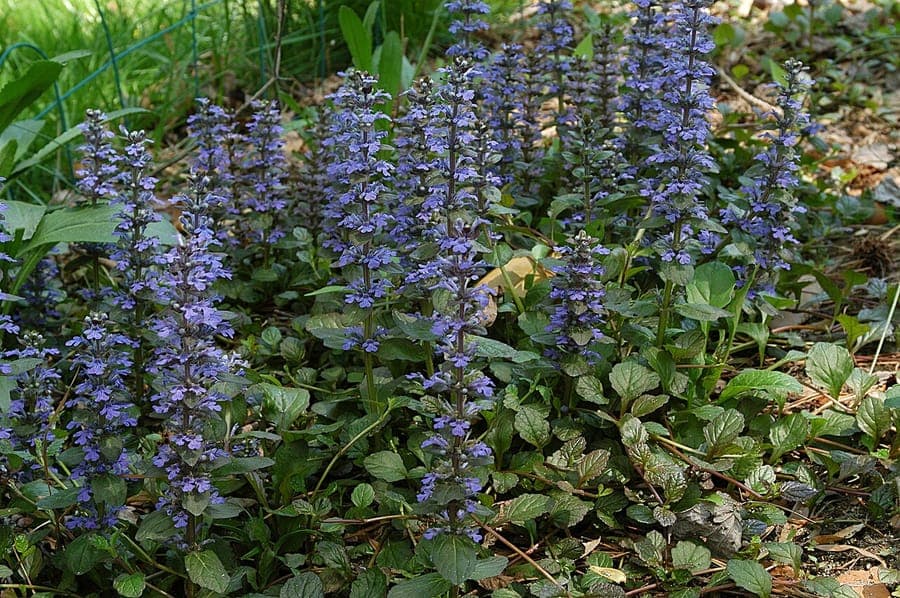
G. Edward Johnson / CC BY-SA 3.0, via Wikimedia Commons
Ajuga: complete guide
Ajuga reptans
Want to see Ajuga: complete guide in your garden?
1 minute, no credit card
Overview
Ajuga reptans, commonly known as bugle, is a go-to ground cover for gardeners dealing with tricky spots. Native to parts of Europe including Austria, the Baltic States, and Belgium, it thrives in USDA hardiness zones 3 to 9. It spreads via stolons, forming dense mats that suppress weeds and stabilize soil. This makes it ideal for slopes, under shrubs, or between pavers. It's especially valuable in early spring when its blooms provide nectar for emerging pollinators.
On gardenworld.app, you can build a custom garden plan that incorporates ajuga into shaded areas where other plants might struggle. Its compact growth (5–10 cm tall) and quick spread mean it fills gaps fast, reducing the need for mulch or frequent weeding.
Appearance & bloom cycle
Ajuga forms rosettes of glossy, dark green to bronze leaves, 3–6 cm long, depending on the cultivar. In mid to late spring-typically May to early June-it sends up striking flower spikes up to 15 cm high. These are usually deep purple or blue-purple, though some varieties like 'Alba' produce white flowers. The bloom period lasts 2–3 weeks and is a magnet for bees, hoverflies, and early butterflies.
Cultivars such as 'Catlin's Giant' offer larger leaves and taller blooms, while 'Burgundy Glow' has variegated pink, white, and green foliage that brightens shady corners. After flowering, spent spikes can be trimmed to maintain a tidy appearance and prevent self-seeding, though spread is mostly vegetative.
Ideal location
Ajuga performs best in partial to full shade (light level 7 out of 10). It tolerates full sun in cooler climates if the soil stays consistently moist, but in hot summers, sun exposure can lead to leaf scorch and reduced vigor. Ideal spots include under deciduous trees, along woodland edges, or in north-facing borders. It also works well in rock gardens or as edging along pathways.
Garden centres often stock ajuga in spring, and many gardeners use it to transition between lawn and planting beds. On gardenworld.app, visual planning tools help you map out spacing-plant plugs 15–20 cm apart for full coverage within a single growing season.
Soil requirements
Ajuga prefers moist, well-drained soil with a pH between 3 and 4-quite acidic. It thrives in humus-rich ground, so amending with compost or leaf mold before planting boosts performance. Avoid heavy clay without drainage, as soggy roots lead to rot. Sandy soils benefit from added organic matter to improve moisture retention.
While adaptable, ajuga doesn't handle drought well in full sun. In alkaline soils, leaves may yellow due to nutrient lock-up. If your soil is above pH 5, consider growing it in containers with ericaceous compost.
Free design
Want to see Ajuga: complete guide in your garden? Make a free design now.
Watering
Keep newly planted ajuga consistently moist for the first 6–8 weeks while roots establish. Once settled, it's moderately drought-tolerant in shade. During prolonged dry spells, especially in summer, give it a deep watering once a week. Avoid overhead watering in humid climates to reduce the risk of fungal issues like powdery mildew.
Mulching with pine needles or shredded bark helps retain moisture and keeps the crown protected. Don't bury the crown-this can lead to rot.
Pruning
Minimal pruning is needed. After blooming, cut back spent flower spikes with clean shears. In early spring, remove any winter-damaged or overcrowded foliage to encourage fresh growth. If the plant becomes too dense, thin out sections to improve airflow.
If ajuga spreads beyond its bounds, use a sharp spade to trim edges. This is especially useful near lawns, where it can creep in. Lift and replant excess or share with fellow gardeners.
Maintenance calendar
- January: Check for vole damage. Light mulch can help protect crowns.
- February: No action needed unless early growth appears.
- March: Clear old debris. Lightly prune damaged leaves.
- April: Monitor for new shoots. Apply compost if soil is poor.
- May: Peak bloom. Keep soil moist.
- June: Deadhead spent spikes. Watch for over-spreading.
- July–August: Low care. Water during dry weeks.
- September: Trim runners encroaching on paths or lawn.
- October: Leave foliage in place for winter protection.
- November–December: Dormant. No maintenance required.
Winter hardiness
Ajuga is reliably hardy in zones 3–9. Foliage often stays evergreen or takes on bronze tones in winter, providing visual interest under snow. In wet winters, ensure drainage is adequate to prevent crown rot. Avoid planting in low-lying areas where water pools.
Companion plants
Pair ajuga with spring ephemerals like crocus, snowdrops, or daffodils-their flowers rise above the foliage before ajuga fills in. Ferns, hostas, and heucheras offer contrasting texture. For a woodland look, combine with epimedium or pulmonaria.
Avoid invasive ground covers like periwinkle or aggressive grasses that compete for space.
Closing
Ajuga reptans is a resilient, attractive ground cover that earns its place in any shade garden. With minimal care, it forms a lush carpet that blooms early and stays attractive year-round. Choose colorful cultivars for added impact, and plant in acidic, moist soil for best results. Available at most garden centres in spring, it's an affordable way to cover bare patches fast. Consider using plugs for quicker establishment-many gardeners buy in bulk from suppliers like those listed on gardenworld.app for large-scale planting.
Want to see Ajuga: complete guide in your garden? Make a free design now.
Upload a photo, pick a style, and get a photorealistic design with plant list in under a minute.
No credit card required


Similar plants
Apple mint (Mentha x villosa): complete guide
Mentha x villosa
Meet apple mint (Mentha x villosa): a fruity-scented kitchen herb with woolly leaves, perfect for tea and mojitos.
Salvia peyronii: complete guide
Salvia peyronii
Discover Salvia peyronii, a rare Lebanese mountain sage. Growing tips, hardiness, and companion planting for a Mediterranean gravel garden.
Bigleaf mint (Mentha x rotundifolia): complete guide
Mentha x rotundifolia
Discover bigleaf mint: cultivation, care tips, and garden uses. Learn how to grow this aromatic herb with soft, hairy leaves.