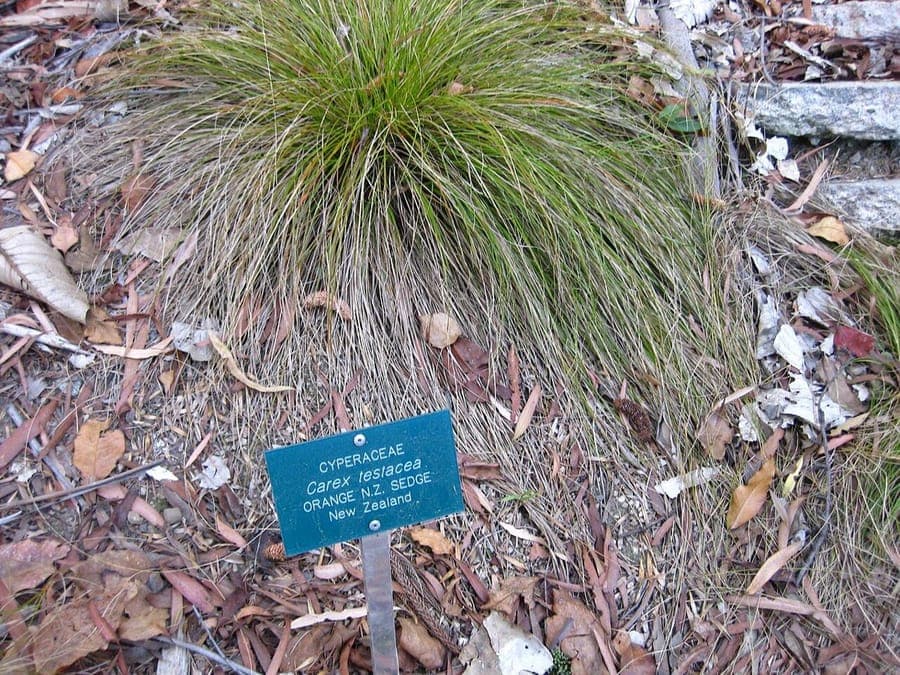
Raffi Kojian / CC BY-SA 3.0, via Wikimedia Commons
Orange New Zealand sedge (Carex testacea): a guide
Carex testacea
Want to see Orange New Zealand sedge (Carex testacea): a guide in your garden?
Full design in HD: €7.99
Look after your Orange New Zealand sedge with the GardenWorld app
Identify plants with your camera and get a care calendar with reminders for this plant.


Overview
Orange New Zealand sedge, Carex testacea, is grown for one thing above all: colour. Its hair-fine leaves are olive green in shade, but in full sun and cold weather they turn copper, burnt orange and old gold. A mature tuft in a gravel garden or a tall pot on a sunny patio catches low winter light in a way very few plants can match. In New Zealand it grows from the coast up into the hills, in open grassland, scrub margins and on dunes, which explains why it shrugs off wind and copes with fairly lean soil.
Carex testacea belongs to the family Cyperaceae and is evergreen. It holds its leaves all year and actually looks best between October and March. That sets it apart from the Japanese sedges grown for shade: where those want cool, moist conditions, this one wants light and a soil that drains quickly. As well as the straight species, you may come across selections such as 'Prairie Fire', with especially bright orange tips, and 'Autumn Gold'.
It is easy to confuse with other bronze sedges from New Zealand. Carex buchananii grows stiffly upright and is reddish-brown right from the base, while Carex comans forms a soft, hair-like mop that flops completely. Carex testacea sits between the two: a loose, rounded tuft whose leaves rise and then arch outwards. If you are planning a sunny border, gardenworld.app can create a garden design for you that gives warm foliage like this a permanent place among sun-loving perennials and grasses.
Appearance, foliage and spikes
The tuft reaches 30 to 50 cm high and about as wide. Each leaf is just 1 to 2 mm across and feels fine, almost like coarse hair. The base of the leaf is green and the colour shifts towards orange along its length, most strongly where the plant gets plenty of sun. Summer foliage is mostly green; from autumn into winter the orange deepens. A plant grown in shade stays green and becomes lax.
The flowering stems appear in June and July. They are remarkably long and thin, soon lying along the ground or spilling over the rim of a pot, sometimes reaching 60 cm or more beyond the tuft. Each carries a narrow male spike at the tip and a few brown female spikes below. They are not showy, but in summer they give the plant a loose, slightly wild fringe. Once ripe, the seed drops and germinates readily, particularly in gravel.
Self-seeding cuts both ways. On the one hand, Carex testacea is fairly short-lived and often starts dying out in the centre after four to six years, so seedlings are a handy replacement. On the other hand, it can spread freely on open, poor ground. In Australia it is classed as a weed of pasture and native grassland. It is not listed as invasive in Europe, but it is sensible to remove the seed stems if you garden next to dunes, heath or other semi-natural habitats.
Carex testacea is not known to be toxic to people or pets.
Ideal location
Full sun is essential for good colour. Give it at least six hours of direct sun a day, ideally on a south- or west-facing site. It survives in part shade but the foliage will stay largely green. Wind is no problem: the fine leaves move with it and that movement is part of the appeal.
It suits gravel gardens, banks, rock gardens, the edge of a sunny path, and containers. A tall pot or raised bed shows off the trailing seed stems particularly well. Plant in groups 35 to 45 cm apart; a line along a path quickly becomes a rippling ribbon of orange.
Soil requirements
Good drainage matters far more than fertility. Sandy soil, sandy loam and gravelly ground are ideal. On heavy clay, work in plenty of coarse grit, or plant on a slight mound, because a wet crown in winter is the most common cause of loss. pH is not critical; mildly acid to mildly alkaline soils are all fine.
Feed sparingly. Rich soil produces soft, green growth with weaker colour. A handful of compost at planting time and nothing afterwards is plenty for most gardens. In containers, mix peat-free compost with about a third grit or fine gravel and put a layer of crocks or clay granules at the bottom.
Free preview
Want to see Orange New Zealand sedge (Carex testacea): a guide in your garden? Make a free preview of your design.
Watering
After its first year Carex testacea is reasonably drought tolerant. Water regularly through the first growing season so the roots go deep, letting the soil dry slightly between waterings. After that, water only during long dry spells in summer. Ground that stays wet for weeks is a bigger threat than a dry week.
Pots are another matter: the root ball dries quickly in summer and the leaf tips then shrivel. Check every few days in July and August. In winter, water hardly at all, only after a prolonged dry spell without frost, and never leave a pot standing in a saucer of water.
Pruning
Do not cut this sedge hard. Like other evergreen sedges it recovers slowly and will look unfinished for months. Instead, in March or April, run gloved fingers through the tuft to pull out the dead, greyish-brown leaves. After winter there is often a thick layer of them, and left in place it encourages rot in the centre.
The long flowering stems can be cut off in late summer as soon as they look untidy. That keeps the plant neat and limits self-seeding. If you want seedlings to replace older plants, leave the stems on one or two specimens until the seed has dropped.
Older clumps that go bare in the middle can be divided in April, but this species re-establishes less readily than the Japanese sedges. It is often easier to pot up a young seedling or simply plant a new one.
Maintenance calendar
January–February: Colour at its peak. Leave the plant alone and keep pots on the dry side.
March–April: Comb out dead foliage. The best time to plant or move seedlings.
May: New leaves emerge from the centre, green at first. A handful of compost around plants on very poor sand if needed.
June–July: Long stems with brown spikes appear. Water in dry weather, especially pots.
August–September: Cut off seed stems if you do not want seedlings.
October–December: The foliage colours up more each week. Clear fallen tree leaves from the tuft.
The planting calendar on gardenworld.app helps you keep track of these tasks and reminds you when it is time to tidy up.
Winter hardiness
The Royal Horticultural Society rates Carex testacea H5, meaning hardy to roughly -10 to -15 °C. In most of Britain and the Low Countries it comes through an ordinary winter without protection, especially in a dry, sunny spot. Long, severe frost can kill part of the foliage, but the plant usually regrows in spring.
Winter wet is more dangerous than cold. Where water lies, the plant rots. Containers are more vulnerable: in December, move them against a sheltered wall, raise them on feet and wrap them in hessian or bubble wrap when frost below about -8 °C is forecast.
Companion plants
The orange tones of Carex testacea look best beside silver foliage and purple or blue flowers. Salvia nemorosa with its violet-blue spikes and the broad, fleshy leaves of Hylotelephium spectabile make striking contrasts. Airy Nassella tenuissima adds a soft, straw-coloured counterpoint. Echinacea purpurea brings pink summer flowers that chime with the copper leaves, and its seed heads stand through winter as dark accents.
For a New Zealand theme, plant the sedge at the foot of Phormium tenax, whose stiff, sword-shaped leaves make the fine tuft look even lighter. In pots it partners well with blue fescues, orange winter violas or dark-leaved heucheras.
Final thoughts
Carex testacea is a sedge for sunshine. Give it light, a soil that drains quickly after rain and a comb-through every spring, and it rewards you with a warm glow that is strongest in the darkest months. It is not long-lived, but it seeds itself modestly and so replaces itself. For anyone wanting to brighten a gravel garden or sunny patio with colour that does not depend on flowers, this New Zealand native is a rewarding choice.
Frequently asked questions about Orange New Zealand sedge
Is Orange New Zealand sedge winter hardy?
The Royal Horticultural Society rates Carex testacea H5, meaning hardy to roughly -10 to -15 °C. In most of Britain and the Low Countries it comes through an ordinary winter without protection, especially in a dry, sunny spot.
When and how do you prune Orange New Zealand sedge?
Do not cut this sedge hard. Like other evergreen sedges it recovers slowly and will look unfinished for months.
How much water does Orange New Zealand sedge need?
After its first year Carex testacea is reasonably drought tolerant. Water regularly through the first growing season so the roots go deep, letting the soil dry slightly between waterings.
Where does Orange New Zealand sedge grow best?
Full sun is essential for good colour. Give it at least six hours of direct sun a day, ideally on a south- or west-facing site.
What soil does Orange New Zealand sedge need?
Good drainage matters far more than fertility. Sandy soil, sandy loam and gravelly ground are ideal.

See it in your garden
See Orange New Zealand sedge in your garden
One photo of your garden and a few questions. You see the result in about a minute.
Try it with a photoIdentify this plant in your own garden. Identify a plant
Similar plants
Argentine needlegrass: complete guide
Nassella tenuissima
Nassella tenuissima, the finest ornamental grass. Elegant, silvery threadlike awns that dance in the slightest breeze. Drought hardy.
Showy stonecrop: complete guide
Hylotelephium spectabile
Everything about Showy stonecrop (Hylotelephium spectabile): flowering, cultivation and care. Tips for successful frost resistance, drought tolerance and maintenance in borders and containers.
New Zealand flax: complete guide
Phormium tenax
Discover Phormium tenax, the stunning architectural plant from New Zealand. Learn about its dramatic foliage, growing requirements, and design applications.
