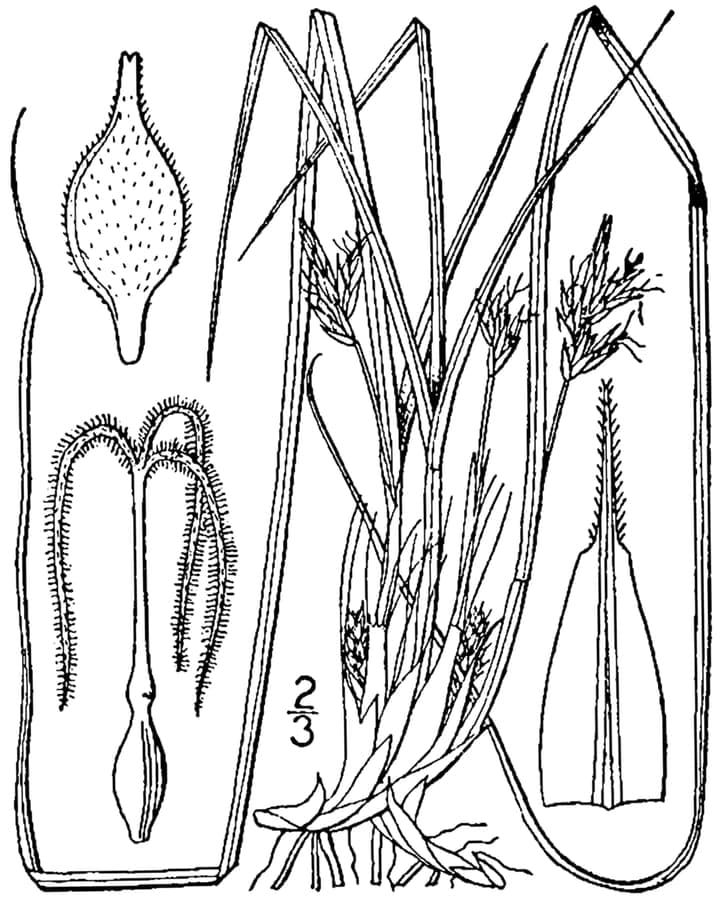
Britton, N.L., and A. Brown. 1913. An illustrated flora of the northern United States, Canada and the British Possessions. 3 vols. Charles Scribner's Sons, New York. Vol. 1: 393. Courtesy of Kentucky Native Plant Society. Scanned by Omnitek Inc. / Public domain, via Wikimedia Commons
Black edge sedge: complete guide
Carex nigromarginata
Want to see Black edge sedge: complete guide in your garden?
Full design in HD: €7.99
Look after your Black edge sedge with the GardenWorld app
Identify plants with your camera and get a care calendar with reminders for this plant.


Overview
Black edge sedge (Carex nigromarginata) is a grass-like plant from the Cyperaceae family, native to southeastern Canada through central and eastern United States, and also found in Mexico. This striking sedge is known for its distinctive black leaf margins, which are unique among sedges.
Appearance and Bloom
Black edge sedge grows as a grass-like plant with narrow leaves that are green with striking black or dark-brown margins - the most distinguishing feature. The plant reaches moderate heights and forms dense, attractive tufts. The black leaf margins provide color and texture year-round. Blooming consists of brownish spikelets in summer.
Ideal Location
Black edge sedge thrives best in moist meadows and partially shaded environments. Plant it in moist gardens, along wetland edges, and in ecological garden designs. The plant loves shaded locations where moisture retention is important.
Soil
This sedge grows on moisture-rich soils, especially clay and loam-rich grounds. The plant thrives in nutrient-rich, moisture-buffering soils. Good drainage is not essential, as this plant is moisture-loving by nature.
Watering
Black edge sedge requires consistently moist soil. Keep the ground regularly moist throughout the growing season. This plant is perfect for moist gardens and ecological designs where water conservation is important. During dry periods, supplemental watering supports continued growth.
Free preview
Want to see Black edge sedge: complete guide in your garden? Make a free preview of your design.
Pruning
Minimal pruning is needed. In early spring, old foliage can be carefully removed. The plant largely maintains itself and can retain its striking black-edged leaves year-round.
Maintenance Calendar
Spring: Carefully remove older foliage. Check moisture availability. Summer: Maintain consistent soil moisture. Fall: The plant may enter its natural rest phase. Winter: Minimal maintenance; the plant may remain semi-green in mild conditions.
Winter Hardiness
Carex nigromarginata is hardy in zones 4-9 and tolerates mixed to mild winters. The plant remains semi-evergreen in many climates and maintains its distinctive black leaf margins.
Companion Plants
Black edge sedge combines well with other moisture-lovers such as Hosta, Helleborus niger, Carex oshimensis, and other shade-loving moisture plants. These plant combinations create interesting structural groupings.
Closing
Black edge sedge is a striking addition to moist gardens and ecological landscape designs. With its distinctive black-edged margins and ability to thrive in shaded, moist environments, it provides year-round interest and aesthetic value. Create beautiful shade gardens with native sedges that bring structure and color. Explore gardenworld.app for professional garden designs and discover how to transform your landscape with this remarkable native plant.
Frequently asked questions about Black edge sedge
Is Black edge sedge winter hardy?
Carex nigromarginata is hardy in zones 4-9 and tolerates mixed to mild winters. The plant remains semi-evergreen in many climates and maintains its distinctive black leaf margins.
When and how do you prune Black edge sedge?
Minimal pruning is needed. In early spring, old foliage can be carefully removed.
How much water does Black edge sedge need?
Black edge sedge requires consistently moist soil. Keep the ground regularly moist throughout the growing season.
Where does Black edge sedge grow best?
Black edge sedge thrives best in moist meadows and partially shaded environments. Plant it in moist gardens, along wetland edges, and in ecological garden designs.
What soil does Black edge sedge need?
This sedge grows on moisture-rich soils, especially clay and loam-rich grounds. The plant thrives in nutrient-rich, moisture-buffering soils.

See it in your garden
See Black edge sedge in your garden
One photo of your garden and a few questions. You see the result in about a minute.
Try it with a photoIdentify this plant in your own garden. Identify a plant
Similar plants
Carex conica: a small evergreen sedge for edges
Carex conica
Carex conica is a compact evergreen sedge from Japan and Korea. A guide to 'Snowline', where to plant it, soil, tidying, dividing and how hardy it really is.
Carex oshimensis: the evergreen striped sedge
Carex oshimensis
Carex oshimensis is an evergreen Japanese sedge with fine, striped leaves. How to plant, place, tidy and divide 'Evergold' and the EverColor series in your garden.
Orange New Zealand sedge (Carex testacea): a guide
Carex testacea
Orange New Zealand sedge (Carex testacea) turns copper and orange in sun and cold. Where to plant it, which soil it likes, how to tidy it and how hardy it is.
